

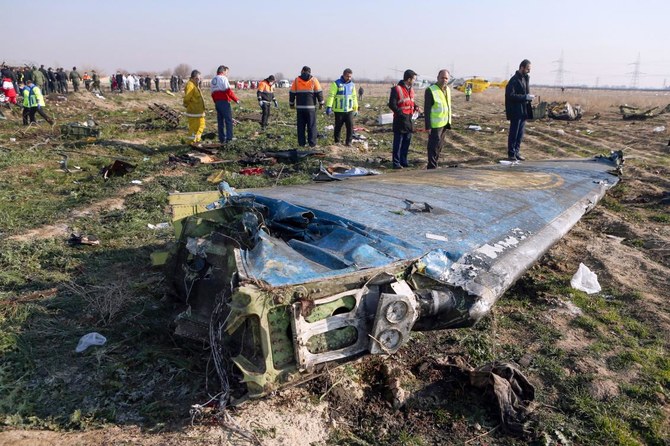

TEHRAN: Iranian authorities have said a Ukrainian airliner, which crashed outside Tehran with the loss of all 176 people on board, had turned back after suffering a problem, as Ukrainian experts joined the investigation Thursday.
Both Canada and the United States called for a full investigation to determine the cause of Wednesday's crash, which came shortly after Tehran launched missiles at US forces in Iraq in response to the killing of a top Iranian general in a US drone strike in Baghdad.
There was no immediate indication that foul play may have caused the Ukraine International Airlines (UIA) plane to go down soon after take-off, and Ukrainian President Volodymyr Zelensky warned against speculating on the crash causes.
"The plane, which was initially headed west to leave the airport zone, turned right following a problem and was headed back to the airport at the moment of the crash," the Iranian Civil Aviation Organisation said on its website late Wednesday.
"The plane disappeared from radar screens the moment it reached 8,000 feet (2,400 metres). The pilot sent no radio message about the unusual circumstances.
"According to eyewitnesses, a fire was seen on board the plane which grew in intensity," the organisation added, reporting the first findings of its investigation into the crash.
The organisation said it was considering evidence from the ground as well as reports from a second aircraft which was flying above the Ukrainian Boeing 737 as the disaster unfolded.
Heartbreaking details started emerging about the victims, most of them from Iran or from the large Iranian diaspora in Canada.
Body bags were lined up on the ground, and the passengers' personal items - including luggage, clothes, a Santa Claus doll and a boxing glove - were scattered in the debris.
According to Ukraine, 82 Iranians, 63 Canadians, 10 Swedes, four Afghans, three Germans and three Britons were on board, as well as 11 Ukrainians - including nine crew.
Prime Minister Justin Trudeau speaks in Ottawa following the fatal plane crash outside of Tehran, Iran, that claimed the lives of 176 people, including 63 Canadians. pic.twitter.com/uMTdY11jDO
— CanadianPM (@CanadianPM) January 9, 2020
About 30 came from the Iranian community around Edmonton, capital of Alberta province in western Canada, where resident Payman Parseyan described the tragedy as "devastating".
"Every one of our community members was touched in one way or another," Parseyan told Canada's national broadcaster CBC.
Some 45 Ukrainian aviation experts and security officials flew to Tehran early Thursday to participate in the investigation, including "deciphering the black boxes" discovered by Iranian authorities at the crash site, the Ukrainian president said.
A Ukrainian security official said investigators were considering seven different possible versions of events.
Oleksiy Danilov, the secretary of Ukraine's national security and defence council which is tasked with coordinating the investigation, said the leads being studied included both technical malfunctions and foul play, but told AFP that "there is no priority version" yet.
The leads under consideration include a collision with another airborne object, a rocket from Iran's missile defence system, an engine explosion caused by a technical problem, and an explosion on board the aircraft due to an "act of terror", Danilov said on Facebook.
He told AFP that for the moment there was no reason to believe that the airliner had been hit by a missile.
Civil aviation chief, Ali Abedzadeh, said Iran would cooperate with Ukraine, but would not send the black boxes to the United States, with which it has had no diplomatic relations for four decades.
According to aviation experts, only a handful of countries are capable of analysing black boxes - notably Britain, France, Germany and the United States.
Canadian Prime Minister Justin Trudeau said his government would ensure a "thorough investigation" and that "Canadians' questions are answered".
Foreign Minister Francois-Philippe Champagne spoke by telephone on Thursday with his Iranian counterpart Mohammad Javad Zarif, Tehran said.
Canada is home to a large Iranian diaspora, and UIA offers relatively inexpensive flights between Toronto and Tehran, with a layover in Kiev.
It was the ex-Soviet country's privately owned main carrier's first fatal crash.


