



EDMONTON, Alberta: A newlywed couple that had traveled to Iran to get married were among the 63 Canadians killed when their Ukrainian Airlines flight crashed early on Wednesday, according to a community leader in the western Canadian city where 30 victims came from.
All 176 people on board the Ukraine International Airlines Boeing 737 were killed when the plane crashed shortly after takeoff from Tehran. It had been heading for the Ukrainian capital Kiev.
Arash Pourzarabi, 26, and Pouneh Gourji, 25, who were graduate students in computer science at the University of Alberta, had gone to Iran for their wedding, said Reza Akbari, president of the Iranian Heritage Society of Edmonton.
They were on the plane with four members of their wedding party and another 24 Iranian-Canadians from Edmonton, Akbari said.
"Oh God, I can’t believe this," Akbari told Reuters. "It’s shocking to the whole community."

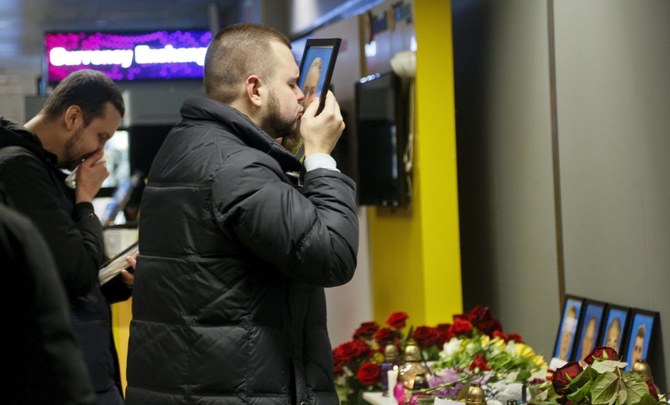
A relative of one of the flight crew members of the Ukrainian 737-800 plane that crashed on the outskirts of Tehran, kisses a portrait of her at a memorial inside Borispil international airport outside Kyiv, Ukraine, on Wednesday. (AP)
Canadian Prime Minister Justin Trudeau said on Wednesday that the government would reach out to international partners to ensure the crash is thoroughly investigated "and that Canadians' questions are answered."
Trudeau will hold a news conference on the crash later on Wednesday, his spokeswoman said.
The flight was a popular transit route for Canadians traveling to Iran, in the absence of direct flights, and carried many students and academics heading home from the holidays. Canada broke off diplomatic relations with Iran in 2012.
"I've had family take the Tehran-to-Toronto route via Kiev in the past year. It's been a new, affordable route for many Iranian-Canadians," Mahsa Alimardani, a student at Britain's Oxford University, said on Twitter.
Among the victims was Mojgan Daneshmand, a professor of electrical engineering at the University of Alberta, "a brilliant, brilliant lady, very smart," the Heritage Society's Akbari said.
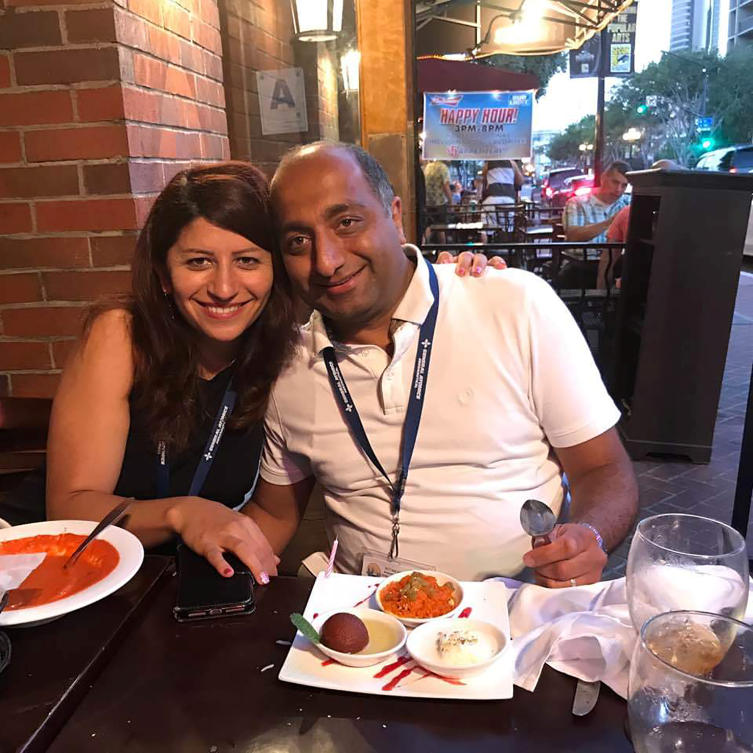
University of Alberta professors Mojgan Daneshmand and Pedram Mousavi, pose in an undated family photo in Edmonton, Alberta, Canada. (Handout via Reuters)
Her husband, Pedram Mousavi, a professor of mechanical engineering at the same college, and the couple's two daughters, also died in the crash.
The University of Alberta declined immediate comment.
Mousavi was "like a father," student Hossein Saghlatoon told Reuters.
The pair had traveled to Iran with daughters Daria and Dorina, aged 14 and 10, to visit elderly parents, Saghlatoon said.
"Everyone has been crying since last night. It's a huge loss and the void is not going to be filled by anyone or anything," Saghlatoon said.
Canadian Foreign Minister Francois-Philippe Champagne said he had been in touch with the government of Ukraine.
"Our hearts are with the loved ones of the victims, including many Canadians," he wrote on Twitter.
The disaster was the largest recent loss of life among Canadians since an Air India flight blew up in 1985 over the Atlantic Ocean, killing 268 Canadians.
According to a 2016 census, around 210,000 of Canada's 38 million inhabitants are of Iranian descent.
UK victims
The three British nationals who died in the crash were named as Mohammed Reza Kadkhoda Zadeh, who owned a dry cleaners, BP engineer Sam Zokaei and engineer Saeed Tahmasebi who worked for Laing O'Rouke..
The British government said the UK was "working closely with the Ukrainian authorities and the Iranian authorities" over the crash, and there was "no indication" the plane was brought down by a missile.


