



TEZPUR, ASSAM: The moment Akkas Ali saw his destroyed home, he burst in tears. The 65-year-old farmer from Bhuttamari Vairabi, Sonitpur district in India’s northeastern Assam state, has spent all his life savings on building the three-bedroom house in the village.
Last month, the district’s administration and a local legislator entered 10 villages in the area with bulldozers and paramilitary personnel. They razed 450 houses and displaced more than 3,000 people.
Ali is now a refugee in his own village and stays at a nearby makeshift camp, without any clue what the future holds for him.
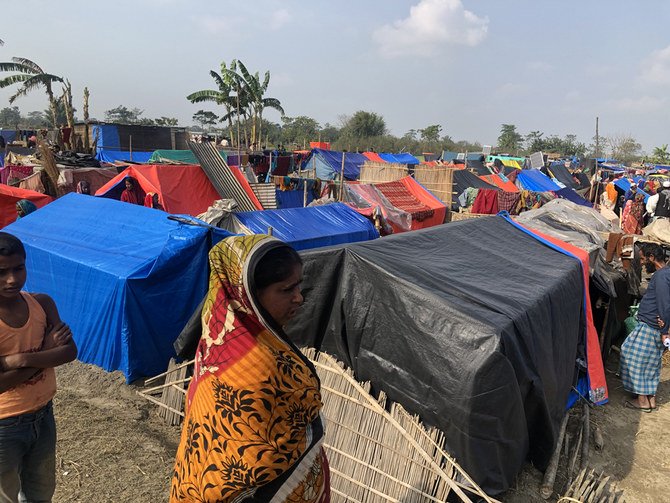
Evicted people show their land ownership documents at the Mukua Shapori camp, Sonitpur district, Assam. (AN Photo)
“My fault is that I am not registered as a voter in the Sootea Assembly constituency where my village falls. I have my vote in the neighboring constituency. Local Bhartiya Janata Party (BJP) legislator Padma Hazarika, with support from the administration, threw me and more than 450 families out from the area just because we don’t vote for him,” he said.
“I am a genuine citizen of Assam and my name figures in the NRC. I am a registered voter of the neighboring Tezpur constituency and I've been living here for more than 15 years, after moving from my native village which was washed away by a flood,” Ali told Arab News, referring to the National Register of Citizens, a citizenship list issued by the Assam government in August last year.
“The government says we are encroachers and Bangladeshis, and they evicted us from our own land despite having all the documents. The larger goal, I feel, is that the BJP wants to settle down Hindu Bengalis in this area who will act as a permanent vote bank for the party,” Ali said.
Ever since New Delhi passed the Citizenship Amendment Act (CAA) in mid-December, tensions have been running high in Assam with the Assamese fearing to lose their ethnic identity if immigrant Hindu Bengalis are allowed to become Indian citizens.
Under the CAA, Hindu, Sikh, Jain, Parsi and Christian minorities from neighboring Bangladesh, Pakistan and Afghanistan are eligible to become citizens, if they have come to India before Dec. 31, 2014. Muslims are not included.
Meanwhile, Assam’s NRC has provisions for declaring all migrants – regardless of their religion – as stateless if they have entered Assam after March 24, 1971. More than 1.9 million people, mostly Hindus, could not find their place on the NRC list. The CAA will now accommodate Hindus, leaving out Muslims.
Members of the Muslim minority in the state fear they would be the real target of the BJP’s majoritarian politics.
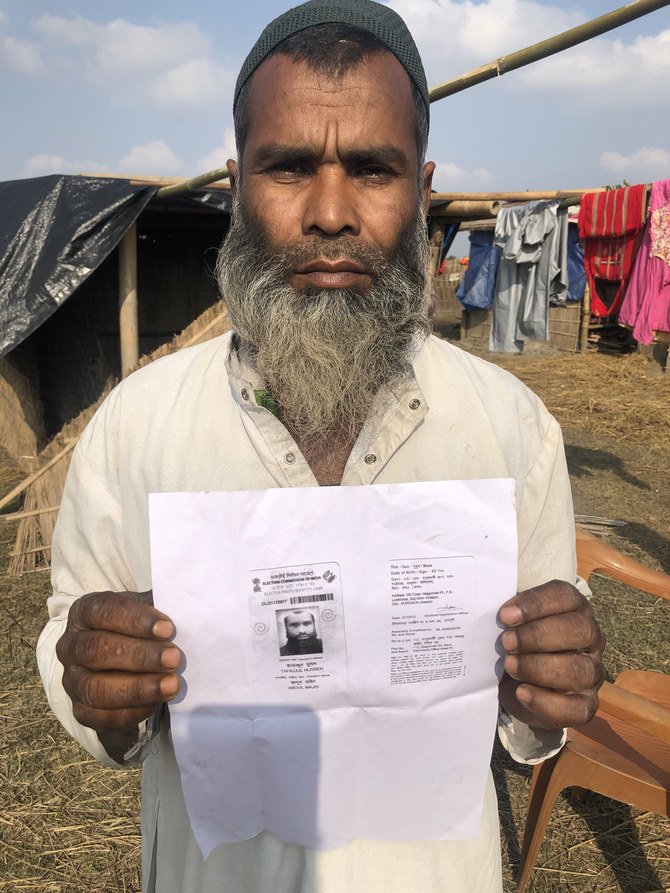
A man shows his documents at the Shirwani camp, Sonitpur district, Assam. (AN Photo)
Abdul Quddus faces a similar fate as Ali.
“First they evicted us saying we are not their voters, and soon they are going to throw out the remaining Muslim families,” said the teacher who has been living in at the Mukua Chapori camp, some two kilometers from his house, also as a refugee.
Arab News asked Hazrika, the local BJP legislator behind the evictions, about their grounds.
“They are encroachers, that’s why they have been evicted,” was his reply.
“I don’t care whether they are Hindu or Muslims, they are encroachers and they have been thrown out of the government land,” Hazrika said, adding that the evictions followed a court order.
He denied, however, the presence of refugee camps in the area.
Manvendra Pratap Singh, deputy commissioner of Sonitpur district and a man at the forefront of the evictions, also defended the move by citing encroachment.
“We have a plan to evict more people from that area, as the whole land belongs to the government and those who claim they are owners of the land bought the land from encroachers,” he said, adding that an industrial park and Tezpur University facilities were going to be built in the area.
He also denied the existence of camps and said that eligible to own land would be resettled. “There exists no refugee camp in the area,” he claimed.
But people in the camps say that no one from the government side has visited them.
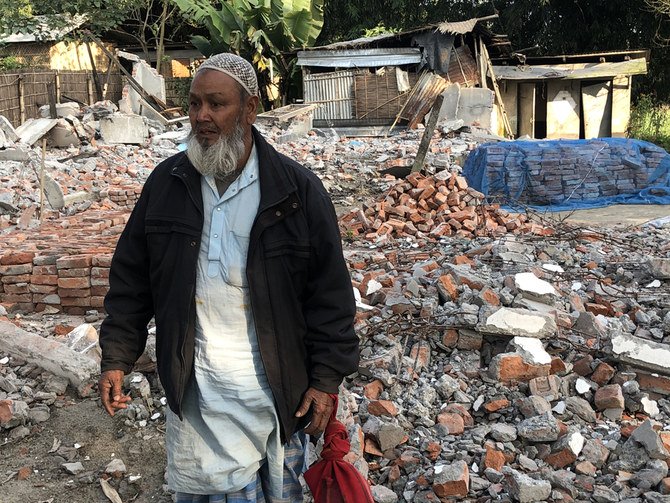
Akkas Ali stands in the ruins of his house in Bhuttamari Vairobi village, Sonitpur district, Assam. (AN Photo)
“We are being treated as foreigners in our own land. The situation is so bad that local schools are refusing (our) kids entry to school premises. The future of hundreds of students is bleak,” said Ali.
According to local social worker Isfaqul Hussain, “there is a larger game at play in Assam now. Wherever Muslim communities are vulnerable, there is an attempt to displace them internally and make them refugees in their own homeland.”
Tezpur-based political analyst Abdul Qadir explained that following the enactment of CAA, the BJP seeks to settle Hindu Bengalis in Muslim-dominated areas.
“The situation was very sad in the beginning when more than 10,000 people suddenly became homeless. Some of them spent nights in the open in this severe winter. Concerned citizens mobilized funds and erected tents,” he said.
“We are living in a difficult time, when human suffering is measured by the parameters of religion.”


