

Reaper drone launched from Qatar fired missile that killed Soleimani

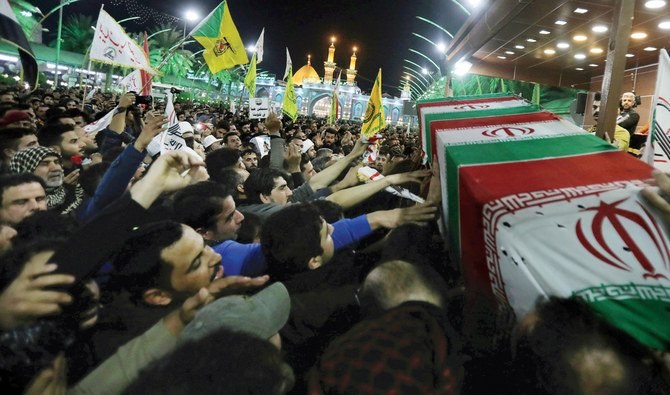
Mourners attend on Saturday the funeral procession of Qassem Soleimani, inset, in Karbala. (Reuters)
Short Url
Updated 05 January 2020
Follow

Reaper drone launched from Qatar fired missile that killed Soleimani

  • New threats of revenge on US as thousands in Baghdad, Karbala mourn Iranian warlord

LONDON: A drone launched from Qatar fired the missile that killed Iran's powerful military commander Qassem Soleimani, US military sources have revealed.

Soleimani, head of the overseas Quds Force of the Islamic Revolutionary Guard Corps, Abu Mahdi Al-Muhandis, deputy chief of Iraq’s Popular Mobilization Forces, and five others were killed in the strike at Baghdad airport early on Friday.

They were hit by Hellfire R9X Ninja missiles launched by the MQ-9 Reaper drone sent from Al-Udeid military and air base in Qatar, UK media reported.

Two missiles were fired, one for each of the two vehicles carrying Soleimani and Al-Muhandis, and were controlled remotely by operators at the US Air Force base in Creech, Nevada. A second backup drone was also launched from US Central Command headquarters in Qatar, but was not needed.

The “near-silent” Reaper drone has a range of 1,850 km, can fly at a height of 15,000 meters, and is an “armed, multi-mission, medium-altitude, long-endurance” aircraft designed primarily for offensive strikes, according to the US Air Force. “It provides a unique capability to perform strike, coordination and reconnaissance against high-value, fleeting, and time-sensitive targets,” it said.

HIGHLIGHT

As Qatar’s role in Soleimani’s death was revealed, Qatar’s foreign minister flew to Tehran for talks with President Hassan Rouhani and Foreign Minister Mohammad Javad Zarif.

US President Donald Trump is thought to have authorized the strike last Sunday, at the same time as approving F-15 fighter jet attacks on bases in Iraq operated by Iran-backed militias. The operation was planned by the US National Security Agency based on intelligence on Soleimani’s movements supplied by informants, electronic intercepts, reconnaissance aircraft, and the security forces of America’s regional allies. Soleimani arrived in Baghdad on a private jet from Damascus minutes before the missile strike.

As Qatar’s role in Soleimani’s death was revealed, Qatari Foreign Minister Sheikh Mohammed bin Abdulrahman Al-Thani flew to Tehran for talks with President Hassan Rouhani and Foreign Minister Mohammad Javad Zarif.

Sheikh Mohammed said the situation in the region was sensitive and concerning, and he called for a peaceful solution leading to de-escalation.

In Baghdad on Saturday, tens of thousands of people took part in a march to mourn Soleimani, as Iran ramped up threats of revenge for his death.

A rocket fell inside the heavily fortified Green Zone near the US Embassy, another hit the nearby Jadriya neighborhood, and two more were fired at the Balad air base north of the city. There were no casualties.

NATO and a separate US-led mission suspended their programs to train Iraqi security and armed forces.

Gholamali Abuhamzeh, a senior commander of the Revolutionary Guards, said Tehran would punish Americans “wherever they are in reach,” and threatened attacks on ships in the Arabian Gulf.


US military launches strikes in Syria against Daesh fighters after American deaths

Updated 20 December 2025
Follow

US military launches strikes in Syria against Daesh fighters after American deaths

  • “This is not the beginning of a war — it is a declaration of vengeance,” Defense Secretary Pete Hegseth says
  • President Trump earlier pledged “very serious retaliation” but stressed that Syria was fighting alongside US troops

WASHINGTON: The Trump administration launched military strikes Friday in Syria to “eliminate” Daesh group fighters and weapons sites in retaliation for an ambush attack that killed two US troops and an American interpreter almost a week ago.
A US official described it as “a large-scale” strike that hit 70 targets in areas across central Syria that had Daesh (also known as Islamic State or IS) infrastructure and weapons. Another US official, who also spoke on condition of anonymity to discuss sensitive operations, said more strikes should be expected.
The attack was conducted using F-15 Eagle jets, A-10 Thunderbolt ground attack aircraft and AH-64 Apache helicopters, the officials said. F-16 fighter jets from Jordan and HIMARS rocket artillery also were used, one official said.
“This is not the beginning of a war — it is a declaration of vengeance. The United States of America, under President Trump’s leadership, will never hesitate and never relent to defend our people,” Defense Secretary Pete Hegseth said on social media.


President Donald Trump had pledged “very serious retaliation” after the shooting in the Syrian desert, for which he blamed Daesh. The troops were among hundreds of US troops deployed in eastern Syria as part of a coalition fighting the terrorist group.
Trump in a social media post said the strikes were targeting Daesh “strongholds.” He reiterated his support for Syrian President Ahmad Al-Sharaa, who he said was “fully in support” of the US effort to target the militant group.
Trump also offered an all-caps threat, warning the group against attacking US personnel again.
“All terrorists who are evil enough to attack Americans are hereby warned — YOU WILL BE HIT HARDER THAN YOU HAVE EVER BEEN HIT BEFORE IF YOU, IN ANY WAY, ATTACK OR THREATEN THE USA.,” the president added.
The attack was a major test for the warming ties between the United States and Syria since the ouster of autocratic leader Bashar Assad a year ago. Trump has stressed that Syria was fighting alongside US troops and said Al-Sharaa was “extremely angry and disturbed by this attack,” which came as the US military is expanding its cooperation with Syrian security forces.
Syria’s foreign ministry in a statement on X following the launch of US strikes said that last week’s attack “underscores the urgent necessity of strengthening international cooperation to combat terrorism in all its forms” and that Syria is committed “to fighting Daesh and ensuring that it has no safe havens on Syrian territory and will continue to intensify military operations against it wherever it poses a threat.”


Daesh has not claimed responsibility for the attack on the US service members, but the group has claimed responsibility for two attacks on Syrian security forces since, one of which killed four Syrian soldiers in Idlib province. The group in its statements described Al-Sharaa’s government and army as “apostates.” While Al-Sharaa once led a group affiliated with Al-Qaeda, he has had a long-running enmity with Daesh.
Syrian state television reported that the US strikes hit targets in rural areas of Deir ez-Zor and Raqqa provinces and in the Jabal Al-Amour area near Palmyra. It said they targeted “weapons storage sites and headquarters used by Daesh as launching points for its operations in the region.”

Trump this week met privately with the families of the slain Americans at Dover Air Force Base in Delaware before he joined top military officials and other dignitaries on the tarmac for the dignified transfer, a solemn and largely silent ritual honoring US service members killed in action.

President Donald Trump, from left, Defense Secretary Pete Hegseth and Chairman of the Joint Chiefs Air Force Gen. Dan Caine attend a casualty return ceremony at Dover Air Force Base, Delaware, on Dec. 17, 2025,of soldiers who were killed in an attack in Syria last week. (AP)

The guardsmen killed in Syria last Saturday were Sgt. Edgar Brian Torres-Tovar, 25, of Des Moines, and Sgt. William Nathaniel Howard, 29, of Marshalltown, according to the US Army. Ayad Mansoor Sakat, of Macomb, Michigan, a US civilian working as an interpreter, was also killed.
The shooting nearly a week ago near the historic city of Palmyra also wounded three other US troops as well as members of Syria’s security forces, and the gunman was killed. The assailant had joined Syria’s internal security forces as a base security guard two months ago and recently was reassigned because of suspicions that he might be affiliated with Daesh, Interior Ministry spokesperson Nour Al-Din Al-Baba has said.
The man stormed a meeting between US and Syrian security officials who were having lunch together and opened fire after clashing with Syrian guards.
When asked for further information, the Pentagon referred AP to Hegseth’s social media post.