
PARIS: Turkey’s decision to approve the deployment of troops to Libya risks plunging the North African nation deeper into a Syrian-style proxy war between regional powers including Russia, experts warn.
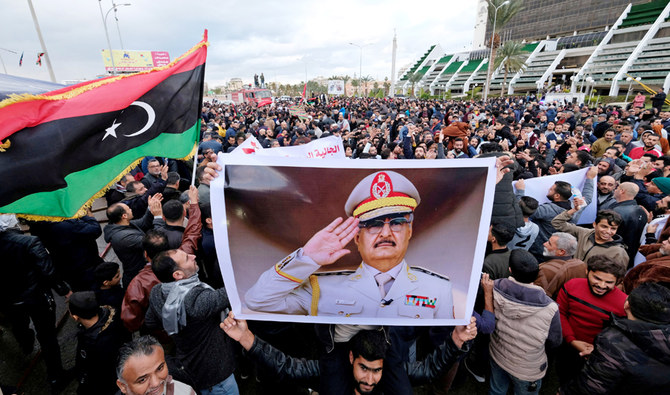
Turkey and Qatar have taken the side of the UN-recognized Government of National Accord (GNA) in the capital Tripoli, which has been under sustained attack since April from the forces of eastern-based military strongman Gen. Khalifa Haftar.
Haftar, who has superior air power, is backed by Turkey’s regional rivals. On Thursday, Turkish MPs passed a bill approving a military deployment in Libya to bolster the beleaguered GNA.
No date was given for the potential troop deployment, which would draw Ankara deeper into a conflict in which Haftar’s forces, who oppose Islamist movements close to Ankara, have the upper hand.
Ankara has already sent the GNA drones, according to the UN.
Some reports have suggested that Ankara has sent in some of the Syrian rebels that led a Turkish intervention against a Kurdish militia in northeast Syria in October.
Russia, whose military intervention in Syria helped turn the tide of that conflict in President Bashar Assad’s favor in 2015, has denied sending mercenaries to Libya.
But the UN’s Libya envoy, Ghassan Salame, has slammed the foreign interference in a conflict that has turned Libya into a haven for militants and migrant smugglers.
“Arms are coming in from everywhere,” he told AFP in an interview in late November, accusing unnamed “external parties” of causing increased civilian casualties through drone strikes.
Like the Syrian conflict, the Libyan war has developed into a “very complex” power play between Ankara and Moscow who are not allies but whose interests sometimes converge, Jalel Harchaoui, a researcher on Libya at Dutch think tank Clingendael Institute, told AFP.
Europe, meanwhile, has been relegated to the role of onlookers, in a war which has facilitated the smuggling of migrants across the Mediterranean from Libya to Europe.
Attempts by French President Emmanuel Macron to broker a peace deal by inviting Haftar to talks in Paris with the GNA in 2017, have come to naught.
As France scales back its mediation attempts following criticism of its perceived pro-Haftar bias, Germany has stepped in to try fill the void.
Berlin has invited regional players to a UN-backed conference in Berlin planned for January.
“The West isn’t leading the way in Libya. The Russians and Turks will do their own Yalta on Libya,” Harchaoui predicted.