

Libya’s Haftar makes ‘call to arms’ over possible Turkey intervention

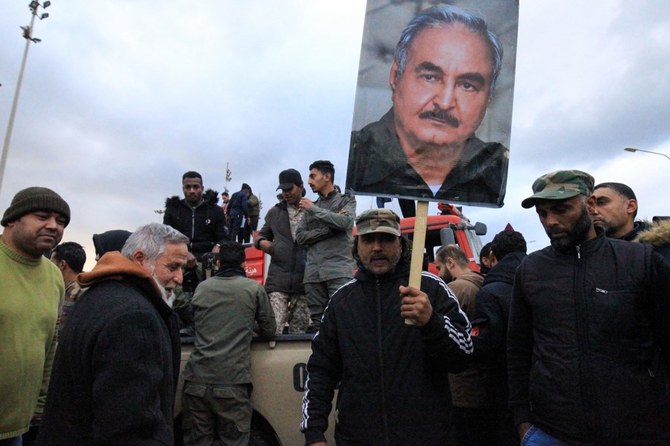
People take part in a demonstration held by Libyans and Syrians in Benghazi to protest against Turkey's prospective military intervention in support of the GNA on Jan. 3, 2020. (AFP)
Short Url
Updated 05 January 2020
Follow

Libya’s Haftar makes ‘call to arms’ over possible Turkey intervention

  • Haftar accused Ankara of wanting to "regain control of Libya", a former province of the Ottoman Empire
  • Turkey's parliament on Thursday approved the deployment of troops to Libya after it received a request for military support from Al-Sarraj's elected government

BENGHAZI: Libya's military strongman Khalifa Haftar has called on all Libyans to take up arms in response to a prospective military intervention from Turkey aimed at shoring up the Government of National Accord (GNA) in Tripoli.
The beleaguered Tripoli government, headed by Fayez Al-Sarraj, has been under sustained attack since April by Haftar, who heads a rival administration in the east. 
Turkey's parliament on Thursday approved the deployment of troops to Libya after it received a request for military support from Al-Sarraj's elected government.
"We accept the challenge and declare jihad and a call to arms," said Haftar in a televised address on Friday.
He urged "all Libyans" to bear arms, "men and women, soldiers and civilians, to defend our land and our honour".
He said it was no longer a question of liberating Tripoli from the militias, but of "facing a coloniser", accusing Ankara of wanting to "regain control of Libya", a former province of the Ottoman Empire.

Meanwhile, African Union chief Moussa Faki Mahamat has expressed his grave concern over potential "interference" in Libya, after Turkey approved the deployment of troops to the conflict-torn North African nation.
Turkish lawmakers on Thursday passed a bill approving a military deployment in Libya to shore up the UN-backed government in Tripoli, which has been under sustained attack since April from a rival administration in the east of the country.
Faki said in a statement late Friday he was "deeply concerned at the deterioration of the situation in Libya and the continuing suffering of the Libyan people."
"The various threats of political and military interference in the internal affairs of the country increase the risk of a confrontation, whose motives have nothing to do with the fundamental interests of the Libyan people and their aspirations for freedom, peace, democracy and development," read the statement.
Faki urged the international community to join forces with Africa in seeking a peaceful resolution of the crisis, warning it had "dangerous consequences" for continent as a whole.
Libya has been beset by chaos since a NATO-backed uprising toppled and killed dictator Muammar Gaddafi in 2011.


Trump warns Iran of ‘very traumatic’ outcome if no nuclear deal

Updated 5 sec ago
Follow

Trump warns Iran of ‘very traumatic’ outcome if no nuclear deal

WASHINGTON: US President Donald Trump threatened Iran Thursday with “very traumatic” consequences if it fails to make a nuclear deal — but Israeli Prime Minister Benjamin Netanyahu said he was skeptical about the quality of any such agreement.
Speaking a day after he hosted Netanyahu at the White House, Trump said he hoped for a result “over the next month” from Washington’s negotiations with Tehran over its nuclear program.
“We have to make a deal, otherwise it’s going to be very traumatic, very traumatic. I don’t want that to happen, but we have to make a deal,” Trump told reporters.
“This will be very traumatic for Iran if they don’t make a deal.”
Trump — who is considering sending a second aircraft carrier to the Middle East to pressure Iran — recalled the US military strikes he ordered on Tehran’s nuclear facilities during Israel’s 12-day war with Iran in July last year.
“We’ll see if we can get a deal with them, and if we can’t, we’ll have to go to phase two. Phase two will be very tough for them,” Trump said.
Netanyahu had traveled to Washington to push Trump to take a harder line in the Iran nuclear talks, particularly on including the Islamic Republic’s arsenal of ballistic missiles.
But the Israeli and US leaders apparently remained at odds, with Trump saying after their meeting at the White House on Wednesday that he had insisted the negotiations should continue.

- ‘General skepticism’ -

Netanyahu said in Washington on Thursday before departing for Israel that Trump believed he was laying the ground for a deal.
“He believes that the conditions he is creating, combined with the fact that they surely understand they made a mistake last time when they didn’t reach an agreement, may create the conditions for achieving a good deal,” Netanyahu said, according to a video statement from his office.
But the Israeli premier added: “I will not hide from you that I expressed general skepticism regarding the quality of any agreement with Iran.”
Any deal “must include the elements that are very important from our perspective,” Netanyahu continued, listing Iran’s ballistic missile program and its support for armed groups such as the Palestinian movement Hamas, Yemen’s Houthi rebels and Hezbollah in Lebanon.
“It’s not just the nuclear issue,” he said.
Despite their differences on Iran, Trump signaled his strong personal support for Netanyahu as he criticized Israeli President Isaac Herzog for rejecting his request to pardon the prime minister on corruption charges.
“You have a president that refuses to give him a pardon. I think that man should be ashamed of himself,” Trump said on Thursday.
Trump has repeatedly hinted at potential US military action against Iran following its deadly crackdown on protests last month, even as Washington and Tehran restarted talks last week with a meeting in Oman.
The last round of talks between the two foes was cut short by Israel’s war with Iran and the US strikes.
So far, Iran has rejected expanding the new talks beyond the issue of its nuclear program. Tehran denies seeking a nuclear weapon, and has said it will not give in to “excessive demands” on the subject.