

Ghosn plays cat-and-mouse game in Lebanese capital

1 / 3
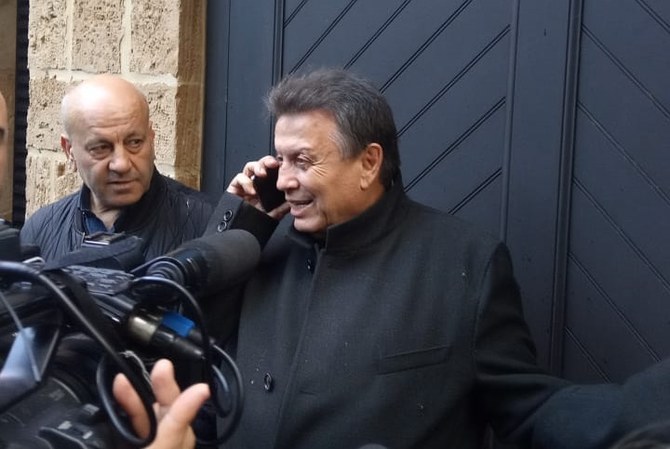
In Lebanon, Ghosn is a free citizen, presumed innocent until proven guilty according to the law, and there are no criminal proceedings against him internally. (Supplied)
2 / 3
In Lebanon, Ghosn is a free citizen, presumed innocent until proven guilty according to the law, and there are no criminal proceedings against him internally. (Supplied)
3 / 3
In Lebanon, Ghosn is a free citizen, presumed innocent until proven guilty according to the law, and there are no criminal proceedings against him internally. (Supplied)
Short Url
Updated 03 January 2020
Follow

Ghosn plays cat-and-mouse game in Lebanese capital

  • Japan, as well as France, each building a criminal case against Ghosn, may well be asking the Lebanese government to extradite him
  • By law, Lebanon has to temporarily hold and question Ghosn, but does not have to hand him over to Interpol or to extradite him anywhere

It was a busy day at the pink-painted Nissan-owned private residence in Beirut’s upmarket Achrafieh neighborhood, where Carlos Ghosn, Japan’s most wanted fugitive, was thought to have taken refuge after fleeing the country “Mission: Impossible” style.

The Thursday morning peace in the normally sedate Rue du Liban (Lebanon Street) was shattered by the Lebanese justice minister’s statement that Interpol had issued a red notice against Ghosn, a direct request for the Lebanese authorities to detain and interrogate him and/or temporarily hold him until Interpol could quiz him.

By law, Lebanon has to temporarily hold and question Ghosn, but does not have to hand him over to Interpol or to extradite him anywhere. In fact, Lebanon has never extradited any of its citizens, opting for trial in their homeland under Lebanese laws.

In Lebanon, Ghosn is a free citizen, presumed innocent until proven guilty according to the law, and there are no criminal proceedings against him internally.

Japan, as well as France, each building a criminal case against Ghosn, may well be asking the Lebanese government to extradite him to be tried for alleged financial misconduct including accusations of using company assets for personal benefit, and tax evasion.

Ghosn, the former chief of Nissan and Renault, or at least his family, are currently squatting at a house owned by Nissan, the company that cut him off and helped construct the legal case against him in Japan.

Contractually, Ghosn and his family had the right to stay at the company-owned property while he worked there. After being ousted, Nissan launched legal moves to have Ghosn and other occupants, namely his in-laws, removed from the premises.

However, Carol Nahas, Ghosn’s second wife, succeeded in receiving a court order last year, shortly before her husband was ousted, allowing her to stay in the house since his trial was yet to be determined in Japan. That was, until he fled.

Nissan’s lawyer, Sakher Hachem, told Arab News Japan that there “will be a hearing on Jan. 13 to determine the legality of the Ghosn family’s presence.”

Hachem added: “He is no longer part of the company, so he is not entitled to stay in a company-owned asset.”

No matter what the case is, the Ghosn’s presence in Nissan’s house is perhaps the utmost provocation that the “cost killer” had dealt to the company since it cut him off.

Nissan had long assigned a security company to monitor the house, which Nahas had lavishly decorated with Nissan money, purportedly splashing out as much as $6 million on furniture and renovation work, and a whopping $74,000 for two magnificent chandeliers. The house was originally bought for $8.8 million. It is believed that the security is not to keep the residents safe, but rather to prevent any of the prized items being removed from the house.

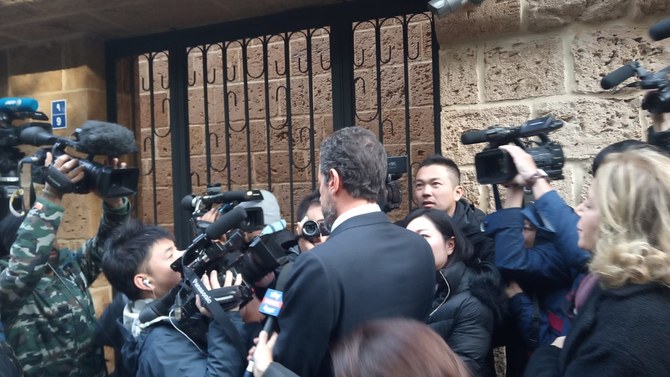
Dozens of foreign and local reporters and television channels have been camped on the tight street’s sidewalks braving cold rain to monitor the comings and goings at the three-storey villa.

Nahas, who is believed to have been the cause of his changed lifestyle to a lavish spender over the past couple of years, arrived at the house on Thursday morning in a rented vehicle, a GMC, not a Nissan.

Shortly after, an unknown man spent less than half-an-hour at the property telling reporters as he left that he was a “general health doctor” who had visited “to check on Carol’s son.”

An hour later, Mario Saradar, president and CEO of Saradar Group, entered the house. Ghosn is a shareholder in the group (a family-owned business which has been at the center of Lebanese banking for more than 60 years) with a stake of nearly 4.6 percent.

Ghosn is believed to be staying at a friend’s house nearby. So far, he has evaded the Japanese authorities since pulling his Hollywood-style stunt to flee the country.

Meanwhile, Ghosn is expected to hold a press conference on Jan. 8 after being denied the opportunity while in Japan.


Washington presses Syria to shift from Chinese telecom systems

Updated 59 min 6 sec ago
Follow

Washington presses Syria to shift from Chinese telecom systems

  • Syria is exploring the possibility of procuring Chinese technology
  • It was unclear whether the United States ⁠pledged financial or logistical support to Syria to do so

DAMASCUS: The United States has warned Syria against relying on Chinese technology in its telecommunications sector, arguing it conflicts with US interests and threatens US national security, according to three sources familiar with the matter.
The message was conveyed during an unreported meeting between a US State Department team and Syrian Communications Minister Abdulsalam Haykal in San Francisco on Tuesday. Washington has been coordinating closely with Damascus since 2024, when Syria’s now President Ahmed Al-Sharaa ousted longtime leader Bashar Assad, who had a strategic partnership with China.
Syria is exploring the possibility of procuring Chinese technology to support its telecommunications towers and the infrastructure of local Internet service providers, according to a Syrian businessman involved in the procurement talks.
“The US side asked for clarity on the ministry’s plans regarding Chinese telecom equipment,” said ⁠another source briefed on ⁠the talks.
But Syrian officials said infrastructure development projects were time-critical and that Damascus was seeking greater vendor diversity, the source added.
SYRIAN OFFICIALS CITE US EXPORT CONTROLS AS TELECOMS BARRIER
Syria is open to partnering with US firms but the matter was urgent and export controls and “over-compliance” remained an issue, according to person familiar with the meeting in San Francisco.
A US diplomat familiar with the discussions told Reuters that the US State Department “clearly urged Syrians to use American technology or technology from allied countries in the telecoms sector.”
It was unclear whether the United States ⁠pledged financial or logistical support to Syria to do so.
Responding to Reuters questions, a US State Department spokesperson said: “We urge countries to prioritize national security and privacy over lower-priced equipment and services in all critical infrastructure procurement. If it seems too good to be true, it probably is.”
The spokesperson added that Chinese intelligence and security services “can legally compel Chinese citizens and companies to share sensitive data or grant unauthorized access to their customers’ systems” and promises by Chinese companies to protect customers’ privacy were “entirely inconsistent with China’s own laws and well-established practices.”
China has repeatedly rejected allegations of it using technology for spying purposes.
The Syrian Ministry of telecommunications told Reuters any decisions related to equipment and infrastructure are made “in accordance with national technical and security standards, ensuring data protection and service continuity.”
The ministry said it is also prioritizing the diversification of partnerships and technology sources to ⁠serve the national interest.
Syria’s telecom ⁠infrastructure has relied heavily on Chinese technology due to US sanctions imposed on successive Assad governments over the civil war that grew from a crackdown on anti-government protests in 2011.
Huawei technology accounts for more than 50 percent of the infrastructure of Syriatel and MTN, the country’s only telecom operators, according to a senior source at one of the companies and documents reviewed by Reuters. Huawei did not immediately respond to a request for comment.
Syria is seeking to develop its private telecommunications sector, devastated by 14 years of war, by attracting foreign investment.
In early February, Saudi Arabia’s largest telecom operator, STC, announced it would invest $800 million to “strengthen telecommunications infrastructure and connect Syria regionally and internationally through a fiber-optic network extending over 4,500 kilometers.”
The ministry of telecommunications says that US restrictions “hinder the availability of many American technologies and services in the Syrian market,” emphasizing that it welcomes expanding cooperation with US companies when these restrictions are lifted.
Syria has inadequate telecommunications infrastructure, with network coverage weak outside city centers and connection speeds in many areas barely exceeding a few kilobits per second.