

Arab coalition: Saudi prisoners arrive in Riyadh after being released from Yemen

Saudi army officers at King Salman airbase in Riyadh. (File/AFP)
Short Url
Updated 05 January 2020
Follow

Arab coalition: Saudi prisoners arrive in Riyadh after being released from Yemen

  • The prisoners were received by Arab coalition spokesman Col. Turki Al-Maliki and their families
  • ICRC’s efforts to hand over prisoners under Stockholm Agreement lauded

RIYADH: The Arab coalition fighting to restore the legitimate government in Yemen announced on Wednesday the return of six Saudi prisoners from Yemen to Riyadh.

Coalition spokesman Col. Turki Al-Maliki said: “At 3:45 p.m., six Saudi prisoners arrived at King Salman Air Base.”

Al-Maliki said that Prince Fahd bin Turki bin Abdul Aziz, commander of the joint forces of the Arab coalition in Yemen, and a number of joint forces command staff were among the families and relatives who welcomed the released Saudi prisoners on their arrival.
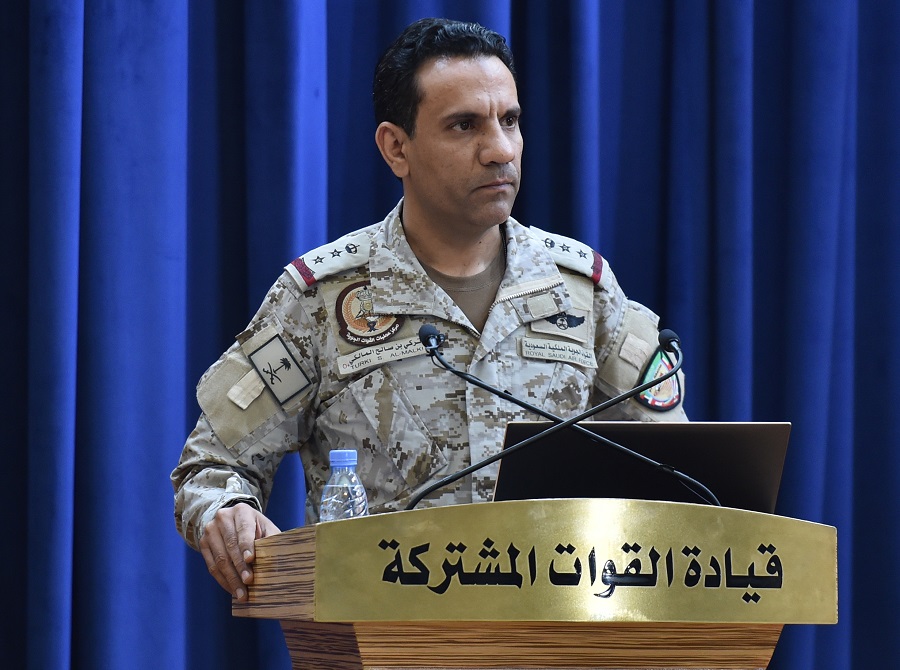


Spokesman of the Saudi-led military coalition Colonel Turki al-Maliki speaks during a press conference in the Saudi capital Riyadh, on September 30, 2019. (File/AFP)

Al-Maliki thanked the International Committee of the Red Cross’s efforts to hand over prisoners under the Stockholm Agreement.

Dr. Hamdan Al-Shehri, a political analyst and international relations scholar, said that the Kingdom was keen to take care of its citizens and soldiers. “Saudi Arabia is eager to finish this war,” he said.

Al-Shehri said that exchanging prisoners usually happened on both sides. “It’s may be a result of a previous exchange of prisoners or maybe after the Riyadh agreement,” he said.

Last November, the Arab Coalition announced the release of 200 prisoners from the Houthi militia.

He said that the international community was putting pressure on the Houthis to release Saudi prisoners and talk about political solutions to the conflict.

“The Houthis are suffering in this war because they are lacking many things and also they are observing the global and regional environment, which is changing,” Al-Shehri said.

He said that Iran was now suffering from many protests and was busy with its own issues. 

“The Houthis are now focusing on the future and they want to finish this war … the leader of the Houthis is thinking about his position in Yemen and what he is going to be in the future so this is maybe a good sign,” he said.

“We thank God for the soldiers who were released and we hope that all prisoners from all sides will be released and end this crisis.”


Saudi Arabia’s KAUST named FIFA’s first research institute in MENA

The canal in the King Abdullah University of Science and Technology campus. (Shutterstock)
Updated 10 February 2026
Follow

Saudi Arabia’s KAUST named FIFA’s first research institute in MENA

  • KAUST President Prof. Sir Edward Byrne said that the university’s selection as the fifth FIFA Research Institute in the world — and the first in the region — marks a significant achievement, reflecting Kingdom’s growing presence in international football

RIYADH: FIFA has designated the King Abdullah University of Science and Technology as its first research institute in the Middle East and Asia to support the development of innovative football research, the Saudi Press Agency reported on Tuesday.

The recognition highlights KAUST’s commitment to integrating sports, academic research and industry through advanced, high-level initiatives grounded in rigorous scientific methodologies, contributing to the advancement of football studies.

KAUST President Prof. Sir Edward Byrne said that the university’s selection as the fifth FIFA Research Institute in the world — and the first in the region — marks a significant achievement, reflecting Saudi Arabia’s growing presence in international football.

The accreditation aligns with national efforts to invest in research and development and promote the knowledge economy, supporting Saudi Vision 2030’s goals of building an advanced sports system based on innovation and sustainability.

The collaboration’s first project focuses on developing advanced AI algorithms to analyze historical FIFA World Cup broadcast footage, transforming decades of match videos into structured, searchable data, according to the KAUST website.

This work opens new opportunities to apply state-of-the-art computer vision techniques and deepen understanding of how football has evolved over time.

The second project uses player and ball tracking data from the FIFA World Cup 2022 in Qatar and the FIFA Women’s World Cup 2023 in Australia and New Zealand to compile comprehensive datasets capturing in-game dynamics.

These datasets provide deeper insights into human movement, playing techniques and performance dynamics through AI-driven analysis.