JEDDAH: US President Donald Trump on Tuesday blamed Iran for “orchestrating” an attack on the US Embassy in Baghdad and said he would hold Tehran “fully responsible.”
The Pentagon said that in addition to Marines sent to protect embassy personnel, about 750 soldiers from the 82nd Airborne Division were being sent to the Middle East and that additional troops were prepared to deploy over the next several days.
Protesters scaled walls and attempted to force their way into the compound on Tuesday during demonstrations against American airstrikes on Iranian-backed militia group targets in Iraq.
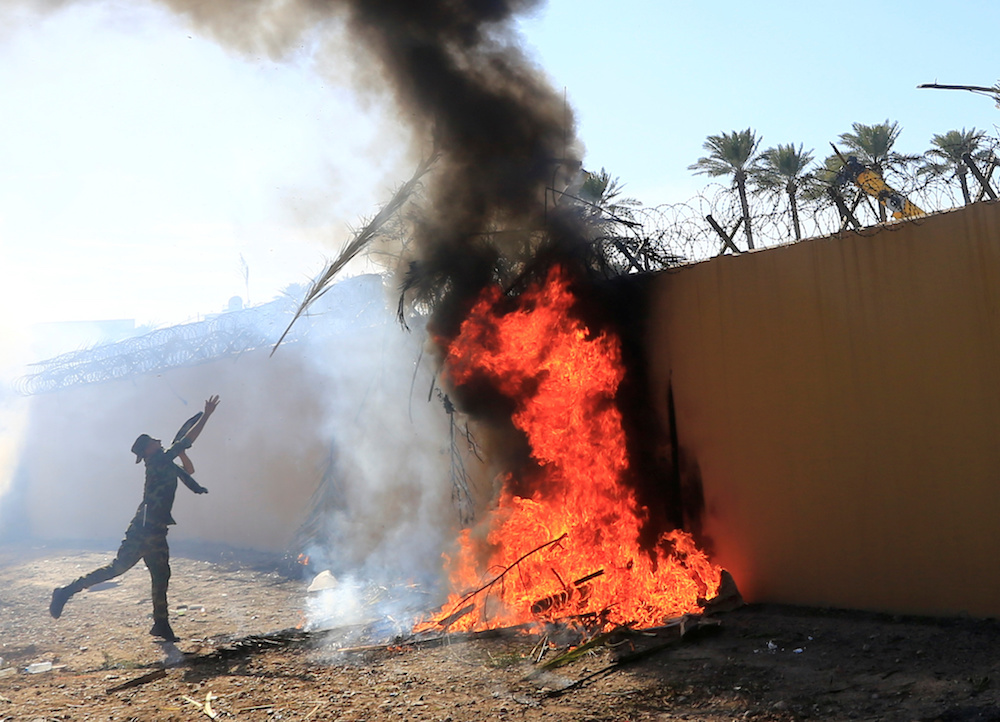
Hashed Al-Shaabi militants set the US Embassy wall on fire as they protest against air strikes on their bases. (Reuters)
Writing on Twitter, Trump said: “Iran killed an American contractor, wounding many. We strongly responded, and always will. Now Iran is orchestrating an attack on the US Embassy in Iraq. They will be held fully responsible. In addition, we expect Iraq to use its forces to protect the embassy, and so notified.”
In a separate tweet, the US president added: “To those many millions of people in Iraq who want freedom and who don’t want to be dominated and controlled by Iran, this is your time!”
With the huge embassy put under lockdown, one official claimed dozens of extra US troops would be temporarily sent there, while another said two Apache helicopters had carried out a “show of force” over the site.
Iran killed an American contractor, wounding many. We strongly responded, and always will. Now Iran is orchestrating an attack on the U.S. Embassy in Iraq. They will be held fully responsible. In addition, we expect Iraq to use its forces to protect the Embassy, and so notified!
— Donald J. Trump (@realDonaldTrump) December 31, 2019
The US State Department and White House did not respond to a request for comment on whether the American ambassador and staff had been evacuated from the compound. However, Iraqi officials said the envoy and other workers had been moved out of the mission on Tuesday for their safety as thousands of angry protesters and militia fighters thronged the gates.
Ahmad Ajaj, a London-based expert in international relations, told Arab News: “The US Embassy in Baghdad’s green zone is a very sensitive and highly protected area. The attack on the embassy by Iraqi militias loyal to Iran represents a catastrophic and unprecedented failure in international relations, and consequently, it places the Iraqi government in an embarrassing position before the world.
“Embassies, according to the Geneva Conventions of 1961, are under the sovereignty of the embassy’s government, and the host countries must provide them with the ultimate protection and prevent any attack against their crew.”
Outside the #US #Embassy in Baghdad's Green Zone. #Iraq pic.twitter.com/XKX257lBkd
— Sinan Salaheddin Mahmoud (@sinansm) December 31, 2019
He said there were indications that a decision was taken within the Iraqi establishment to give demonstrators access to the US Embassy, and what happened was similar to an incident in 1979 when Iranian students attacked and occupied the American Embassy in Tehran at the time of Ayatollah Khomeini’s revolution.
“It seems that Iran, through its loyalists, wants to send a message to the US that it still has influence in Iraq and that it can move its tools to attack US interests in the region. It means to tell Trump to deal with it directly or retreat from the economic pressures the US imposes on Iran,” Ajaj added.
“However, I do not think that Trump will back away from his policy of continuing pressure on Iran economically, diplomatically and militarily, especially as he is campaigning for the upcoming US elections.
The man here asks the protesters to step back. From outside the #US #Embassy in Baghdad's Green Zone. #Iraq pic.twitter.com/hSvaLFJ3Tk
— Sinan Salaheddin Mahmoud (@sinansm) December 31, 2019
“I expect the US to escalate and take up the issue to the UN Security Council and accuse Iran directly of being behind it … diplomatically, the US is expected to mobilize the support of its European allies in order to support it in its campaign against Iran, especially since what happened is contrary to international law and will be condemned by the international community.”
On Monday, US State Department officials said Washington had shown restraint and patience in the face of escalating provocations from Iran or Iranian-backed groups, but that it was time to re-establish deterrence against Tehran’s aggression.
Iran’s most senior men in Iraq inc Falih Fayad, Iraq’s National Security Advisor and Hadi Al-Amiri, leader of al-Bina coalition (claims to be largest bloc in Iraq parliament) are among the so called ‘protesters‘ who have reportedly attacked the outers of US embassy in Baghdad. pic.twitter.com/Y8nwFw8tuB
— Abdulla Hawez (@abdullahawez) December 31, 2019
“We had very much hoped that Iran would not miscalculate and confuse our restraint for weakness. But after so many attacks it was important for the president to direct our armed forces to respond in a way that the Iranian regime will understand,” Brian Hook, the US special representative for Iran, told reporters.
(With agencies)