


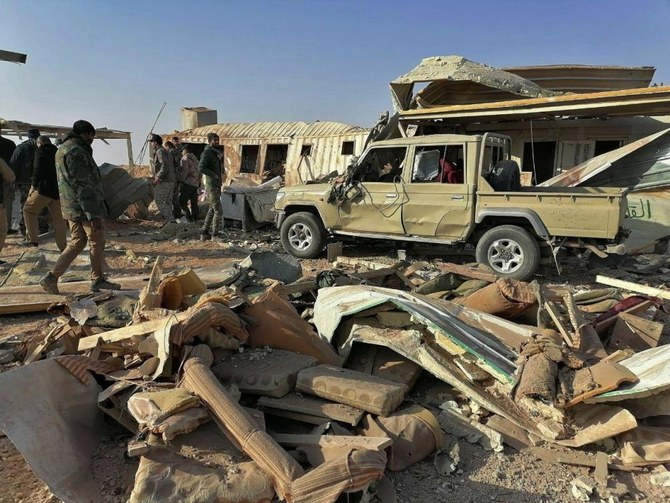

BAGHDAD: Airstrikes against an Iran-backed militia in Iraq and Syria aimed to restore America’s “deterrence capability” against Iran in the region, US officials said Monday.
The comments come as Iraq’s government threatened to “review” its relations with the US over the attacks on five Kataeb Hezbollah bases.
US ambassador in Iraq left Baghdad to an unknonw destination, Al-Arabiya sources reporte on Tuesday. The Iraqi foreign ministry refused to comment on the news.
The airstrikes - the largest yet by the US targeting an Iraqi state-sanctioned militia - were in response to a rocket attack on a US base last week that killed an American contractor.
“This was a defensive action that was designed to protect American forces and American citizens in Iraq but we are also working on the mission set of restoring deterrents against Iranian aggression,” US special representative for Iran Brian Hook said. “After so many attacks it was important for the president to direct our armed forces to respond in a way that the Iranian regime will understand.”
The US action is the latest round of tensions with Iran that increased after Washington ramped up sanctions against Tehran after withdrawing from an international agreement to curtail its nuclear program.
Kataeb Hezbollah operates under the umbrella of the state-sanctioned militias known as the Popular Mobilization Forces, many of which are supported by Iran.
The strikes included 3 targets in Western Iraq & 2 targets in Eastern Syria that were either command & control facilities or weapons caches for Kata'ib Hezbollah & will degrade their ability to conduct future attacks against @CJTFOIR coalition forces. The strikes were successful.
— Department of Defense (@DeptofDefense) December 30, 2019
The group said Monday that the strikes had killed 25 people, and vowed to exact revenge for the “aggression of evil American ravens.”
A spokesman denied it was behind rocket attacks on US bases, including the one that killed the American contractor, saying Washington is using them as a pretext to attack his group.
Iraqi Prime Minister Adel Abdul Mahdi on Monday condemned the air strikes as an “unacceptable vicious assault that will have dangerous consequences.”
The air strikes will force Iraq to reconsider working with the US-led international coalition against Daesh, the National Security Council said in a statement. Iraq’s foreign ministry said it would summon the US ambassador in Baghdad.
However, Washington hit back, accusing Iraqi authorities of having failed to “protect” US interests.
“We have warned the Iraqi government many times, and we've shared information with them to try to work with them to carry out their responsibility to protect us as their invited guests,” a senior US State Department official said.
The US has ramped up its military presence in the region in response to the threat from Iran and a string of attacks blamed on Tehran. These included planting mines on international shipping in the region and launching a drone and missile attack on oil facilities in Saudi Arabia.
Assistant Secretary of Near Eastern Affairs David Schenker said President Donald Trump had exercised “strategic patience” in response to 11 Iran-backed attacks that have taken place since May.
However, Schenker said that over the past several years, the Iranians have taken “non-response as an understanding of weakness and have continuously pushed the envelope.”
Schenker said the locations hit on Sunday were “significant targets and the ones on the Syrian side of the border were even more significant in many ways.”
Both Hook and Schenker said the US does not want an escalation in the region, but rather a “deescalation.”
Hook said that the US has enhanced their “troop posture by 14,000 to the region since May, specifically with Saudi (Arabia), where they have enhanced their air defenses.”
He said the US works very closely with regional allies, especially the countries that are "on the front line of Iranian aggression, to protect them against Iranian attacks, whether it kinetic or cyber.”
The US has maintained some 5,000 troops in Iraq at the invitation of the Iraqi government, to help assist in the fight against Daesh.
An official with the Popular Mobilization Forces said one of the American missiles struck a room where the fighters were taking a nap in the afternoon, killing some of them in their sleep as the ceiling collapsed.
In Tehran, foreign ministry spokesman Abbas Mousavi condemned the US strikes against Kataeb Hezbollah as an “obvious case of terrorism” and accused Washington of ignoring Iraq’s sovereignty.
Lebanon’s Iran-backed Hezbollah also blasted the “brutal American aggression,” saying those who took the decision to carry out the attack “will soon discover how stupid this criminal decision was.”
Kataeb Hezbollah is led by Abu Mahdi Al-Muhandis, one of Iraq’s most powerful men. He once battled US troops and is now the deputy head of the Popular Mobilization Forces. In 2009, the State Department linked him to the elite Quds Force of Iran’s Revolutionary Guard, designated a foreign terrorist organization by President Donald Trump earlier this year.
The attack that killed the American contractor and US counter-strikes come as months of political turmoil roil Iraq. About 500 people have died in anti-government protests, most of them demonstrators killed by Iraqi security forces.
The mass uprisings prompted the resignation last month of Abdul-Mahdi, who remains in a caretaker capacity.
In a statement, Abdul-Mahdi said Esper had called him about a half-hour before the US strikes on Sunday to tell him of US intentions to hit bases of the militia suspected of being behind Friday’s rocket attack. Abdul-Mahdi said he asked Esper to call off the US plan.
(With Agencies)


