



In a world rife with religious intolerance, rampant bigotry, and more divisiveness than ever, many people believe that “every man for himself” has become the motto for survival. But others believe that the key to a better tomorrow lies in standing together, united for a brighter future. One of those people is Naif Al-Harbi.
The 26-year-old activist found his calling as a student at Arizona State University, in the US. During his college years, he joined a student group known as SunDABT, an interfaith organization seeking to create a more peaceful, tolerant, and inclusive community at the university.
“The experience changed me. I started to become a new person. I decided to be that person for the rest of my life, and to bring that exposure of interfaith and intercultural dialogue to my people,” said Al-Harbi.
Al-Harbi aims to bring together people of various different faiths, races, and cultures with his initiative, but also to promote a better understanding of Saudi Arabia in the outside world.
“Saudi people have a lot of misconceptions about outsiders, and outsiders have a lot of misconceptions about Saudis. I want to become a bridge between cultures and societies,” he said.
Soon...#peace101 pic.twitter.com/CKXpnTMfMP
— Saudis For Peace Eng (@Saudis4Peace) March 27, 2018
He thinks that this is mostly due to the changes that Saudi society has experienced in recent years. “Saudis today are way more open to getting to know others from different religions and cultures. When I first had the idea to start ‘Saudis for Peace’ in 2015, I faced a lot of issues from my family and friends. But I kept fighting for it, and I believed in it.”
Dialogue
His big break came in 2017, when the Misk Foundation invited him to be a speaker at the Misk-UNDP Youth Forum in New York. Al-Harbi delivered a passionate address about the importance of interfaith and intercultural dialogue, which kick-started Saudis for Peace. “It was like a door opened for me,” he said.
Unable to do it all on his own, he took to social media to recruit people to his cause. Since then, he has been propelled into success; between his personal Twitter account and that of Saudis for Peace, he has more than 30,000 followers. Saudis for Peace now boasts 40 members in addition to Al-Harbi himself.
“I thought I was doing this alone. I was really surprised, but also gratified, to see the response on social media,” he said.
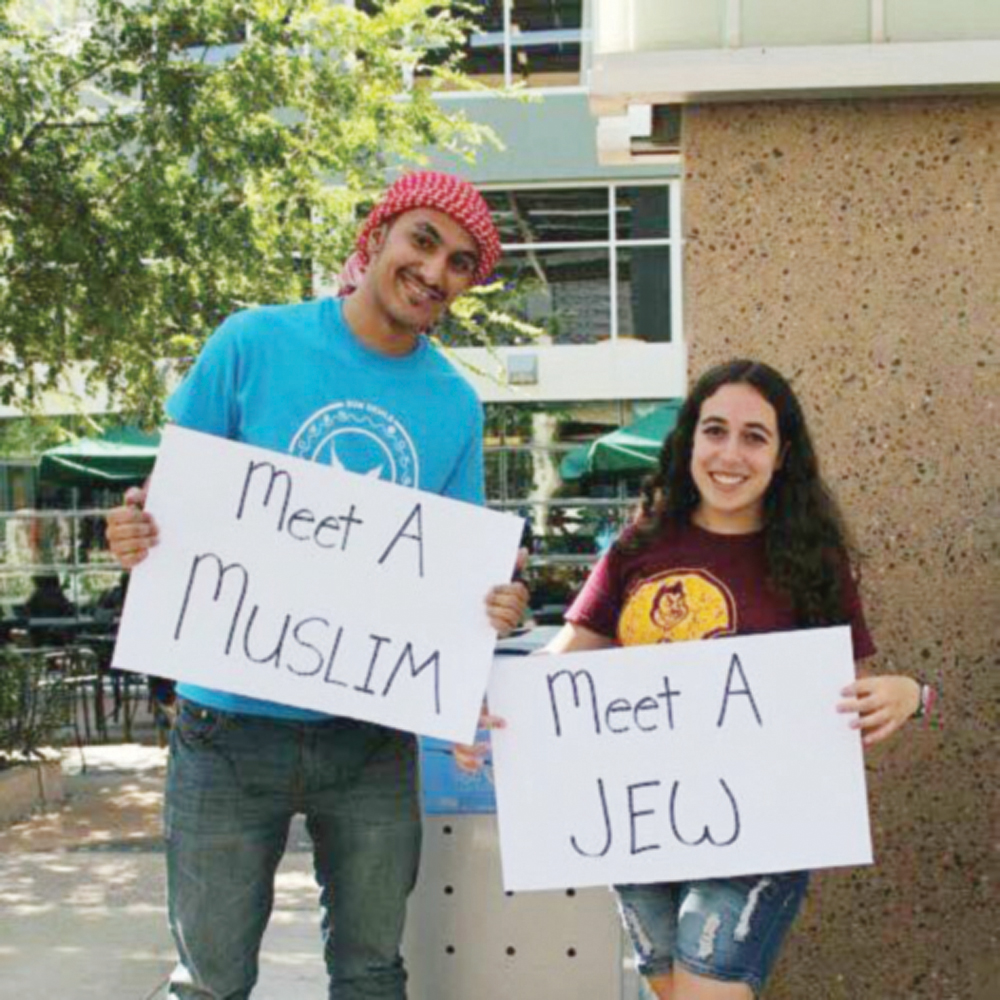
Naif Al-Harbi, as a student at Arizona State University, during an event for interfaith group SunDABT.
To Al-Harbi’s delight, people are taking notice. Saudis for Peace was officially recognized and licensed as an NGO by the United Religions Initiative (URI) earlier this year. According to Al-Harbi, Saudis for Peace is currently made up of a majority of Sunni Muslims: “It’s about 70 percent Sunni, 30 percent Shiite right now,” he said.
However, he was keen to note that any and all faiths, genders, orientations, and races were welcome in the organization. “We don’t discriminate against anyone. And it’s important to note that we celebrate our differences. I don’t want to sit in a room with a bunch of people that just agree with everything I say. That would be doing it wrong,” he said.
However, he does put matters to a vote in the group, especially in situations where he thinks there might be tension. “Interfaith work isn’t as easy as people may think, but it’s our reality, and we need it, especially with Saudi Arabia opening itself up to tourists. We need to create an inclusive environment for everyone,” he said.
Since its formation, Saudis for Peace has participated in a number of projects to open the doors to interfaith discussion. One of the biggest is a series of short documentaries on YouTube called “Peace 101,” which explore the world’s major religions, all translated into Arabic.
The organization also translated the Golden Rule of religion — the ethics of reciprocity — into Arabic, a feat that Al-Harbi takes pride in.
Despite the fact that it is still a new organization with a lot of ground to cover, Al-Harbi is optimistic about the future. “I’m not a powerful person, I don’t have unlimited funds or very high connections, but I managed to build myself up from zero. This is huge, and I appreciate every moment of it,” he said.
His hope for the future of Saudis for Peace is that it can deliver a message; tolerance, understanding, and compassion are the answer for peace that everyone is looking for, and it all starts with just opening oneself up to discussion.
— Saudis For Peace Eng (@Saudis4Peace) July 22, 2018
“It’s like Ibn Rushd (Averroes) says: Ignorance leads to fear, fear leads to hatred, and hatred leads to violence,” he said.


