Turkey readying to give Libya military support

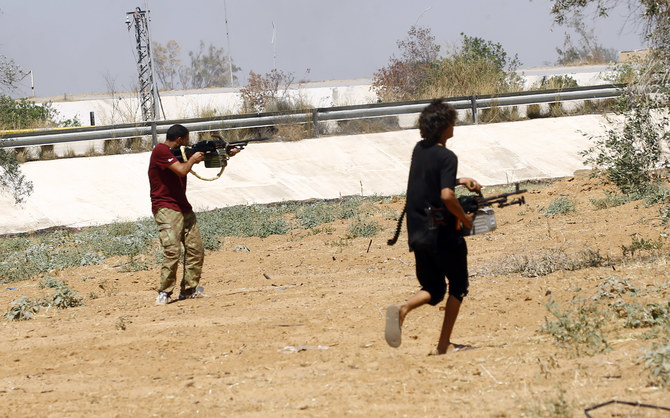
Fighters loyal to the internationally-recognized Libyan Government of National Accord (GNA) open fire from their position in the Al-Sawani area south of the Libyan capital Tripoli during clashes with forces loyal to strongman Khalifa Haftar. (AFP)
Short Url
Updated 26 December 2019
Follow

Turkey readying to give Libya military support

  • Turkey backs Tripoli administration in Libya, which has been split into rival political and military factions

ANKARA: Turkey is ready to give Libya military support, a spokesman for President Recep Tayyip Erdogan said, with the country’s Parliament readying to authorize troop deployment.

Turkey backs the government of Fayez Al-Serraj in Libya, which has been split into rival political and military factions since 2011 when ruler Muammar Gaddafi was ousted and killed. 

Al-Serraj’s Government of National Accord (GNA) has been battling the forces of veteran eastern commander Khalifa Haftar, who launched an offensive to seize Tripoli from fighters loyal to the GNA. 

Turkey and Libya recently signed a military cooperation deal. It includes provisions for a quick reaction force if requested by Tripoli.

Opinion

This section contains relevant reference points, placed in (Opinion field)

“We will continue to support the internationally recognized Libyan government. This support may be in terms of military training, or other areas, such as political support,” presidential spokesman Ibrahim Kalin said after Omer Celik, a spokesman for the ruling Justice and Development Party, said the country would use hard power instruments to protect its national interests if necessary.

The military cooperation deal has been criticized by the Turkish opposition, which said further military supplies to the GNA breach a UN arms embargo.  

But Erdogan pledged Sunday to intensify military backing to Libya along with ground, air and marine options. Some Turkish media have reported that the government may establish a military base in Libya to support its operations.

“It is important not to confuse Erdogan’s rhetoric and the physical reality of the actions he has taken lately,” Jalel Harchaoui, a Libya expert at the Netherlands Institute of International Relations, told Arab News. “Those are two very different things.”

He recalled that Turkey sent around 60 national intelligence officers to operate combat drones in Libya during the summer, in violation of the arms embargo.

HIGHLIGHT

The Turkish opposition has criticized military cooperation deal, saying military supplies to the Tripoli administration breach a UN arms embargo.

He said that the operation, although clandestine, helped the GNA to survive. “However, that Turkish mission stopped almost entirely in the second half of October. After the defense accord was signed on November 27, the mission has been partially resumed. But it is now a much more timid, much smaller version of summer’s operation. Very few airstrikes are being carried out by the Turks on behalf of Libya’s internationally recognized government.”

Ankara was only talking about possibly sending government troops, he said, but none of it had happened.

“Turkey’s intervention right now is much smaller than three or four months ago. And even back then, the Turkish military intervention was remarkably smaller than the Emiratis’ own military intervention, which now involves airstrikes conducted using fighter jets on a routine basis. Overall, since April, the total number of Emirati drone strikes has been three times as large as the Turkish drone strikes in Libya.”

Harchaoui said that Ankara seemed “deeply interested” in attempting some sort of diplomatic entente, particularly with Russia.

Russia has said it is concerned about the possibility of Turkey deploying troops in Libya. Russian President Vladimir Putin is visiting Turkey next month, with the two nations expected to launch an important Libya initiative.

Erdogan said Wednesday he had discussed with his Tunisian counterpart, President Kais Saied, possible steps and cooperation to establish a cease-fire in Libya.

In a news conference alongside Saied, Erdogan said he believed Tunisia would have “valuable and constructive” contributions to establishing stability in Libya.



Ramadan lanterns: A symbol of celebration

Updated 55 min 5 sec ago
Follow

Ramadan lanterns: A symbol of celebration

CAIRO: Muslims around the world are observing Ramadan, a month of dawn-to-dusk fasting, intense prayer and charity.

The holy month has long been associated with a rich tapestry of customs and traditions that define its unique celebrations.

Among the most prominent symbols of these festivities is the Ramadan lantern, a cherished emblem that illuminates streets and homes, reflecting the spiritual and cultural essence of the season.

In the historic districts of Cairo — such as Al-Hussein, Al-Azhar and Sayyida Zeinab — millions of Egyptians gather to celebrate Ramadan.

These neighborhoods are transformed into vibrant scenes of light and color, adorned with elaborate illuminations and countless Ramadan lanterns that hang across streets and balconies.

Vendors line the bustling alleys, offering a wide array of goods associated with the sacred month.

Foremost among these cherished items is the Ramadan lantern, which remains the most iconic and sought-after symbol of the season, embodying both tradition and festivity.

The lantern, in its earliest form, served as a vital source of illumination in ancient times.

Initially, torches crafted from wood and fueled with oils were used to light homes and pathways.

During the Middle Ages, Egyptians advanced their methods of lighting, developing oil lamps and decorative lanterns. In the Mamluk era, streets were illuminated on a wider scale, and artisans excelled in architectural innovation, producing intricately designed lanterns adorned with refined artistic motifs.

Gamal Shaqra, professor of modern history, told Arab News: “The story of the Ramadan lantern is widely traced back to the Fatimid era, with several narratives surrounding its origin. One account links it to Jawhar Al-Siqilli, the general who founded Cairo and built Al-Azhar Mosque, and to the arrival of Caliph Al-Muizz li-Din Allah in 969 A.D.

“According to this, Egyptians welcomed the Fatimid caliph by carrying lanterns to light his path, using them as both illumination and a gesture of celebration.”

He added: “Following this historic scene, lanterns began to be used to light streets and public spaces. Over time, the lantern evolved into a defining symbol of Ramadan festivities, as children took to the streets carrying their brightly lit lanterns and chanting traditional songs celebrating the holy month.

“The tradition continued to flourish during the Ayyubid and Mamluk periods, with lantern designs becoming increasingly diverse. In the era of Mohammad Ali, the craft saw further development, as lanterns were manufactured from metal sheets and fitted with colored glass, marking a significant evolution in both design and production.”

Methods of manufacturing the Ramadan lantern have diversified over time, alongside the evolution of its artistic designs in the modern era.

With the advancement of tools and technology, merchants have increasingly introduced wooden lanterns crafted using laser-cut techniques, offering intricate patterns and contemporary styles.

Despite these innovations, handcrafted lanterns continue to retain their distinctive value and authenticity. Made by skilled artisans, these traditional pieces remain deeply cherished, preserving the spirit of heritage and craftsmanship associated with the holy month.

Artist Mohamed Abla told Arab News that the design of the Ramadan lantern was inspired by the form of the mishkat — the ornate niche found in mosques that embodies Islamic art and traditionally serves as a source of illumination.

He added that the lantern had long been a subject for visual artists, who had depicted it in their paintings as a symbol of folk heritage and the enduring traditions associated with celebrating the holy month.

During a tour of popular marketplaces, a clear variation in lantern prices was noted, reflecting the craftsmanship and effort invested in their production.

In the tourist markets along Al-Moeaz Street, brass and bronze lanterns are prominently displayed in antique shops, showcasing elaborate designs that appeal to both visitors and collectors seeking traditional Ramadan decor.