LUCKNOW, India: Indian authorities stepped up security and shut down the Internet in various places on Tuesday while members of the ruling party planned marches backing a new citizenship law even though nationwide protests against it are escalating.
An interior ministry official said the government expected all state security officials to be on duty on Christmas Eve and through the holiday week.
“We want the police to prevent an outbreak of violence but we also realize that the situation can get out of control, hence paramilitary forces will be deployed in markets and public spaces,” said a senior security official in New Delhi.
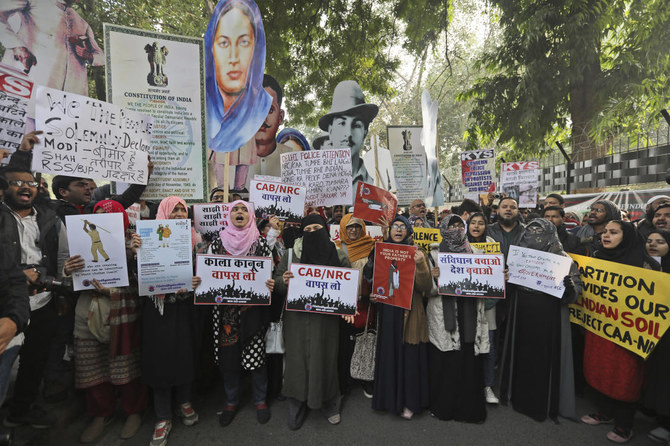
At least 20 rallies in support or against the new law were scheduled in different cities with protesters from both sides canvassing on social media to get people out over Christmas and the New Year.
The Citizenship Amendment Act (CAA) aims to fast-track citizenship for persecuted Hindus, Parsis, Sikhs, Buddhists, Jains and Christians who arrived in India before Dec. 31, 2014, from Muslim-majority Afghanistan, Bangladesh and Pakistan.
Its passing on Dec. 11 triggered demonstrations in the eastern state of Assam, where protesters fear it will make illegal migrants from Bangladesh legal residents.
Elsewhere, critics say the law discriminates against Muslims and is part of Prime Minister Narendra Modi’s Hindu nationalist agenda. The government denies that.
Activists opposed to the law said they were trying to keep up the momentum and were looking for ways to work around the police clampdown and Internet blackouts.
Senior members of Modi’s Bharatiya Janata Party (BJP) leading rallies to support the law said they were determined to counter what they see as misleading criticism of it.
“We want to explain that the law is not anti-Muslim and we want to expose that those who are leading the protests against the law are misleading innocent, uneducated Muslims,” said BJP spokesman Gopal Krishna Agarwal.
At least 21 people have been killed since the law was passed in protests that represent the first major opposition to Modi’s legislative agenda since his party’s landslide re-election this year.
Police in the northern state of Uttar Pradesh (UP), which has seen the most deaths in the protests, suggested that Islamists were stirring up the anti-CAA demonstrations.
“We have proof that an Islamic group with its headquarters in Delhi and its strongest base in the southern state in Kerala is behind the violence in the UP,” said senior police officer Kalanidhi Naithani.
In the last 10 days, police in UP have taken nearly 900 people into custody for violence, said an official in the state’s police control room. More than 2,000 people have been arrested across India.
New York-based Human Rights Watch criticized the police action and called on them to stop using unnecessary lethal force against demonstrators.
The rights group said police had only used excessive force only against those protesting against the law, including many students.
“The authorities should prosecute violent protesters, but they also need to hold police officers to account for using excessive force,” said Meenakshi Ganguly, the group’s South Asia director.
In Uttar Pradesh’s capital of Lucknow, Tabassum Raza, a 26-year-old Muslim woman, said she was beaten by police who stormed into her home.
“After barging into my house, one of the policemen immediately pointed a gun at my forehead and asked me to tell where were the men were hiding,” she said.
“When I told them there was no one in they started beating me with batons and damaged everything,” Raza said, showing bruised forearms and legs.
Vikash Chandra Tripathi, superintendent of police in West Lucknow, said the allegations were baseless and police were only searching for people involved in the violence.
He said the police would investigate if an official complaint is lodged.
“So far the police have not received any complaints from anyone regarding,” he said.


![]()

India beefs up security amid outrage against citizenship law, anger with police
Short Url
https://arab.news/bcwd6
India beefs up security amid outrage against citizenship law, anger with police
- ‘We want the police to prevent an outbreak of violence but we also realize that the situation can get out of control’
- Activists opposed to the citizenship law said they were trying to keep up the momentum


Latest updates


© 2026 SAUDI RESEARCH & PUBLISHING COMPANY, All Rights Reserved And subject to Terms of Use Agreement.