No Christmas Mass at Notre-Dame cathedral for first time in two centuries

1 / 3
Firefighters douse flames and smoke billowing from the roof at Notre-Dame Cathedral in Paris on April 15, 2019. (AFP)
2 / 3
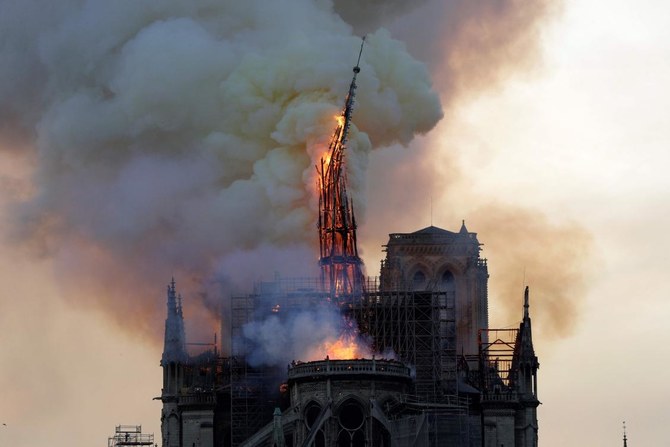
The steeple and spire of the landmark Notre-Dame Cathedral collapses as the cathedral is engulfed in flames in central Paris on April 15, 2019. (AFP)
3 / 3
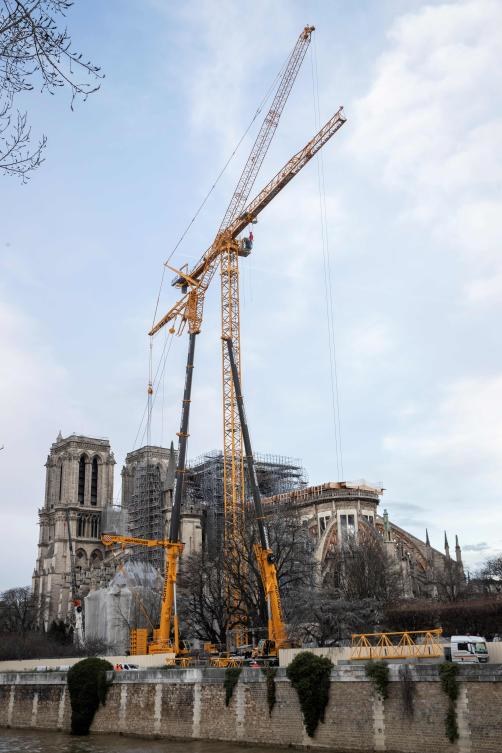
A picture taken on December 19, 2019 shows cranes outside the Notre-Dame Cathedral in Paris, which was partially destroyed when fire broke out beneath the roof on April 15, 2019. (AFP)
Short Url
Updated 21 December 2019
Follow

No Christmas Mass at Notre-Dame cathedral for first time in two centuries

  • The building had remained open for Christmas through two centuries, being forced to close only during the anti-Catholic revolutionary period
  • The culture ministry said in October that nearly one billion euros ($1.1 billion) had been pledged or raised for the reconstruction

PARIS: Notre-Dame cathedral will fail to hold a Christmas mass for the first time since 1803, French officials confirmed on Saturday, as workers continue to repair and rebuild the Paris landmark eight months after a devastating fire.
The cathedral’s press office said midnight mass would still be celebrated on Christmas Eve by rector Patrick Chauvet but it would be held at the nearby church of Saint-Germain l’Auxerrois.
Notre-Dame, part of a UNESCO world heritage site on the banks of the River Seine, was ravaged by the April 15 blaze — losing its gothic spire, roof and many precious artefacts.
The building had remained open for Christmas through two centuries of often tumultuous history — including the Nazi occupation in World War II — being forced to close only during the anti-Catholic revolutionary period in the late 18th and early 19th centuries.
President Emmanuel Macron has set a timetable of five years to completely repair the eight-centuries-old structure, which remains shrouded in scaffolding with a vast crane looming over it.
Paris prosecutors suspect criminal negligence and opened an investigation in June, suggesting a stray cigarette butt or an electrical fault could be the culprit.
The culture ministry said in October that nearly one billion euros ($1.1 billion) had been pledged or raised for the reconstruction.


Uganda army denies seizing opposition leader as vote result looms

Updated 58 min 6 sec ago
Follow

Uganda army denies seizing opposition leader as vote result looms

  • Election day was marred by significant technical problems after biometric machines
  • There were also reports of violence against the opposition in other parts of the country

KAMPALA: Uganda’s army denied claims on Saturday that opposition leader Bobi Wine had been abducted from his home, as counting continued in an election marred by reports of at least 10 deaths amid an Internet blackout.
President Yoweri Museveni, 81, looked set to be declared winner and extend his 40-year rule later on Saturday, with a commanding lead against Wine, a former singer turned politician.
Wine said Friday that he was under house arrest, and his party later wrote on X that he had been “forcibly taken” by an army helicopter from his compound.
The army denied that claim.
“The rumors of his so-called arrest are baseless and unfounded,” army spokesman Chris Magezi told AFP.
“They are designed to incite his supporters into acts of violence,” he added.
AFP journalists said the situation was calm outside Wine’s residence early Saturday, but they were unable to contact members of the party due to continued communications interruptions.
A nearby stall-owner, 29-year-old Prince Jerard, said he heard a drone and helicopter at the home the previous night, with a heavy security presence.
“Many people have left (the area),” he said. “We have a lot of fear.”
With more than 80 percent of votes counted on Friday, Museveni was leading on 73.7 percent to Wine’s 22.7, the Electoral Commission said.
Final results were due around 1300 GMT on Saturday.
Wine, 43, whose real name is Robert Kyagulanyi, has emerged as the main challenger to Museveni in recent years, styling himself the “ghetto president” after the slum areas where he grew up in the capital, Kampala.
He has accused the government of “massive ballot stuffing” and attacking several of his party officials under cover of the Internet blackout, which was imposed ahead of Thursday’s polls and remained in place on Saturday.
His claims could not be independently verified, but the United Nations rights office said last week that the elections were taking place in an environment marked by “widespread repression and intimidation” against the opposition.

- Reports of violence -

Analysts have long viewed the election as a formality.
Museveni, a former guerrilla fighter who seized power in 1986, has total control over the state and security apparatus, and has ruthlessly crushed any challenger during his rule.
Election day was marred by significant technical problems after biometric machines — used to confirm voters’ identities — malfunctioned and ballot papers were undelivered for several hours in many areas.
There were reports of violence against the opposition in other parts of the country.
Muwanga Kivumbi, member of parliament for Wine’s party in the Butambala area of central Uganda, told AFP’s Nairobi office by phone that security forces had killed 10 of his campaign agents after storming his home.