

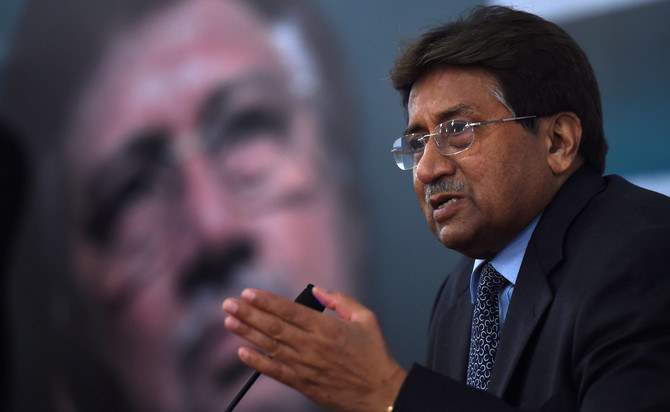

ISLAMABAD: Pakistan’s self-exiled former military ruler, General (retired) Pervez Musharraf, is all set to challenge a special court’s verdict against him in high treason case, after consultations with his lawyers, local media reported on Wednesday.
Musharraf’s political party, All Pakistan Muslim League, said a day before that it would appeal the “one-sided” decision in the Supreme Court while reacting to the special court’s ruling that sentenced the former army chief to death on charges of suspending the constitution and incarcerating judges of the superior judiciary in 2007.
“The judgment is announced in haste, and the conviction of my client in absentia doesn’t have any legal foundation to stand on,” Musharraf’s lawyer Salman Safdar told Arab News on Tuesday, calling the sentence “unconstitutional and illegal” and describing the case as “politically motivated.”
“Proper legal procedure was not followed to initiate the case in the first place,” he added. “The sentence will be overturned in appeal [in a superior court],” he said, adding that he had yet to consult his client about the appeal process.
Legal experts maintained on Wednesday that Musharraf could get his death sentence overturned in the high treason case by filing an appeal against it in the Supreme Court.
“The special court’s verdict is not final,” Ashtar Ausaf Ali, Pakistan’s former attorney-general and advocate Supreme Court, told Arab News on Wednesday. “General Musharraf still has a number of legal options to exercise to get his conviction overturned.”
“Musharraf can file appeal against the verdict in Supreme Court within thirty days,” Ausaf said. “This case will be discussed in detail again, and every aspect of it will come under scrutiny in the Supreme Court.”
Talking about the merits of the case, he said that Musharraf can “easily get his conviction overturned” if the case is pleaded properly in the apex court. The former general’s appeal in the Supreme Court can be entertained on “humanitarian grounds” if he decides to stay abroad, he added.
Musharraf seized power in a 1999 military coup against the government of Prime Minister Nawaz Sharif but stepped down nine years later in 2008 after mass protests. He remained in self-imposed exile for several years but returned to Pakistan in 2013, after which Nawaz Sharif filed the high treason case against him.
He was allowed to leave Pakistan in 2016 for health reasons which his lawyer had argued at the time were preventing him from standing trial on treason and other charges.
The ruling announced on Tuesday marks the first time that a Pakistani military ruler has been held accountable for abrogating the constitution and sending an elected government packing.
General Musharraf’s conviction focuses on the suspension of the country’s constitution in 2007, as Pakistan’s parliament or superior judiciary had not validated his action which under the law is punishable either by death sentence or life imprisonment.
Pakistan’s opposition parties hailed the verdict, but the country’s all-powerful armed forces said in a statement that the ruling had caused “pain and anguish” to the army’s ranks and file.
“Musharraf is sentenced through a selective application of law and justice, and that’s why the armed forces and general public have protested against it,” General (r) Naeem Khalid Lodhi, defense analyst, told Arab News.
He said that the former army chief had suspended the constitution after consultations with his cabinet, the chief ministers of his time, governors and other top government functionaries, but they were all spared. “There is a need to reform the whole judicial system as nobody in the country trusts it,” he said.
About the army’s reaction to the verdict, he said the country’s armed forces had “learned their lesson” through different mistakes and would never take any unconstitutional step to protect the former chief of army staff.
“This is a legal case and will be fought in the courts only,” Lodhi added.
Ashtar Ausaf, however, said that former military ruler may tender an apology to the nation for his action of suspending the constitution and then file a mercy plea before the president.
“President under the constitution has authority to pardon a convicted person,” Ausaf said.


