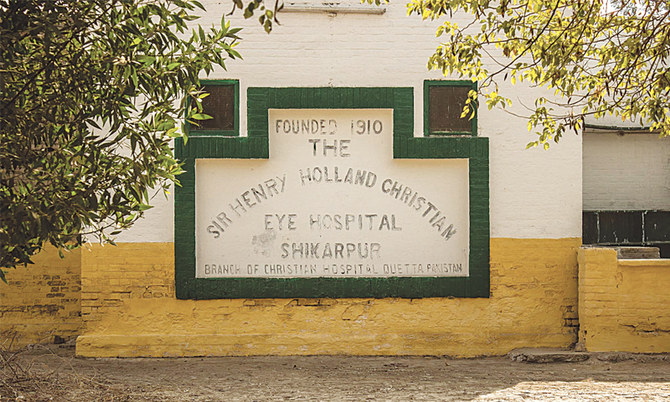
ISLAMABAD: Pakistan's fifty-plus Christian missionary hospitals have been providing healthcare services to the underprivileged at the lowest possible cost for over a century, but they are now finding it difficult to continue their services in the face of increasing inflation and number of patients.
The Christian Hospital Taxila, known across the country for affordable treatment, is one of the missionary medical facilities that receive more than 120,000 patients annually, resulting in a burden on its limited resources.
“All Christian hospitals including this one [in Taxila], their mission is to give quality care at the lowest possible cost,” Dr. Ashchenaz Lall, director at the medical facility, told Arab News this week in an interview. “And this puts a lot of financial constraints because we earn and spend, getting no help from outside.”
Covering more than 30 acres of area, the hospital is located at the center of the city – some 35 kilometers northwest of Islamabad. It was established in 1920 with the help of the Presbyterian Church of the United States, and its Anglo-Indian style colonial building provides a brief history of the area as well. It is a general hospital but is best known for its treatment of blindness.
“We have reasonable equipment but have the desire to continue improving it because that ultimately affects patients,” said Lall who is also chairman of Christian Hospitals Association of Pakistan (CHAP) that patronizes over 50 missionary hospitals across the country.
Lall said the missionary hospitals required different diagnostic and surgical equipment to take better care of patients, but the lack of resources was hampering the desire to expand their medical facilities to cater to the maximum number of people. The missionary hospitals are located in different cities of the country, including Peshawar, Abbottabad, Chitral, Lahore, Sahiwal, Quetta, and Karachi.
“Our mission is to help the people of Pakistan irrespective of their caste, color, creed, or race,” he said while checking patients in his small cubicle.
Different departments of the hospital including eye, urology and cardiac are packed with hundreds of patients, including women and children, and the hospital staff keeps sending them to relevant doctors with a smile on their faces.
“I have been to many hospitals before, but the doctors here have treated me well,” Azhar Mahmood, a patient who came to the medical facility from Khushab district in Pakistan’s Punjab province, told Arab News.
The patients who come from remote areas are admitted to relevant wards for free and are then operated and treated.
“We get genuine medicine here… we are poor people and come here for treatment,” Zeenat Bibi, 80, who is admitted in the hospital for cataract surgery, told Arab News. “We have complete trust in the doctors here.”
To cope with the shortage of different facilities, Lall said the administration was planning to start a nursing hospital from next year to meet the shortage of health workers. “We also want to start laparoscopic surgery and need equipment for that, improve other surgical procedures, and start a medical store 24/7 for the general public,” he said.
The world faces a shortfall of 18 million health workers to accelerate universal health coverage by 2030, particularly in low and lower-middle-income countries, according to a recent report by the World Health Organization.
The hospital administration looks toward local and foreign donors to start all these and other projects. “There have been donors in the past. They have helped this hospital also in providing equipment and other things, but for a very long time, there is no donation as such,” he said.
“Probably their [donors'] policies have changed, [or] the donation has exhausted,” he said.
With the arrival of Christmas, Lall appeals the donors to provide funds to the missionary hospitals in Pakistan, so that they continue to serve humanity.
“Christmas is a time to celebrate and it’s a thanksgiving occasion also,” he said. “Our hospitals will always welcome help in different shapes, in the form of equipment, other diagnostic facilities, and if they can help us financially, hospitals will welcome it.”


![]()

Pakistan's missionary hospitals look for donors to expand healthcare services
Short Url
https://arab.news/8nz68
Pakistan's missionary hospitals look for donors to expand healthcare services
- 50-plus missionary hospitals across the country face financial constraints to provide quality medical care
- The mission of these hospitals "is to give quality care at the lowest possible cost"
Latest updates


© 2026 SAUDI RESEARCH & PUBLISHING COMPANY, All Rights Reserved And subject to Terms of Use Agreement.