In UAE, affordable school brings new hope for Pakistani students

Omar Farooqui with the children at the opening of the academy. (Photo Credit: Hope Academy)
Short Url
Updated 15 December 2019
Follow

In UAE, affordable school brings new hope for Pakistani students

  • A 2017 HSBC study said the UAE had the second-highest school fees in the world
  • A majority of the children studying at Dubai’s ‘Hope Academy’ have never been to school

DUBAI: Hundreds of students with financial constraints, a majority of them Pakistanis, are waiting in line for enrollment in Dubai’s Hope Academy since it opened its doors just over a month ago.

Over 250 children-- from kindergarten level to the 8th grade-- are currently studying at the affordable, community-based school, in a country where school fees are otherwise considered the second highest in the world, according to a 2017 HSBC study.
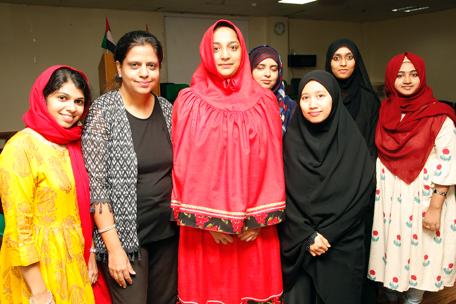


The teachers of Hope Academy. (Photo Credit: Hope Academy)

“These are children of those people living in the UAE who cannot afford to send their children to regular schools,” Omar Farooqui, President of Coded Minds, told Arab News, and added: “It is as if a ghost population has come to the fore.”

Coded Minds is a Dubai-based global iSTEAM and leadership education company and has founded Hope Academy.

“Hope Academy is a movement,” Farooqui continued. “It was an idea that came from behind a table where we discussed how we could bring quality STEM education to the masses.”

“We are expanding to other emirates including Abu Dhabi and Ajman to accommodate 500 other children by January,” he said.

Statistics gathered by the academy show that 29.94 percent of the children seeking admission belongs to Pakistan, followed by 11.65 percent Syrians and Indians-- from a total of 45 different nationalities.

“These are the children of people who have not regularized their status in the UAE or cannot afford school fees, widowers, single parents and many others with unfortunate circumstances,” Farooqui said.

“But we didn’t realize that there was this huge number,” he added.

He said that there were families with multiple children who had never been to school.

The academy charges $286 per year and teaches core subjects -Science, Technology, English and Maths. 

The academy will also be partnering with the United Nations High Commissioner for Refugees (UNHCR) in the future and offer its services to the children of 8,000 refugee families in the country, Farooqui said.
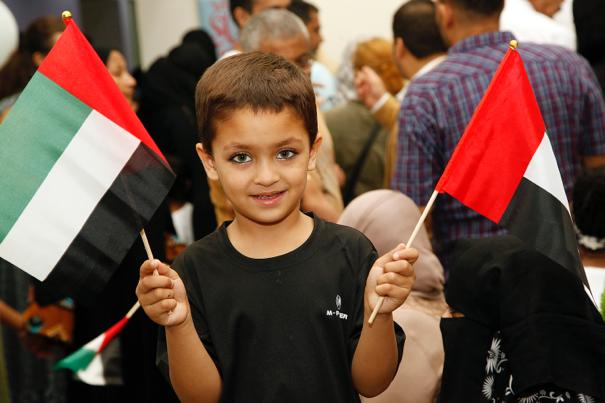


Mohammed Rayyan on his first day at school. (Photo Credit: Hope Academy)

Teachers are hired full-time, with a whopping 70 percent of them, women. Since many of the children have never been to regular schools, the academy carries out an assessment of their educational readiness and adjusts them in classes accordingly.

For Ishaq Ahmed who is from Swabi in northwest Pakistan, the opportunity is a Godsend. Ironically, Ahmed is a school driver but he cannot afford to send his five-year-old son to the school where he works.

“I am so happy I got to know about this academy and now my son is a part of it,” Ahmed said.

This is the first time his son has been to school.

“Whenever I get the time in between work, I go and check on my child. My heart fills with pride on seeing him sit in class and learn,” he said.

Earlier this year, the Pakistan Association Dubai (PAD) became the first welfare association in the UAE to join hands with Hope Academy, followed by the Pakistan Social Centre Sharjah.

Rizwan Fancy, Director for Welfare at PAD said: “There are a large number of Pakistani children in the UAE who cannot continue their education because of financial problems. Such initiatives will help lots of families who are desperate for an opportunity to send their children back to the classroom.”


Pakistan opposition to continue protest over ex-PM Khan’s health amid conflicting reports

Updated 16 February 2026
Follow

Pakistan opposition to continue protest over ex-PM Khan’s health amid conflicting reports

  • Pakistan’s government insists that the ex-premier’s eye condition has improved
  • Khan’s personal doctor says briefed on his condition but cannot confirm veracity

ISLAMABAD: Pakistan’s opposition alliance on Monday vowed to continue their protest sit-in at parliament and demanded “clarity” over the health of jailed former prime minister Imran Khan, following conflicting medical reports about his eye condition.

The 73-year-old former cricket star-turned-politician has been held at the high-security Adiala prison in Rawalpindi since 2023. Concerns arose about his health last week when a court-appointed lawyer, Barrister Salman Safdar, was asked to visit Khan at the jail to assess his living conditions. Safdar reported that Khan had suffered “severe vision loss” in his right eye due to central retinal vein occlusion (CRVO), leaving him with just 15 percent sight in the affected eye.

On Sunday, a team of doctors from various hospitals visited the prison to examine Khan’s eye condition, according to the Adiala jail superintendent, who later submitted his report in the court. On Monday, a Supreme Court bench led by Chief Justice Yahya Afridi observed that based on reports from the prison authorities and the amicus curiae, Khan’s “living conditions in jail do not presently exhibit any perverse aspects.” It noted that Khan had “generally expressed satisfaction with the prevailing conditions of his confinement” and had not sought facilities beyond the existing level of care.

Having carefully perused both reports in detail, the bench observed that their general contents and the overall picture emerging therefrom are largely consistent. The opposition alliance, which continued to stage its sit-in for a fourth consecutive day on Monday, held a meeting at the parliament building on Monday evening to deliberate on the emerging situation and discuss their future course of action.

“The sit-in will continue till there is clarity on the matter of [Khan's] health,”  Sher Ali Arbab, a lawmaker from Khan's Pakistan Tehreek-e-Insaf (PTI) party who has been participating in the sit-in, told Arab News, adding that PTI Chairman Gohar Ali Khan and Opposition Leader in Senate Raja Nasir Abbas had briefed them about their meeting with doctors who had visited Khan on Sunday.

Speaking to reporters outside parliament, Gohar said the doctors had informed them that Khan’s condition had improved.

“They said, 'There has been a significant and satisfactory improvement.' With that satisfactory improvement, we also felt satisfied,” he said, noting that the macular thickness in Khan’s eye had reportedly dropped from 550 to 300 microns, a sign of subsiding swelling.

Gohar said the party did not want to politicize Khan’s health.

“We are not doctors, nor is this our field,” he said, noting that Khan’s personal physician in Lahore, Dr. Aasim Yusuf, and his eye specialist Dr. Khurram Mirza had also sought input from the Islamabad-based medical team.

“Our doctors also expressed satisfaction over the report.”

CONFLICTING ACCOUNTS

Despite Gohar’s cautious optimism, Khan’s personal physician, Dr. Yusuf, issued a video message on Monday, saying he could neither “confirm nor deny the veracity” of the government’s claims.

“Because I have not seen him myself and have not been able to participate in his care... I’m unable to confirm what we have been told,” Yusuf said.

He appealed to authorities to grant him or fellow physician, Dr. Faisal Sultan, immediate access to Khan, arguing that the ex-premier should be moved to Shifa International Hospital in Islamabad for specialist care.

Speaking to Arab News, PTI’s central information secretary Sheikh Waqas Akram said Khan’s sister and their cousin, Dr. Nausherwan Burki, will speak to media on Tuesday to express their views about the situation.

The government insists that Khan’s condition has improved.

“His eye [condition] has improved and is better than before,” State Minister Talal Chaudhry told the media in a brief interaction on Monday.

“The Supreme Court of Pakistan is involved, and doctors are involved. What medicine he receives, whether he needs to be hospitalized or sent home, these decisions are made by doctors. Neither lawyers nor any political party will decide this.”