

Japan to issue 2.2tn yen bonds to offset trade war’s hit on tax revenues

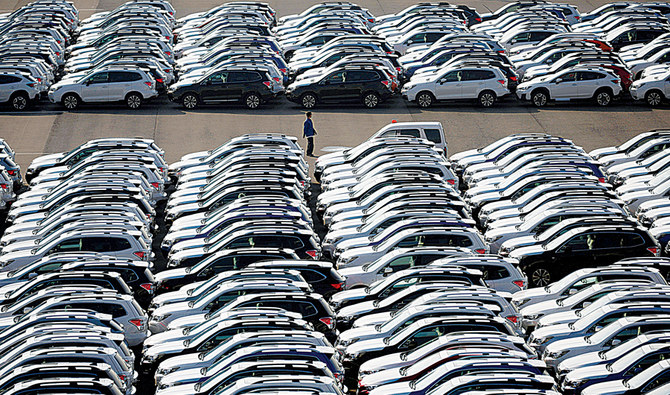
Finance ministry officials said Tokyo will cut the tax income estimate for the current fiscal year due to a slump in exports amid the US-Sino trade war. (Reuters)
Short Url
Updated 14 December 2019
Follow

Japan to issue 2.2tn yen bonds to offset trade war’s hit on tax revenues

  • Cabinet OKs budget with 4.5 trillion yen in additional outlay

TOKYO: Japan’s government will issue an additional 2.2 trillion yen ($20.25 billion) of deficit-financing bonds to make up for a tax revenue shortfall, Finance Minister Taro Aso said, after the cabinet approved on Friday an extra budget for the fiscal year ending March 2020.

The extra budget will be compiled along with an annual budget for the year starting in April 2020 and sent to parliament for approval early next year.

It is the first time that the government has resorted to issuing extra deficit financing bonds since 2016, and shows how Prime Minister Shinzo Abe is struggling to balance the budget, a target he has already pushed back by five years to March 2026.

The government’s difficulties raising revenue and trimming debt issuance will further cloud the outlook for the “Abenomics” stimulus policy mix of bold monetary easing, flexible spending and structural reform.

Finance ministry officials said the government will slash the tax income estimate for the current fiscal year by 2.3 trillion yen from its initial target of 62.5 trillion yen as a slump in exports amid the Sino-US trade war has hit revenues.

Aside from the 2.2 trillion yen of additional deficit-covering bonds, the government will also issue additional construction bonds worth about 2.2 trillion yen to finance infrastructure spending.

The extra budget features additional fiscal spending worth about 4.5 trillion yen, the bulk of which will be spent, along with next fiscal year’s annual budget, to fund the stimulus spending of 13.2 trillion yen the cabinet adopted last week, the officials said.

The spending package was aimed at funding disaster recovery, countering downside economic risks and sustaining a fragile economy beyond the 2020 Tokyo Olympics.

In addition, the government will tap some additional 1.5 trillion yen from its fiscal investment and loan program, taking advantage of low borrowing costs under the Bank of Japan’s negative interest rate policy.

The amount of extra budget spending was much smaller than the 10 trillion yen that was first floated by ruling party lawmakers last month, highlighting limited fiscal space left for policymakers.


Closing Bell: Saudi stocks slip as Tadawul falls 1% amid broad market weakness

Updated 30 December 2025
Follow

Closing Bell: Saudi stocks slip as Tadawul falls 1% amid broad market weakness

RIYADH: Saudi stocks fell sharply on Tuesday, with the Tadawul All Share Index closing down 108.14 points, or 1.03 percent, at 10,381.51.

The broader decline was reflected across major indices. The MSCI Tadawul 30 Index slipped 0.78 percent to 1,378.00, while Nomu, the parallel market index, fell 1 percent to 23,040.79.

Market breadth was strongly negative on the main board, with 237 stocks falling compared to just 24 gainers. Trading activity remained robust, with 164.7 million shares changing hands and a total traded value of SR3.19 billion ($850.6 million).

Among the gainers, SEDCO Capital REIT Fund led, rising 2.73 percent to SR6.77, followed by Chubb Arabia Cooperative Insurance Co., which gained 2.69 percent to SR20.20.

National Medical Care Co. added 1.72 percent to close at SR141.60, while Alyamamah Steel Industries Co. and Thimar Advertising, Public Relations and Marketing Co. advanced 1.57 percent and 1.13 percent, respectively.

Losses were led by Al Masar Al Shamil Education Co., which tumbled 8.36 percent to SR24.65. Raoom Trading Co.fell 6.75 percent to SR64.20, while Alkhaleej Training and Education Co. dropped 6.60 percent to SR18.12 and Naqi Water Co. declined 5.51 percent to SR54.00. Gulf General Cooperative Insurance Co. closed 5.44 percent lower at SR3.65.

On the announcement front, Chubb Arabia Cooperative Insurance Co. signed a multiyear insurance agreement with Saudi Electricity Co. to provide various coverages, expected to positively impact its financial results over the 2025–2026 period. The deal will run for three years and two months and is within the company’s normal course of business.

Meanwhile, Bupa Arabia for Cooperative Insurance Co. announced a one-year health insurance contract with Saudi National Bank, valued at SR330.2 million, covering the bank’s employees and their families from January 2026. Despite the sizable contract, Bupa Arabia shares fell 0.8 percent to close at SR137, weighed down by the broader market weakness.

In contrast, United Cooperative Assurance Co. revealed an extension of its engineering insurance agreement with Saudi Binladin Group for the Grand Mosque expansion in Makkah. The contract value exceeds 20 percent of the company’s gross written premiums based on its latest audited financials and is expected to support results through 2026. However, the stock came under selling pressure, ending the session down 4.51 percent at SR3.39.