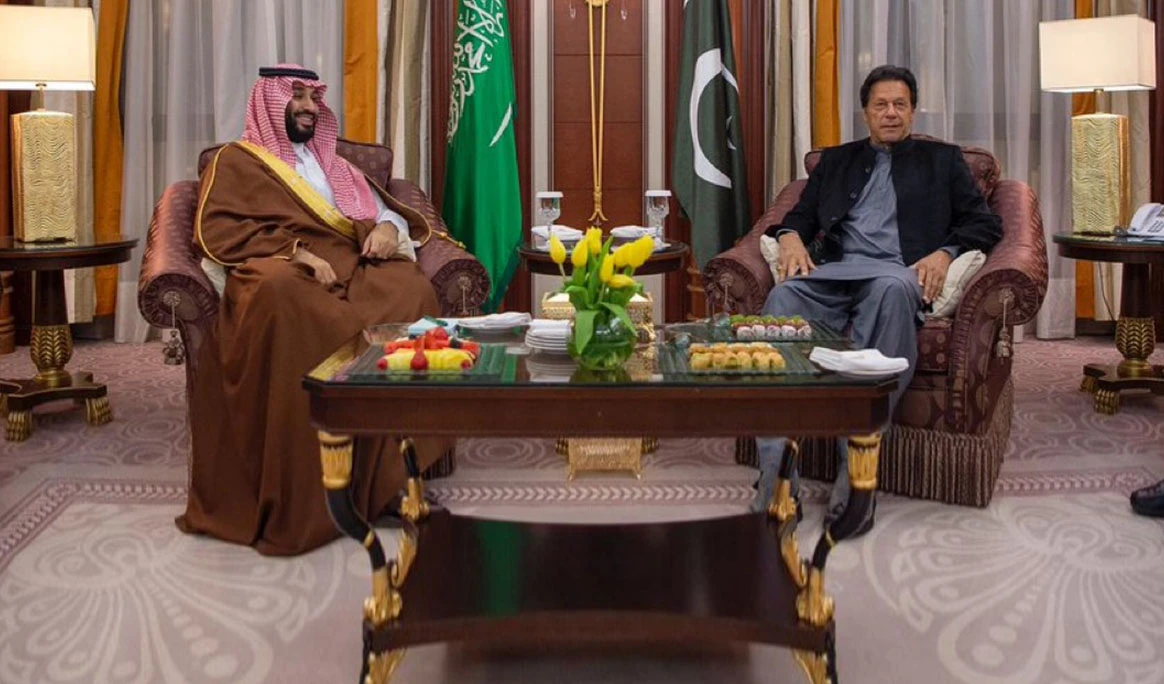
PM Khan meets Crown Prince Mohammed bin Salman in Riyadh

1 / 3
Pakistani Prime Minister Imran Khan, right, meets Saudi Crown Prince Mohammed bin Salman in Riyadh on Dec. 14, 2019. (Supplied)
2 / 3
Pakistani Prime Minister Imran Khan prays at Prophet's Mosque in Madinah during his daylong visit to Saudi Arabia, on Dec. 14, 2019. (Supplied)
3 / 3
Prime Minister Imran Khan arrives in Saudi Arabia on a daylong visit on Dec 14, 2019. On his arrival in Madinah, he was received by Saudi officials and Pakistani diplomats in the Kingdom. (Photo Courtesy of PM Office)
Short Url
Updated 15 December 2019
Follow

PM Khan meets Crown Prince Mohammed bin Salman in Riyadh

  • This is Khan’s fourth visit to the Kingdom since May this year
  • Presently, Pakistan’s army chief is on an official visit to Abu Dhabi — ISPR

ISLAMABAD: Prime Minister Imran Khan met with Saudi Arabia’s Crown Prince Mohammed bin Salman during his day-long visit to Riyadh on Saturday to discuss bilateral matters, the Associated Press of Pakistan reported. 
Earlier, accompanied by Foreign Secretary Sohail Mahmood, Khan arrived in Madinah and prayed at the Prophet’s mosque, according to the Saudi Press Agency (SPA). Khan sent his salutations upon the Prophet Muhammad (peace be upon him), before traveling onwards to Riyadh to meet with the Kingdom’s top leadership.
In February this year, Crown Prince Muhammad Bin Salman visited Pakistan for the first time in a much-celebrated tour, with Prime Minister Khan personally receiving and driving him from the airport after his arrival.
Khan is undertaking a daylong visit to Saudi Arabia to discuss regional and bilateral issues, the Ministry of Foreign Affairs said on Saturday.
In an earlier handout issued on Friday, the ministry said the visit was “part of the regular exchanges between the leadership of Pakistan and the Kingdom of Saudi Arabia.”
“The consultations will cover bilateral matters and recent developments in the regional context,” the statement added.
In October, Khan visited Tehran before heading to Riyadh to focus on “peace and security in the region.” He also reiterated his offer to mediate during his visit to the 74th United Nations General Assembly summit this September, to ease the regional situation in the Middle East.
Meanwhile, Pakistan’s army chief Gen. Qamar Javed Bajwa is visiting Abu Dhabi, the military’s spokesperson Maj. Gen. Asif Ghafoor said in a Twitter post on Saturday.
The army chief met with Abu Dhabi’s Crown Prince Sheikh Mohammed bin Zayed bin Sultan Al-Nahyan, who is the Deputy Supreme Commander of the UAE Armed Forces, the tweet said and added that regional security and matters of mutual interest were discussed.
Khan’s trip follows Foreign Minister Shah Mahmood Qureshi’s visit earlier this week to Riyadh where Qureshi held a meeting with his Saudi counterpart, Prince Farhan bin Abdullah, to review bilateral relations between the two countries and discuss the latest regional and international developments.
On Friday, during the weekly press briefing, foreign office spokesman, Dr. Mohammad Faisal, said in response to questions about Prime Minister Imran Khan’s upcoming visit to Saudi Arabia:
“You have witnessed the high frequency of leadership level exchanges especially since last August. The Prime Minister has undertaken at least three visits to the Kingdom of Saudi Arabia since May this year.”
“High-level political exchanges between the two countries are the hallmark of this brotherly relationship. Pakistan and Saudi Arabia have brotherly relationship rooted in history and based on mutual trust and understanding,” the foreign office spokesman said.
Senior Daesh spokesperson in Pakistan’s custody— state media

Updated 5 sec ago
Follow

Senior Daesh spokesperson in Pakistan’s custody— state media

  • Sultan Aziz Azzam, a senior member of Daesh regional affiliate ISKP, has been listed as “Specially Designated Global Terrorist” by Washington
  • Azzam, who oversaw banned outfit’s media operations, was arrested in May while attempting to cross into Pakistan from Afghanistan, says state media

ISLAMABAD: Pakistani authorities have taken into custody Sultan Aziz Azzam, a senior member of Daesh who used to oversee the banned outfit’s media operations and headed its “Al Azzam” outlet, state media reported on Thursday. 

The state-run Pakistan TV Digital reported that Azzam was a senior member of Daesh regional affiliate ISKP, who hails from Afghanistan’s Nangarhar province and is a graduate of the University of Nangarhar where he studied Islamic jurisprudence. 

The state media said he joined ISKP in 2016 and later became a prominent member of its leadership council.

“He was arrested in May 2025 while attempting to cross from Afghanistan into Pakistan,” Pakistan TV Digital reported, citing intelligence sources. 

In November 2021, Washington listed Azzam as a “Specially Designated Global Terrorist” (SDGT). The move bars American citizens from engaging in transactions with persons designated as SDGTs. 

According to a report on the UN Security Council’s website, Azzam has played an “instrumental role” in spreading Daesh’s violent ideology, glorifying and justifying “terrorist acts.” 

“Building on his former experience as an Afghan journalist, his activity as ISIL-K’s spokesperson has increased ISIL-K’s visibility and influence among its followers,” the report states. 

The report further states Azzam claimed responsibility on behalf of Daesh for the suicide attack near Hamid Karzai International Airport on Aug. 26, 2021, which killed at least 170 Afghans and 13 US service members and injured 150 more. 

The development takes place amid tense relations between Pakistan and Afghanistan, with Islamabad alleging militants use Afghan soil to carry out attacks against Pakistan. Kabul denies the allegations. 

Tensions surged in October when Pakistan and Afghanistan engaged in fierce border clashes, claiming to have killed dozens of soldiers of the other side. 

Pakistan has urged the Afghan Taliban-led government to take “decisive action” against militants it says operate from its soil. Afghanistan says it cannot be held responsible for Pakistan’s security challenges.