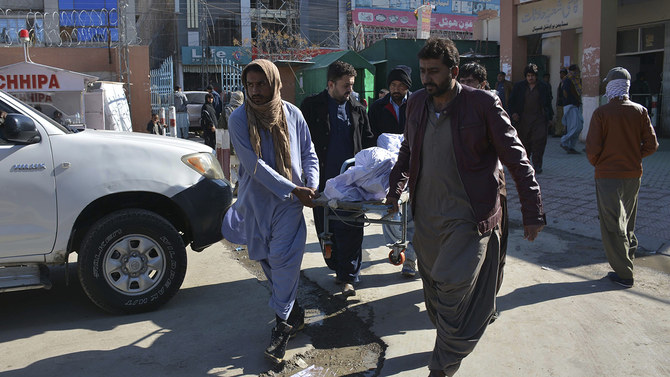
KARACHI: At least 15 people were killed when a truck carrying Iranian oil collided with a passenger bus in southwestern Pakistan, officials said on Friday.
“Fifteen bodies were brought to the hospital,” Dr. Waseem Baig, spokesman of a civil hospital in Quetta, Balochistan, told Arab News. The bodies were charred beyond recognition and “DNA tests will be conducted to identify the deceased,” he said.
Deputy Commissioner of Killa Saifullah district, Atiq Shahwani, said the bus with 12 passengers from Dera Ghazi Khan in Punjab collided with the truck near Muslim Bagh area. “The vehicles caught fire and 13 people died,” Shahwani told Arab News, adding the bus owner said that fourteen people, including a driver and a conductor, were on board when the accident happened. “One man has survived,” he said.
When told that the hospital said 15 bodies had been brought to its morgue, Shahwani said the two others might be the truck’s driver and his passenger.
“Four vehicles smuggling Iranian fuel, taking advantage of heavy snowfall, wanted to pass by a levies checkpoint last night when security forces spotted them. Three big vehicles were caught but the small pick-up truck managed to escape and collided with the bus in the morning,” Shahwani said, adding the authorities had zero tolerance for smuggling and had caught 15,000 liters of smuggled Iranian diesel and oil just a few days ago. “There is a continuous crackdown,” he said.
Meanwhile, Gul Muhammad, the only survivor of the accident, told reporters he was asleep when the accident took place and immediately jumped out of the bus when he saw flames. He identified one passenger his nephew Ataullah, a resident of Chaman in Balochistan. The driver was identified as Abdullah, whose son Arif also died in the accident.
Home Minister Ziaullah Langove has expressed his displeasure over the incident and asked the authorities to identify those responsible for the lapse.
“Why has the smuggling not been stopped despite the strict ban?” he said.
Deaths due to oil smuggling are frequent in Balochistan. At least 27 people were killed in January in a similar accident.
In October, a pick-up carrying Iranian fuel collided with a vehicle of the Commissioner of Makran Division, retired Cpt. Tariq Zehri, killing the senior bureaucrat and prompting authorities to start the crackdown on the smugglers.
“Following the tragic accident of the Commissioner Makran Division, who was a lovely human being, all commissioners and deputy commissioners have been instructed in writing to check all motorcycles, jeeps, cars, pickups, buses and trucks, laden with POL containers,” Balochistan Chief Secretary Cpt. Fazeel Asghar tweeted after the accident.
Customs authorities and the Frontier Corps have also been requested to prevent the smuggling of petroleum, oil and lubricant (POL) products into Pakistan, he said.


![]()

Balochistan: 15 killed as bus rams into vehicle smuggling Iranian oil
Short Url
https://arab.news/nwc2y
Balochistan: 15 killed as bus rams into vehicle smuggling Iranian oil
- Truck smuggling Iranian oil managed to evade customs check
- Bodies of victims were charred beyond recognition
Latest updates



© 2026 SAUDI RESEARCH & PUBLISHING COMPANY, All Rights Reserved And subject to Terms of Use Agreement.