JERUSALEM: Israel’s parliament was rushing through a bill Wednesday to call a third general election in a year, prolonging a political crisis and fueling deep dissatisfaction with politicians.
A deal to avert a new vote must be reached before 11:59 p.m. (2159 GMT), but talks between rightwing premier Benjamin Netanyahu and his centrist rival Benny Gantz broke down.
They had been discussing a unity government but have spent recent days trading blame for the lack of progress.
The Knesset on Wednesday morning passed a preliminary reading of a bill to dissolve itself, setting a new election for March 2.
It must be voted on three times before midnight or the election will automatically be triggered for March 10.
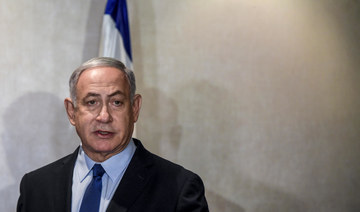
A new election would be another challenge for Netanyahu — Israel’s longest serving premier, now governing in a caretaker capacity — at a time when he must fend off a leadership challenge in his Likud party.
But it may also be seen as a victory for the incumbent, who faced the risk of major defections from his rightwing bloc when he was indicted on corruption charges last month.
Netanyahu and Gantz, a former armed forces chief who heads the centrist Blue and White party, had been discussing a potential unity government, but disagreed on who should lead it.
Following the corruption charges, Gantz called on Netanyahu to step down and encouraged defections among his allies, but they largely stood by the 70-year-old.
Gantz has demanded Netanyahu publicly declare he would not seek parliamentary immunity from prosecution as a precondition to further talks.
“It now seems that we will be going into a third election cycle today because of Netanyahu’s attempt to obtain immunity,” Gantz told lawmakers on Wednesday. “We must stand in opposition to this.”
On Tuesday night, Netanyahu called on Gantz to stop “spinning.”
“After 80 days, it’s time that for one day, for the citizens of Israel, we sit and have a serious discussion about forming a broad unity government. It’s not too late,” he said on social media.
If the bill passes, it would be the first time Israel’s weary electorate has been asked to go to the polls three times within 12 months.
The three elections could cost the economy 12 billion shekels ($3.4 billion, 3.1 billion euros) in total, the Manufacturers Association of Israel estimated.
The parties of Netanyahu and Gantz were nearly deadlocked but each fell well short of a majority in September’s election, following a similarly inconclusive poll in April.
Both were then given 28-day periods to try to forge a workable coalition but failed, forcing President Reuven Rivlin to turn to parliament with his deadline for Wednesday.
Both parties had been trying to convince Avigdor Lieberman, a crucial kingmaker, to join their blocs.
But the secular nationalist, whose Yisrael Beitenu party holds the balance of power, refused.
Lieberman on Wednesday accused both parties of putting their interests over those of the country.
“I can’t accept that the country’s agenda is dictated by one man’s personal (legal) issues,” he said of Netanyahu, before accusing Gantz’s party of “acting disgracefully and cheating their voters.”
A poll published by Israel’s Channel 13 found that 41 percent of people thought Netanyahu was to blame for the third elections, 26 percent Lieberman, 5 percent Gantz and 26 held all of them equally responsible.
Netanyahu was indicted last month for bribery, breach of trust and fraud relating to three separate corruption cases.
He denies the allegations and accuses the media, police and prosecution of a witch-hunt.
No date has yet been set for the beginning of the proceedings and, under Israeli law, Netanyahu can remain in office despite the indictment.
He also faces a challenge from within his Likud party, which tentatively decided on Wednesday to have leadership primaries on December 26.
His only confirmed rival, Gideon Saar, hailed the idea, saying there was a need for “a breakthrough that will end the ongoing political crisis.”
With his eye on the campaign trail, Netanyahu lately pushed his plan to annex a strategic part of the occupied West Bank, as well as to sign a defense treaty with the United States.
He is a close ally of US President Donald Trump, who has taken a number of controversial steps in support of his rightwing agenda.
Despite Netanyahu’s indictment, polls suggest a third round of elections could still be neck and neck — prompting some Israelis to speculate about yet another electoral stalemate.


![]()

Israel heads to third election as midnight deadline looms

Short Url
https://arab.news/nduxh
Israel heads to third election as midnight deadline looms
- Netanyahu called on Gantz to stop “spinning.”
- The Knesset on Wednesday morning passed a preliminary reading of a bill to dissolve itself, setting a new election for March 2.

Latest updates


© 2026 SAUDI RESEARCH & PUBLISHING COMPANY, All Rights Reserved And subject to Terms of Use Agreement.