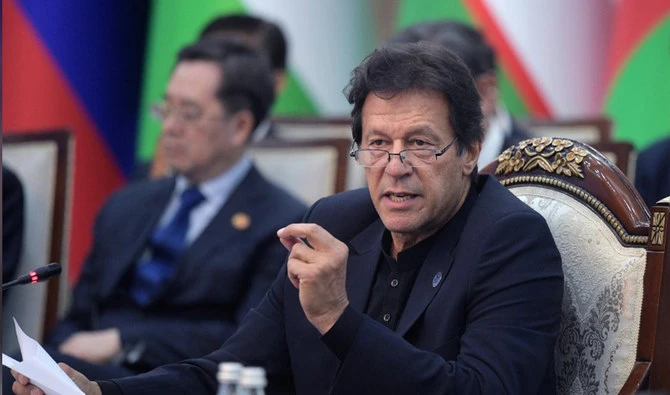
ISLAMABAD: Pakistan’s Prime Minister Imran Khan on Tuesday strongly condemned the decision taken by India’s Parliament to pass the controversial Citizenship Amendment Bill (CAB), which grants citizenship to all religious minorities from neighboring countries, except Muslims.
“It violates all norms of int [international] human rights law & bilateral agreements with Pak. It is part of the RSS Hindu Rashtra design of expansionism propagated by the fascist Modi Govt,” he tweeted.
On Monday, Indian Lok Sabha — the lower House of Parliament — took up the hearing for the CAB, with Pakistan’s Foreign Office criticizing the move later in the day.
“It is a complete violation of the Universal Declaration of Human Rights and other international Covenants on elimination of all forms of discrimination based on religion or belief,” a statement released by the FO said, adding that the legislation is also “in complete contravention of various bilateral agreements between Pakistan and India, particularly the one concerning the security and rights of minorities.”
The FO termed the legislation as another major step toward the realization of the concept of “Hindu Rashtra idealized and relentlessly pursued by the right-wing Hindu leaders for several decades.”
“We condemn the legislation as regressive and discriminatory, which is in violation of all relevant international conventions and norms, and a glaring attempt by India to interfere in the neighboring countries with malafide intent,” the statement read.
The CAB seeks to amend the country’s Citizenship Act 1955, aimed at granting citizenship to persecuted minorities such as Hindus, Buddhists, Jains, Christians and Parsis from Bangladesh, Afghanistan and Pakistan, but excludes Muslims.
Pakistan slams India’s controversial citizenship bill
https://arab.news/neuh9
Pakistan slams India’s controversial citizenship bill
- PM Khan says the legislation violates all norms of international human rights law
- Passed by the Indian lower house on Monday, the bill seeks to grant nationality to all minorities, except Muslims
Pakistan, Indonesia sign MoUs to expand cooperation as Islamabad seeks to ease trade imbalance
- Pakistan offers to send doctors and medical experts to support Indonesia’s expanding health needs
- Indonesian president highlights close foreign policy coordination with Pakistan, including on Gaza
ISLAMABAD: Pakistan and Indonesia signed seven memoranda of understanding on Tuesday to deepen cooperation in trade, education and health, with Prime Minister Shehbaz Sharif saying Islamabad aimed to narrow a $4.5 billion bilateral trade imbalance heavily tilted in Jakarta’s favor.
The agreements were concluded during Indonesian President Prabowo Subianto’s two-day visit to Pakistan, his first trip to the country since taking office and the first by an Indonesian head of state in seven years.
Subianto, who arrived on Monday, held detailed talks with Sharif before the signing ceremony.
“Our discussion has been extremely productive,” Sharif said at a joint media appearance. “More than 90 percent of our current imports from Indonesia are palm oil. We have discussed how to take corrective measures to balance this through Pakistan’s agri-exports, IT-led initiatives and other areas.”
Sharif earlier noted Pakistan’s bilateral trade with Indonesia stood at around $4.5 billion, with the imbalance overwhelmingly in Jakarta’s favor.
Subianto thanked Pakistan for what he called an exceptionally warm welcome, noting his aircraft had been escorted by Pakistan Air Force JF-17 fighter jets.
He said the meeting had produced agreements across several fields, including trade, agriculture, education and science and technology.
The Indonesian president also welcomed Pakistan’s offer to help his country address critical shortages of medical professionals.
“Indonesia has vast needs for doctors, dentists and medical experts, and Pakistan’s support in this regard is strategic and critical,” he said.
Sharif noted Pakistan would be ready to send doctors, dentists and medical professors to assist Indonesia’s plans to expand its medical colleges and universities.
He added that Islamabad would “work closely and diligently” with Jakarta to achieve the targets set during the visit.
Subianto said both countries were also coordinating closely on foreign policy, particularly on developments in Gaza, and reaffirmed Indonesia’s support for a two-state solution.
He invited Sharif to visit Jakarta to deepen cooperation under the new agreements.
Pakistan and Indonesia marked the 75th anniversary of diplomatic ties this year, with both leaders saying the visit would help lift relations to what Sharif called “a much higher level” in trade, development and people-to-people links.