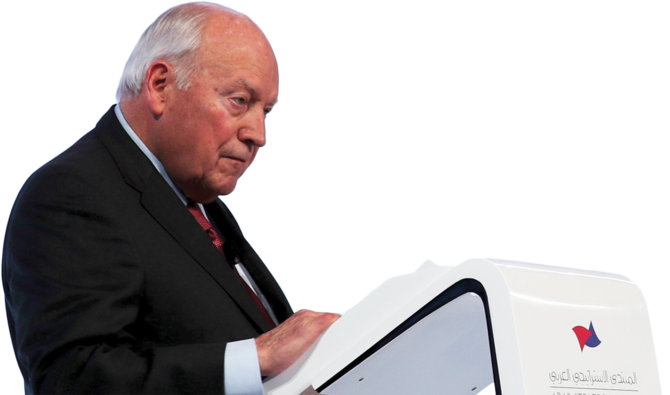

DUBAI: Dick Cheney, one of the most influential vice presidents in US history, has warned that “American disengagement” from the Middle East would only benefit Iran and Russia.
The 78-year-old politician’s warning came during a speech at the Arab Strategy Forum (ASF) in Dubai, an annual event in which the world’s leading decision-makers address global challenges and opportunities in “a precise, balanced and politically scientific manner.”
Cheney’s remarks could be seen as indirect criticism of US President Donald Trump’s pledges to pull forces out of northern Syria.
Addressing conference delegates, he cited the withdrawal of US troops from Syria and the 2015 lifting of sanctions against Iran during Barack Obama’s presidency, as events that amplified instability in the region.
“Our allies were left abandoned, and no one wants to feel that way again,” said Cheney, who was chief executive of Halliburton between 1995 and 2000 and held high posts in several Republican administrations.
The former VP’s remarks came during the forum’s concluding session titled, “The global order 2030: The Unites States and China,” which was attended by Dubai’s ruler Sheikh Mohammed bin Rashid Al-Maktoum.
Joined by Li Zhaoxing, a former Chinese foreign minister, in a candid panel discussion, Cheney offered his views on the world order in the next decade within the context of Iran’s regional ascendancy, China’s rise and Russian ambitions in the Middle East.
“I am not here to speak on behalf of the US government, or to speak to it,” Cheney said, adding that his talking points reflected concerns he suspected everyone shared.
“For decades, there’s been a consensus of America’s influence in the world and how to use it,” he said, citing instances where US disengagement had caused the political situation in the Middle East to implode.
“Humanity has benefited from America’s protectionism of the world and its relationship with its allies in the region.”
According to him, the upcoming decade would be bleak should the US adopt a disengagement policy, with the pressures most felt by supporters and partners in the Middle East.
Turning to the role that the US and China would play in the global status quo by 2030, Cheney said there were still concerns over China’s reputation.
“We had hoped that there would be a political evolution in China, but that hasn’t happened yet,” he added.
Li said: “China will never learn from a world superpower and will never try to be hegemonic,” citing as examples China’s strong relations with the UAE and the wider Arab world, and the impact of the Belt and Road Initiative (a global development strategy) on Chinese foreign policy.
“History is the best teacher, but the US has forgotten its own history. You don’t keep your promises,” added Li, directing his statement at Cheney.
Cheney said that since the end of the Cold War, the US had expected that its policy toward China would have had a beneficial effect on its behavior and helped to deepen bilateral relations.
“It was disappointing to see that these expectations were not borne out – China has only grown richer, the regime has become more oppressive, and instead of evolving, it became more assertive,” he said.
In a separate ASF meeting at the Ritz-Carlton, Dubai International Financial Center, Karim Sadjadpour, senior fellow at the Carnegie Endowment for International Peace think tank, discussed Iran’s policies in a session titled, “The race for relevance and influence in the region: GCC, Iran, Turkey and Russia.”
Sadjadpour said he expected in the next 10 years to see the arrival of “an Iranian Putin” with a military background as the country’s next leader.
“After 40 years of a clerical regime and a military autocracy, there is now a rise of Persian nationalism. This is a shift from the sheer revolution ideology,” he said.
Sadjadpour said there had been an evolution of “Shiite Arab” identity during the past two decades, with the focus more on religion than nationality.
Under the circumstances, he noted that Sunni Arab powers had an important role to play in welcoming Shiite Arabs into their fold “and luring them away from Iran.”
The analyst added that the future of the Arab world could not be explored and forecast without considering a growing mental health crisis. “Today, hundreds of millions of people in the region suffer from PTSD (post-traumatic stress disorder), and the effects of this will be with us for decades to come, resulting in issues like radicalism.”
He said there was a need for training thousands of counselors in the field of mental health in order to reach out to those whose lives had been robbed by extreme violence and conflicts.