
BEIRUT: A year after the guns fell largely silent along Lebanon’s southern frontier, the war is still killing — quietly, indiscriminately, and often unseen.
When the ceasefire between Israel and Hezbollah came into effect on Nov. 27, 2024, the country woke to a long-awaited calm. But the end of the bombardment did not mean the end of danger.
Daily Israeli violations persisted, and across the south, the Bekaa Valley and Beirut’s southern suburbs, a far more enduring threat lay buried beneath rubble, fields and roads: landmines and unexploded ordnance.
The scale of the bombardment Lebanon endured left behind a lethal mix of shell fragments, fuse remnants and unexploded artillery shells.
Much of this ammunition has become highly sensitive, capable of detonating with vibration or movement. For communities trying to return to normal life, it has turned routine activities — farming, construction, even clearing weeds — into potentially fatal acts.

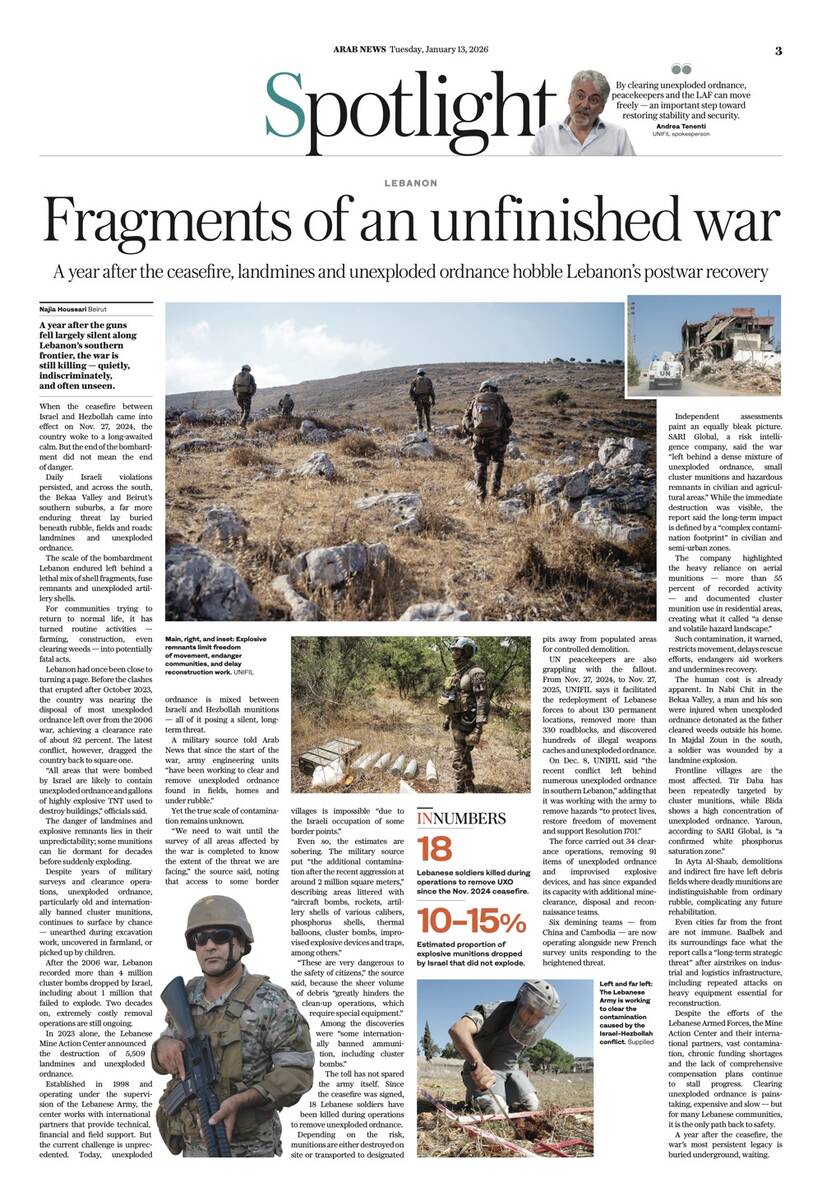
Explosive remnants limit freedom of movement, endanger communities, and delay reconstruction work. (UNIFIL)
Lebanon had once been close to turning a page. Before the clashes that erupted after October 2023, the country was nearing the disposal of most unexploded ordnance left over from the 2006 war, achieving a clearance rate of about 92 percent.
The latest conflict, however, dragged the country back to square one.
“All areas that were bombed by Israel are likely to contain unexploded ordnance and gallons of highly explosive TNT used to destroy buildings,” officials said.
Following the Oct. 7, 2023 Hamas-led attacks on southern Israel that triggered the Gaza war, Hezbollah initiated limited operations against Israel’s north in solidarity with the Palestinian militant groups responsible for the assault.
Israel retaliated against Hezbollah’s attacks with escalating strikes, which included the use of incendiary weapons such as white phosphorus.

Much of the ammunition has become highly sensitive, capable of detonating with vibration or movement, and requires expert disposal. (Lebanese Mine Action Center)
Besides the significant degradation of Hezbollah, the primary consequence of the grinding conflict, which ended with a fragile ceasefire in November 2024, was the mass displacement of communities and the devastation of civilian infrastructure across southern Lebanon.
Neither party has yet fulfilled its obligations under the US and French-brokered ceasefire deal, with Hezbollah failing to disarm and fully withdraw its fighters north of the Litani River and Israeli troops continuing to occupy five strategic hilltops on Lebanese territory.
The danger of landmines and explosive remnants lies in their unpredictability: some munitions can lie dormant for decades before suddenly exploding. It is a familiar tragedy in a country shaped by repeated wars.
Despite years of military surveys and clearance operations, unexploded ordnance, particularly old and internationally banned cluster munitions, continues to surface by chance — unearthed during excavation work, uncovered in farmland, or, in the worst cases, picked up by children.

A session for schoolchildren as part of an awareness campaign about the dangers of unexploded ordnance. (Supplied)
After the 2006 war, Lebanon recorded more than four million cluster bombs dropped by Israel, including about one million that failed to explode. Two decades on, extremely costly removal operations are still ongoing.
In 2023 alone, the Lebanese Mine Action Center announced the destruction of 5,509 landmines and unexploded ordnance.
Established in 1998 and operating under the supervision of the Lebanese Army, the center works with international partners that provide technical, financial and field support. But the current challenge is unprecedented.
INNUMBERS
*18 Lebanese soldiers killed during operations to remove UXO since the Nov. 2024 ceasefire.
*10-15 percent — estimated proportion of explosive munitions dropped by Israel that did not explode.
Today, unexploded ordnance is mixed between Israeli and Hezbollah munitions — all of it posing what officials describe as a silent, long-term threat.
A military source told Arab News that since the start of the war, army engineering units “have been working to clear and remove unexploded ordnance found in fields, homes and under rubble.”
Yet the true scale of contamination remains unknown. The Lebanese Army does not yet have a complete inventory of the ordnance scattered across the country.
“We need to wait until the survey of all areas affected by the war is completed to know the extent of the threat we are facing,” the source said, noting that access to some border villages is impossible “due to the Israeli occupation of some border points.”
Even so, the estimates are sobering. The military source put “the additional contamination after the recent aggression at around two million square meters,” describing areas littered with “aircraft bombs, rockets, artillery shells of various calibers, phosphorus shells, thermal balloons, cluster bombs, improvised explosive devices and traps, among others.”
“These are very dangerous to the safety of citizens,” the source said, because the sheer volume of debris “greatly hinders the clean-up operations, which require special equipment.”

A Lebanese soldier on patrol with UNIFIL. (Supplied/UNIFIL)
Among the discoveries were “some internationally banned ammunition, including cluster bombs.”
The toll has not spared the army itself. Since the ceasefire was signed, 18 Lebanese soldiers have been killed during operations to remove unexploded ordnance.
Depending on the risk, munitions are either destroyed on site or transported to designated pits away from populated areas for controlled demolition.
UN peacekeepers are also grappling with the fallout. From Nov. 27, 2024, to Nov. 27, 2025, UNIFIL says it facilitated the redeployment of Lebanese forces to about 130 permanent locations, removed more than 330 roadblocks, and discovered hundreds of illegal weapons caches and unexploded ordnance, handing them over to the Lebanese Army.
On Dec. 8, UNIFIL said “the recent conflict left behind numerous unexploded ordnance in southern Lebanon,” adding that it was working with the army to remove hazards “to protect lives, restore freedom of movement and support Resolution 1701.”
The force carried out 34 clearance operations, removing 91 items of unexploded ordnance and improvised explosive devices, and has since expanded its capacity with additional mine-clearance, disposal and reconnaissance teams.
Six demining teams — from China and Cambodia — are now operating alongside new French survey units responding to the heightened threat.
Independent assessments paint an equally bleak picture. SARI Global, a risk intelligence company, said the war “left behind a dense mixture of unexploded ordnance, small cluster munitions and hazardous remnants in civilian and agricultural areas.”

The danger of landmines and explosive remnants lies in their unpredictability: some munitions can lie dormant for decades before suddenly exploding. (Lebanese Mine Action Center)
While the immediate destruction was visible, the report said the long-term impact is defined by a “complex contamination footprint” in civilian and semi-urban zones.
The company highlighted the heavy reliance on aerial munitions — more than 55 percent of recorded activity — and documented cluster munition use in residential areas, creating what it called “a dense and volatile hazard landscape.”
Such contamination, it warned, restricts movement, delays rescue efforts, endangers aid workers and undermines recovery.
The human cost is already apparent. In Nabi Chit in the Bekaa Valley, a man and his son were injured when unexploded ordnance detonated as the father cleared weeds outside his home. In Majdal Zoun in the south, a soldier was wounded by a landmine explosion.
Frontline villages are the most affected. Tir Daba has been repeatedly targeted by cluster munitions, while Blida shows a high concentration of unexploded ordnance. Yaroun, according to SARI Global, is “a confirmed white phosphorus saturation zone.”
In Ayta Al-Shaab, extensive demolitions and indirect fire have left debris fields where deadly munitions are indistinguishable from ordinary rubble, complicating any future rehabilitation.
Even cities far from the front are not immune. Baalbek and its surroundings face what the report calls a “long-term strategic threat” after airstrikes on industrial and logistics infrastructure, including repeated attacks on heavy equipment essential for reconstruction.
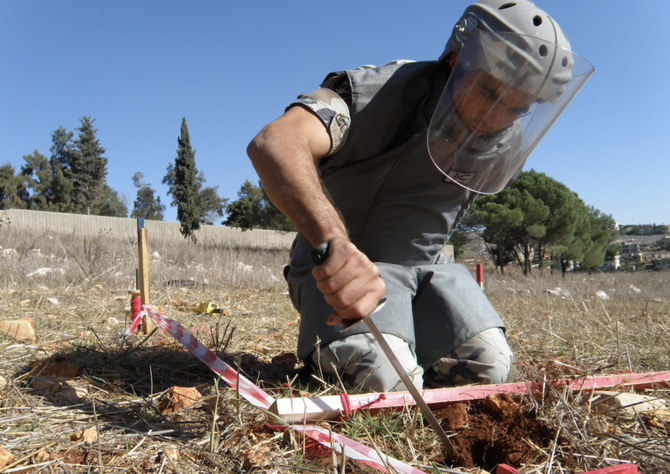
Despite the efforts of the Lebanese Armed Forces, the Mine Action Center and their international partners, vast contamination, chronic funding shortages and the lack of comprehensive compensation plans continue to stall progress.
Clearing unexploded ordnance is painstaking, expensive and slow — but for many Lebanese communities, it is the only path back to safety.
A year after the ceasefire, the war’s most persistent legacy is buried underground, waiting.