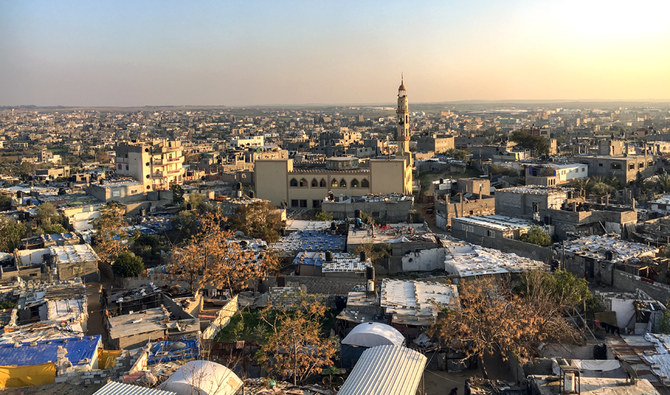

GAZA CITY: An American field hospital, being set up by a US nongovernmental organization adjacent to the northern borders of the Gaza Strip, has caused widespread controversy, and calls for a boycott.
Hamas, which has been in control of the Gaza Strip since mid-2007, has been struggling to justify its approval of a US hospital in the besieged area, despite claims that it had been brokered by Egypt and the UN, and funded by Qatar.
While Hamas says that the hospital is a service and will alleviate the health crisis in Gaza, and has no political dimension, the leaders of Fatah and other factions have questioned “American intentions” of the move, believing the hospital might be part of a strategy to drive a wedge between Gaza and the West Bank.
That fear has intensified since the publication of photographs on social media platforms of people wearing “foreign military” uniforms working on the construction of the site, in an area adjacent to the Erez crossing.
On Friday, Palestinian President Mahmoud Abbas warned against continuing with the construction, saying: “We will not allow the American hospital in Gaza and other economic projects to pass.”
Palestinian Prime Minister Mohammad Shtayyeh said earlier: “The hospital embodies the American plan to refuse to deal with the political demands and national rights of our people, and what is happening is one of the outcomes of the Bahrain workshop.”
Hamas leader and former Health Minister Bassem Naim said Gaza needed such a hospital to provide advanced medical services not otherwise available to people due to the “Israeli blockade and
the Palestinian Authority’s sanctions.”
The 4,500 square foot, 50-bed facility will be funded by the Qatari government with assistance from FriendShips, a Louisiana-based organization which is reportedly moving tents and equipment used in a hospital in Syria to the enclave.
Concerning the location of the hospital, which raised questions and doubts about its proximity to the Israeli security fence, Naim said that any field hospital “is subject to security controls from the sponsoring state to ensure the freedom of movement of staff.”
The hospital has two entrances, one to the Gaza Strip and intended for patients and local nursing staff, and another leading to the Israeli side to secure the passage of foreign staff working in the hospital.
Hamas spokesman Hazim Qassem said: “The decision to establish the American field hospital came because part of the blockade had a major impact on the health conditions in the Gaza Strip, due to Israeli policy and the neglect of the West Bank government (PA) in dealing with medical conditions in Gaza.”
He added that due to the deterioration of the health situation in Gaza, it was agreed that medicine would enter Gaza from donors, and that the field hospital belonging to humanitarian charities would be built.
Hamas reached understandings with Israel at the end of last year to ease the siege on the Gaza Strip with some facilities at crossings and the fishing zone in exchange for keeping protesters away from the fence during the weekly demonstrations along the border between Gaza and Israel.
That led to Fatah accusations of participating in a US-Israeli plan to separate Gaza and establish a separate state.
“This hospital is part of the American-Israeli plan to separate the West Bank from the Gaza Strip, under humanitarian slogans, and thus the establishment of a state in Gaza, and the elimination of the dream of an independent and sovereign Palestinian state,” said Fatah leader Muneer Al-Jaghoub.
“Has the American conscience suddenly woken up? The US cut off all aid to the Palestinian people, including support for hospitals in occupied Jerusalem and the UNRWA. Will this hospital in Gaza be innocent?”
Ramallah-based political science professor Jamal Al-Fadi said: “The establishment of an American military hospital in the Gaza Strip falls within the framework of a suspicious understanding between a faction that rules the Gaza Strip and the occupation, especially with the severing of relations with Washington after its recent decisions against our people and our cause.”
Al-Fadi added, in an interview with Voice of Palestine Radio: “This hospital is the face of American and Israeli intelligence, or part of the American movement to implement the ‘Deal of the Century.’”
Saleh Naami, a journalist close to Hamas, said: “For many years, USAID has been very active in the West Bank and Gaza, launching health, infrastructure projects under the rule of Hamas and PA, and no one objected same as some European and Arab governments are active. Is it in the miserable conditions of the siege of Gaza that can lead the luxury to object to a health project that relieves the suffering of the people?”
Naami added that claims the hospital was a US spy base as part of US President Donald Trump’s “Deal of the Century” were “ridiculous and not worth responding to,” adding: “Gaza and the West Bank are controlled by the occupation authorities.”