Palestinian president says to discuss elections with Hamas, factions

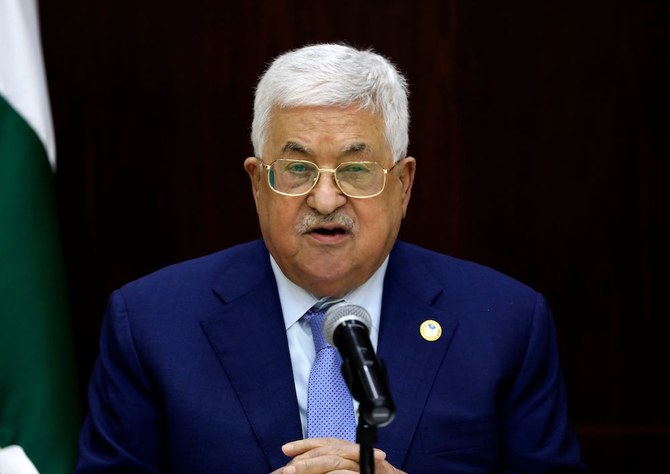
Palestinian President Mahmoud Abbas chairs a meeting of the central committee of the Fatah movement in the West Bank city of Ramallah. (File/AFP)
Updated 06 October 2019
Follow

Palestinian president says to discuss elections with Hamas, factions

RAMALLAH: Palestinian president Mahmoud Abbas said Sunday he would discuss plans for new parliamentary elections with all factions, including longtime rivals Hamas.
Meeting with senior Palestinian leaders in Ramallah in the occupied West Bank, Abbas renewed a pledge to hold the polls — the first since 2006 — but without giving a timeframe.
He announced they had formed committees to “communicate with the election commission and factions such as Hamas and all factions, as well as with the Israeli authorities.”
He said any elections should take place in “the West Bank, Jerusalem and the Gaza Strip.”
Hamas and Fatah have been at loggerheads since 2007, when they seized Gaza and threw out Abbas’s forces, which retained control of the internationally recognized Palestinian government based in the West Bank.
No parliamentary elections have been held since 2006, with the two sides trading blame.
Multiple attempts at reconciliation have failed and analysts say new elections are impossible without improved relations.
Hamas said in a statement Saturday it didn’t “know what Abu Mazen means by general election,” using the common nickname for Abbas.
The movement said it had already committed itself to elections.
Abbas has previously pledged on multiple occasions to hold elections but without any results.
Meanwhile, Abbas also confirmed the Palestinian Authority (PA) had received on Sunday $1.5 billion shekels ($430 million) from Israel — representing taxes that had been withheld from the Jewish state.
Israel in February decided to withhold around $10 million per month from revenues of some $190 million per month it collects on the behalf of the PA, triggering Abbas’s fury.
The money comes from customs duties levied on goods destined for Palestinian markets that transit through Israeli ports and constitutes more than 50 percent of the PA’s revenues.


Syria’s leader set to visit Berlin with deportations in focus

Updated 2 sec ago
Follow

Syria’s leader set to visit Berlin with deportations in focus

BERLIN: Syrian President Ahmed Al-Sharaa is expected in Berlin on Tuesday for talks, as German officials seek to step up deportations of Syrians, despite unease about continued instability in their homeland.
Sharaa is scheduled to meet his counterpart Frank-Walter Steinmeier, the German president’s office said.
Chancellor Friedrich Merz’s office has yet to announce whether he would also hold talks with Sharaa during the visit.
Since ousting Syria’s longtime leader Bashar Assad in late 2024, Sharaa has made frequent overseas trips as the former Islamist rebel chief undergoes a rapid reinvention.
He has made official visits to the United States and France, and a series of international sanctions on Syria have been lifted.
The focus of next week’s visit for the German government will be on stepping up repatriations of Syrians, a priority for Merz’s conservative-led coalition since Assad was toppled.
Roughly one million Syrians fled to Germany in recent years, many of them arriving in 2015-16 to escape the civil war.
In November Merz, who fears being outflanked by the far-right AfD party on immigration, insisted there was “no longer any reason” for Syrians who fled the war to seek asylum in Germany.
“For those who refuse to return to their country, we can of course expel them,” he said.

- ‘Dramatic situation’ -

In December, Germany carried out its first deportation of a Syrian since the civil war erupted in 2011, flying a man convicted of crimes to Damascus.
But rights groups have criticized such efforts, citing continued instability in Syria and evidence of rights abuses.
Violence between the government and minority groups has repeatedly flared in multi-confessional Syria since Sharaa came to power, including recent clashes between the army and Kurdish forces.
Several NGOs, including those representing the Kurdish and Alawite Syrian communities in Germany, have urged Berlin to axe Sharaa’s planned visit, labelling it “totally unacceptable.”
“The situation in Syria is dramatic. Civilians are being persecuted solely on the basis of their ethnic or religious affiliation,” they said in a joint statement.
“It is incomprehensible to us and legally and morally unacceptable that the German government knowingly intends to receive a person suspected of being responsible for these acts at the chancellery.”
The Kurdish Community of Germany, among the signatories of that statement, also filed a complaint with German prosecutors in November, accusing Sharaa of war crimes, genocide and crimes against humanity.
There have also been voices urging caution within government.
On a trip to Damascus in October, Foreign Minister Johann Wadephul said that the potential for Syrians to return was “very limited” since the war had destroyed much of the country’s infrastructure.
But his comments triggered a backlash from his own conservative Christian Democratic Union party.