

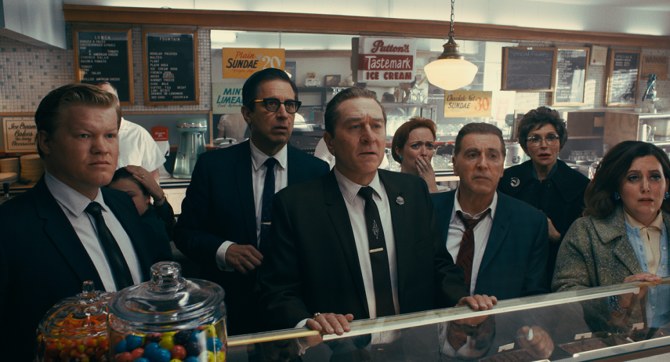
Scorsese scores with mayhem and the mafia in ‘The Irishman’

Martin Scorsese is the director of the movie. (Supplied)
Updated 06 December 2019
Follow

Scorsese scores with mayhem and the mafia in ‘The Irishman’

  • Martin Scorsese and Harvey Keitel get together for the first time since “Mean Streets,”

CHENNAI: Incredibly, it’s been nearly 25 years since director Martin Scorsese worked with his on-screen ‘alter-ego’ Robert DeNiro (in 1995’s “Casino”).

They finally reunite in “The Irishman,” in which DeNiro gives arguably the greatest performance of his long and stellar career as Frank Sheeran, a World War II veteran who, in the 1950s, gets sucked into the mob, which pushes him into any number of nefarious activities, and sees him estranged from his much-loved daughter Peggy.

There are other long-awaited reunions in the film’s cast — Scorsese and Harvey Keitel get together for the first time since “Mean Streets,” and Joe Pesci, one of the great mob character actors, is back with DeNiro and the director. There’s also a much-hyped first-time meeting between Scorsese and another legend of American cinema, Al Pacino, who plays Jimmy Hoffa, the leader of the mighty Teamsters union — heavily linked with organized crime — who disappeared in 1975. It seems remarkable that these two heavyweights of the genre had to wait until Pacino was 79 to work together for the first time.
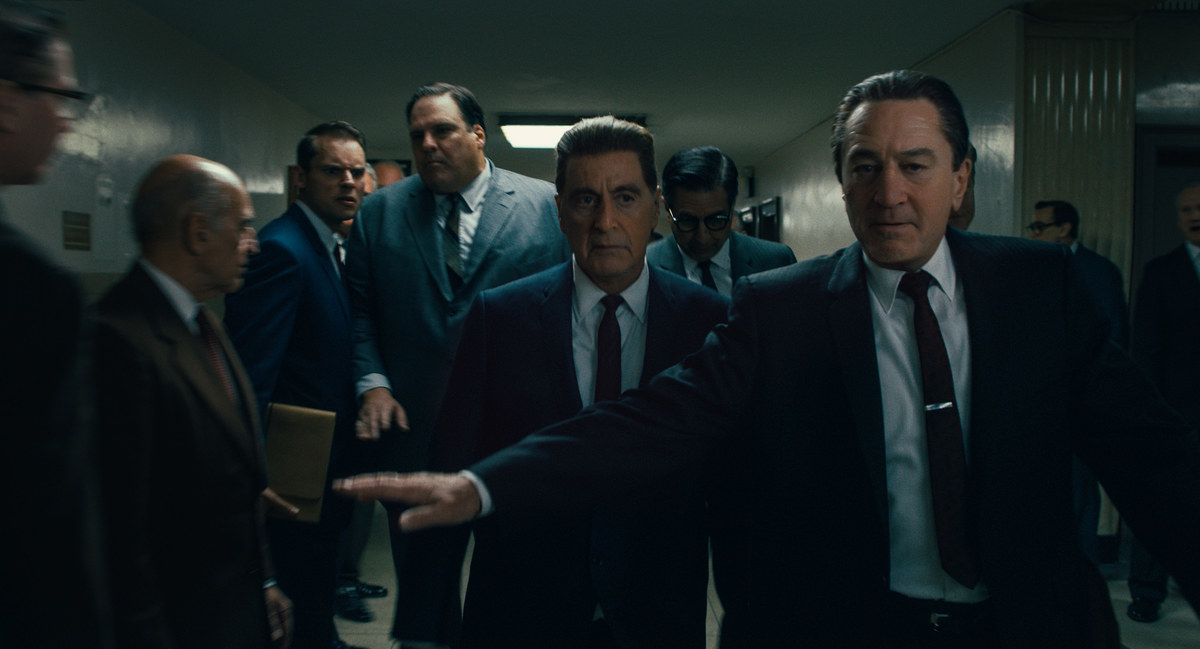


It’s been nearly 25 years since director Martin Scorsese worked with his on-screen ‘alter-ego’ Robert DeNiro. (Supplied)

“The Irishman” is Sheeran's story (it is based on Charles Brandt’s 2004 book “I Heard You Paint Houses,” which was based on Sheeran’s recollection of events that took place in the Fifties and Sixties when he was working as a truck driver and became involved with gangster Russell Bufalino (Pesci). Sheeran goes on to become Hoffa’s bodyguard.

“The Irishman” is a vast canvas (it clocks in at 209 minutes) of political corruption, avarice, murderous ambition and violence — all made to seem perfectly normal. The film doesn’t attempt to portray the mobsters’ softer sides, as so many mafia movies and TV series have. Sheeran does display an emotional connection to his daughter, but there is nothing remotely familial about Bufalino or Hoffa.
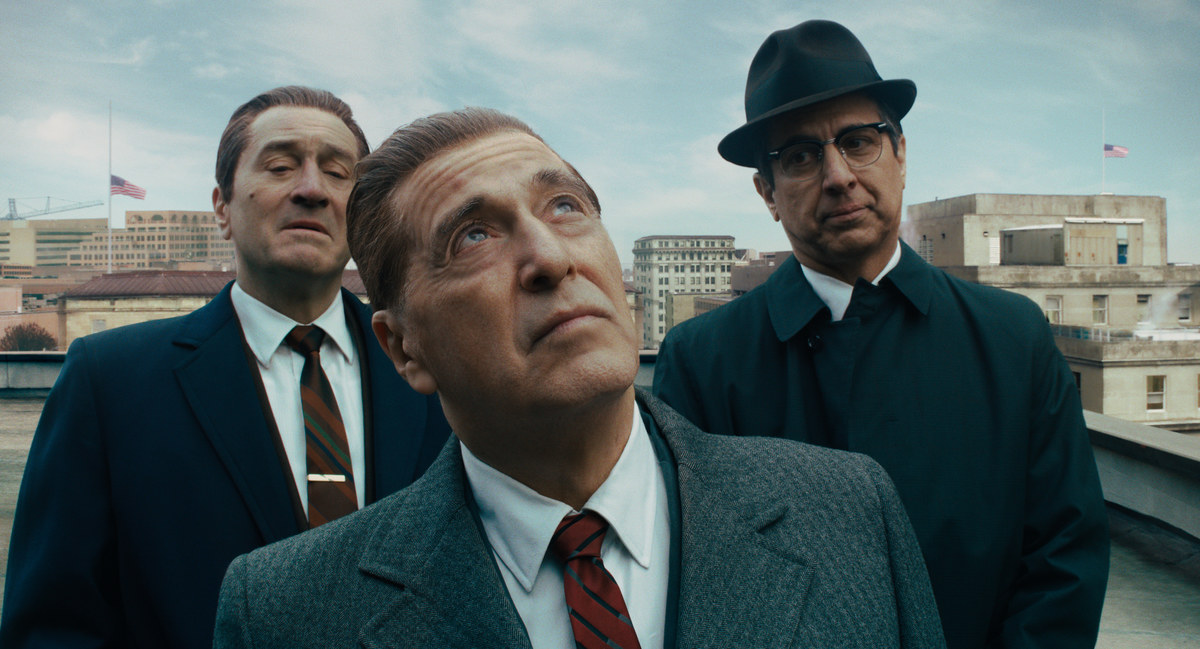


The film doesn’t attempt to portray the mobsters’ softer sides, as so many mafia movies and TV series have. (Supplied)

The one bum note in “The Irishman” is Scorsese’s decision to use actual footage from the time to illustrate the links between politics and the mafia. It doesn’t quite convince. The rest of the movie, however, is superb.

Pacino is at his amped-up, mercurial best — it’s a delight to see him and DeNiro at the peak of their acting powers, working with an equally gifted director. DeNiro cleverly lets us glimpse hints of the ruthless villain beneath Sheeran’s dignified veneer with a performance of restrained brilliance.

Crafted with excellence and elegance by Scorsese and backed by a powerhouse cast of ageing actors (‘de-aged’ with digital technology for the period scenes), “The Irishman” is a remarkable piece of cinema from some of the medium’s most-gifted protagonists.


At Jazan festival, Suad Al-Asiri paints memory, land and leadership

Updated 13 January 2026
Follow

At Jazan festival, Suad Al-Asiri paints memory, land and leadership

  • Local artist channels personal hardship into works that reflect Jazan’s identity, heritage
  • Jazan: A Nation and a Prince, places region at the heart of a composition featuring Prince Mohammed bin Abdulaziz and Prince Nasser bin Mohammed bin Abdullah bin Jalawi

RIYADH: At the Ahad Al-Masarihah pavilion at Jazan Festival 2026, Suad Al-Asiri’s paintings blend memory, place and personal history, offering visual narratives shaped by beauty and hardship. 

A novelist and visual artist, Al-Asiri has long used art as a storytelling tool. After a near-fatal car accident in March 2024, her work took on a new urgency. Bedridden for 11 months, cut off from the public world for more than a year, she describes that period as one of the most painful in her life — yet also transformative. 

“First of all, praise be to God for granting me life, as the accident was extremely severe,” she said. “By God’s grace, I was given a new life. All my thinking after the accident was about becoming an inspiration to others — about enduring pain and obstacles, and still leaving an impact.” 

Her return to public life came in 2025, when she participated in National Day celebrations with the ministry of interior. By the time she arrived at Jazan Festival, she was ready to channel that experience into her art. 

The centerpiece of her display, “Jazan: A Nation and a Prince,” places the region at the heart of a composition featuring Prince Mohammed bin Abdulaziz and Prince Nasser bin Mohammed bin Abdullah bin Jalawi, governor and deputy governor of Jazan respectively. 

Visitors linger over the details: the painting incorporates coffee beans, sesame and khudair — materials drawn from local products.

“I wanted people to recognize these products immediately,” she said. “They are part of Jazan’s daily life, and using them makes the work more tangible, more connected to everyday experience.” 

The painting sparks conversation. Visitors discuss leadership, identity, and the intimate relationship between people and their environment. 

Beyond the central piece, Al-Asiri presents individual portraits of the two princes, expanding the dialogue into a broader exploration of heritage and memory.  

Her journey into art is tied to her life as a storyteller. Early experiments with charcoal and pencil evolved into abstract art, drawn by its expressive freedom. 

From there, she explored realism, surrealism, and eventually modern art, particularly pop art, which has earned her wide recognition in artistic circles. Her novels and media work complement her visual practice, earning her the title “the comprehensive artist” from the governor.

Yet what stands out most in this exhibition is how Al-Asiri’s personal resilience flows through each piece. Her experience of surviving a devastating accident, enduring months of immobility, and returning to the public eye informs every brushstroke. 

Visitors sense not just her artistic skill, but her determination to turn life’s hardships into inspiration for others. 

Walking through the pavilion, one can see it in the way she blends heritage symbols, southern landscapes, and scenes of daily life. 

Each painting becomes both a document and a dialogue — a celebration of Jazan’s culture, a reflection on identity, and a testament to the power of human perseverance. 

At Jazan Festival 2026, Suad Al-Asiri’s art is a quiet, persistent inspiration for anyone who pauses long enough to listen.