

$25.6 billion Saudi Aramco flotation smashes share sale world record

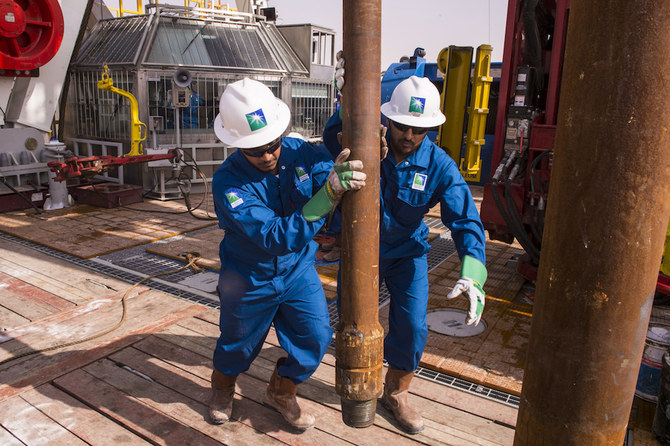
Saudi Aramco has priced its initial public offering at SR32 ($8.53) per share. (Aramco)
Updated 07 December 2019
Follow

$25.6 billion Saudi Aramco flotation smashes share sale world record

  • Initial offering values oil giant at $1.7 trillion — the same as Google and Amazon combined
  • The IPO will raise $25.6 billion beating Alibaba's record $25 billion listing in 2014

DUBAI: The biggest share listing in history — the initial public offering (IPO) of shares in Saudi Aramco — will take place on the Tadawul stock exchange in the next 10 days after the world’s most profitable company announced the results of its offer for sale.

Aramco shares will be priced at the top of the range on offer — SR32 per share — after strong demand from Saudi and regional investors, who bid for nearly five times the number of shares on offer.

That values Aramco at $1.7 trillion, bigger than any other quoted company in the world, or roughly equivalent to the stock market value of Google and Amazon combined.

At that price, the IPO is the largest ever, though only 1.5 percent of Aramco is being sold. That portion is valued at $25.6 billion, more than the previous IPO record holder, the Chinese e-commerce group Alibaba, in 2014.

The IPO may even be increased to meet unsatisfied investor demand. Aramco has the option to issue a further 450 million shares under the terms of a “purchase option” agreed with the investment banks advising on the deal. The final size could be as much as $29.4 billion.

Two-thirds of the IPO has been taken up by institutions, and the rest by private investors in Saudi Arabia and other GCC states. It was 465 percent oversubscribed.

Aramco marketed the IPO only in the Arabian Gulf following a decision not to make “road show” trips to big Western financial centers. Advisers were confident there was sufficient demand in the Middle East, but the Saudi government has the option to sell further shares in the future to foreign investors or on a foreign stock exchange.

One Middle East financier for an Asian institution said: “So far so good for the Saudis. There may be some foreign and sovereign investors named in the next few days, which will be interesting.”

Trading in the shares will take place after legal and procedural requirements are completed on Dec. 12.


Saudi-US roundtable meeting held to strengthen economic relations

Updated 58 min 59 sec ago
Follow

Saudi-US roundtable meeting held to strengthen economic relations

RIYADH: The Saudi-US Roundtable was held in Riyadh on Jan. 20, coinciding with the ninth session of the Saudi-US Trade and Investment Association, organized by the General Authority for Foreign Trade.

The meeting was attended by the Deputy Governor of International Relations at GAFT Abdulaziz Al-Sakran and the Secretary General of the Federation of Saudi Chambers Waleed Alorainan. It was also attended by the President and CEO of the Saudi-US Business Council Charles Hallab and representatives from government agencies, as well as 83 private sector companies.

The meeting reviewed ways to strengthen economic relations between Saudi Arabia and the US. It also explored opportunities for trade and investment cooperation in various sectors that play a fundamental role in developing trade ties and increasing bilateral trade volume, which reached approximately $33 billion in 2024.

Al-Sakran indicated that the roundtable meeting comes within the framework of the authority’s keenness to enhance the role of the private sector in developing trade relations by enabling it to access foreign markets and removing all external obstacles it faces, in coordination with relevant entities.

He noted that trade relations between the Kingdom and the US have witnessed significant economic activity, resulting in a trade volume exceeding $500 billion over the past decade.

It is worth noting that GAFT works to develop bilateral trade relations by overseeing business councils and coordination councils. In addition, it enables Saudi Arabia’s non-oil exports to access foreign markets and helps overcome the various challenges they face.