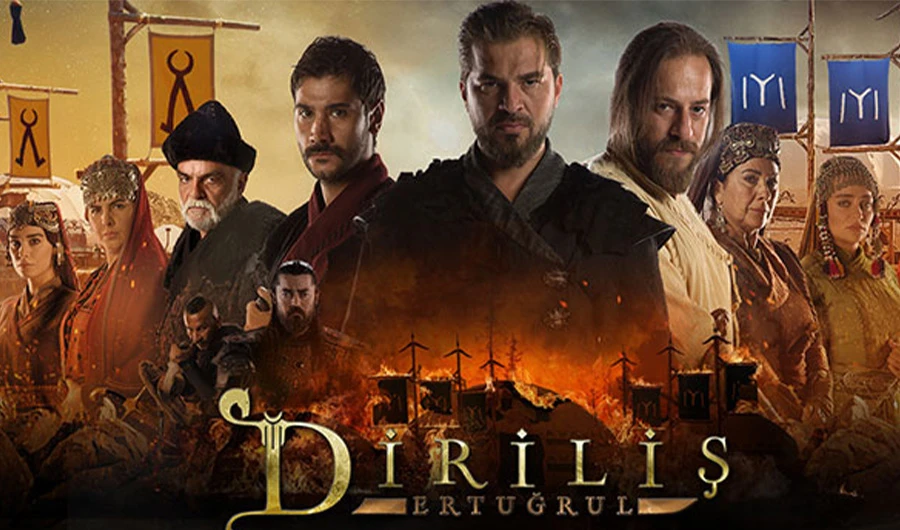
PM Khan asks PTV to air famous Turkish fiction drama 'Ertugrul' in Urdu

Poster of famous Turkish historical fiction series Dirilis: Ertugrul. (Photo Courtesy: Social Media)
Updated 03 December 2019
Follow

PM Khan asks PTV to air famous Turkish fiction drama 'Ertugrul' in Urdu

  • State TV brings the series to Pakistan following praises from PM Imran Khan
  • Dubbing work is already underway

ISLAMABAD: Pakistan’s state television, the PTV, is set to air a famous Turkish historical fiction series “Dirilis: Ertugrul” dubbed in Urdu soon, the state broadcaster told Arab News on Monday.
The move follows a special request by Prime Minister Imran Khan, who in October recommended the popular TV opera to all Pakistanis as promoting the true Islamic values, and insisted that the five-season series should be dubbed in Urdu.
Often described as a Turkish “Game of Thrones,” by the fans, the series is set in 13th century Anatolia, before the establishment of the Ottoman Empire. It illustrates the struggle of Ertugrul Gazi, the father of Osman I – the founder of the Ottoman dynasty.
Since its premiere on state-run Turkish TV channel TRT 1 in November 2014, the serial has been telecasted in 60 countries.
“We have taken this initiative as the prime minister wants to protect our social, cultural and religious norms,” said Dr. Firdous Ashiq Awan, special assistant to the prime minister on information and broadcasting.
“The Muslim world has its own cultural heritage and values, but we are looking into western ones,” she told Arab News in an interview in Islamabad on Monday.
According to Awan, the drama can enlighten and broaden the understanding of the history of Islam, especially among younger generations.
“I attended golden jubilee celebrations ceremony of the OIC (Organization of Islamic Cooperation) in Jeddah last week, where it was also discussed how to improve social, cultural and religious ties between member states by sharing media content,” she said, adding there was a special focus on using the media to improve the perception of Islam in the West and strengthen ties between OIC countries.
“It is also Prime Minister Imran Khan’s vision to share media content to counter Islamophobia and improve understanding of Islamic values,” Awan said.
PTV director for international relations, Shazia Sikander, who is also the head of this project, told Arab News that PTV is dubbing “Dirilis: Ertugrul” in Urdu as it has already secured all rights from TRT.
“PTV has got exclusive rights for dubbing and screening it in Pakistan,” she said, adding that the series is already on PTV’s dub stage, with voice actors selected carefully to make sure the historical drama will captivate to the audience.
Pakistan, global crypto exchange discuss modernizing digital payments, creating job prospects 

Updated 05 December 2025
Follow

Pakistan, global crypto exchange discuss modernizing digital payments, creating job prospects 

  • Pakistani officials, Binance team discuss coordination between Islamabad, local banks and global exchanges
  • Pakistan has attempted to tap into growing crypto market to curb illicit transactions, improve oversight

ISLAMABAD: Pakistan’s finance officials and the team of a global cryptocurrency exchange on Friday held discussions aimed at modernizing the country’s digital payments system and building local talent pipelines to meet rising demand for blockchain and Web3 skills, the finance ministry said.

The development took place during a high-level meeting between Finance Minister Muhammad Aurangzeb, Pakistan Virtual Assets Regulatory Authority (PVARA) Chairman Bilal bin Saqib, domestic bank presidents and a Binance team led by Global CEO Richard Teng. The meeting was held to advance work on Pakistan’s National Digital Asset Framework, a regulatory setup to govern Pakistan’s digital assets.

Pakistan has been moving to regulate its fast-growing crypto and digital assets market by bringing virtual asset service providers (VASPs) under a formal licensing regime. Officials say the push is aimed at curbing illicit transactions, improving oversight, and encouraging innovation in blockchain-based financial services.

“Participants reviewed opportunities to modernize Pakistan’s digital payments landscape, noting that blockchain-based systems could significantly reduce costs from the country’s $38 billion annual remittance flows,” the finance ministry said in a statement. 

“Discussions also emphasized building local talent pipelines to meet rising global demand for blockchain and Web3 skills, creating high-value employment prospects for Pakistani youth.”

Blockchain is a type of digital database that is shared, transparent and tamper-resistant. Instead of being stored on one computer, the data is kept on a distributed network of computers, making it very hard to alter or hack.

Web3 refers to the next generation of the Internet built using blockchain, focusing on giving users more control over their data, identity and digital assets rather than big tech companies controlling it.

Participants of the meeting also discussed sovereign debt tokenization, which is the process of converting a country’s debt such as government bonds, into digital tokens on a blockchain, the ministry said. 

Aurangzeb called for close coordination between the government, domestic banks and global exchanges to modernize Pakistan’s payment landscape.

Participants of the meeting also discussed considering a “time-bound amnesty” to encourage users to move assets onto regulated platforms, stressing the need for stronger verifications and a risk-mitigation system.

Pakistan has attempted in recent months to tap into the country’s growing crypto market, crack down on money laundering and terror financing, and promote responsible innovation — a move analysts say could bring an estimated $25 billion in virtual assets into the tax net.

In September, Islamabad invited international crypto exchanges and other VASPs to apply for licenses to operate in the country, a step aimed at formalizing and regulating its fast-growing digital market.