Turbulent future for loss-making Alitalia after rescue stalls

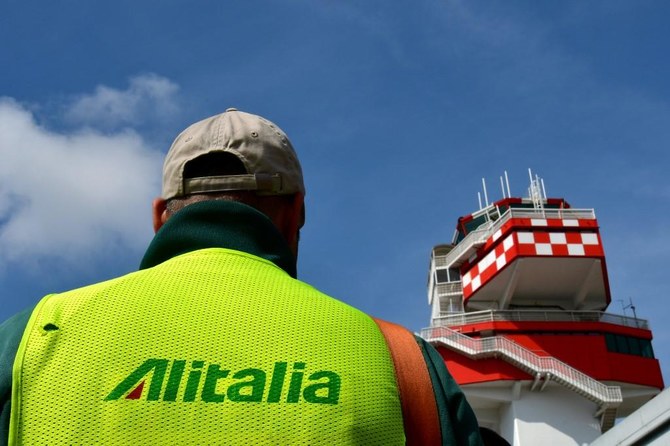
Alitalia has been losing money for years, its business squeezed by competition from low-cost carriers, fuel price rises and luxury airlines from the Middle East. (AFP)
Updated 01 December 2019
Follow

Turbulent future for loss-making Alitalia after rescue stalls

  • Struggling carrier now at a standstill after a consortium of potential buyers failed to make an offer
  • Alitalia has been losing money for years, its business squeezed by competition

ROME: Efforts to save loss-making Alitalia have reached an impasse after months of unsuccessful negotiations with potential buyers, leaving Italy’s government undecided on the next move.
The struggling carrier, which has been under special administration since 2017 and continues to burn through cash, is now at a standstill after a consortium of potential buyers failed to make an offer, and with little hope for one in sight.
“It’s evident that right now a business solution doesn’t exist,” Economy Minister Stefano Patuanelli said this week, addressing a Senate commission.
The company “has a dimension that the market has difficulty accepting,” he said.
The government has reportedly said it will provide a €400 million ($440 million) bridge loan to the struggling company — at the risk of running afoul of European Commission rules on state aid, after the 900 million provided already in 2017.
Patuanelli brushed off such concerns Friday, saying he was “not worried.” The government, he said, was exploring its options, which media reports said include replacing the commissioners running the airline, or outright nationalization.
The minister has said placing the beleaguered carrier in the state’s hands “would not necessarily be negative.”
Alitalia has been losing money for years, its business squeezed by competition from low-cost carriers, fuel price rises, and luxury airlines from the Middle East.
After months of negotiations and the expiration of the latest deadline for a binding bid, plans for a consortium of investors to save the airline fell through last week after Atlantia said the conditions had not yet been met to participate.
Atlantia, a major operator of toll expressways and airports controlled by the Benetton family, operates Rome’s airports and had already twice taken stakes in Alitalia.
Others making up the potential partnership were state railway Ferrovie dello Stato, US airline Delta and the Italian treasury.
Delta said earlier this month it was ready to invest up to €100 million in Alitalia in return for a 10 percent stake.
Lufthansa has its eye on the lucrative Italian market but has said it would only be interested in investing in a restructured Alitalia.
Patuanelli said Friday that Lufthansa at the moment was interested in “a commercial partnership, but with no equity investment.” The minister has said costs must be cut at the carrier, echoing Lufthansa’s demands for restructuring.
Unions have planned a December 13 strike, their worries mounting given the lack of a new plan in sight and uncertainty over how many jobs could be threatened under any restructuring.
“We are against any idea of cutting up Alitalia and losing our country’s heritage,” the secretary of the CGIL union said on Friday.
Alitalia was placed under special administration two years ago after workers rejected a restructuring plan that would have laid off 1,700 workers out of some 11,000.
Estimates are hard to come by on how much the state would have to spend to keep it afloat. The Sole 24 Ore daily put the sum at 8.7 billion euros, citing Italian investment bank Mediobanca.
The company’s best, or least bad, year in the past decade was 2011, when it lost some €69 million, a sum that swelled to €280 million the following year and to €580 million in 2014, according to Italian news agency AGI.
“The abnormality about Alitalia is that it loses money when it flies,” consumer’s rights association ADUC wrote on Thursday.
“With the money wasted on Alitalia, the government could have bought six airlines, namely Air France, KLM, Turkish Airlines, Norwegian, Finnair and SAS.”


AI will never replace human creativity, says SRMG CEO 

Updated 30 January 2026
Follow

AI will never replace human creativity, says SRMG CEO 

  • Speaking to Maya Hojeij, senior business anchor at Asharq with Bloomberg, Jomana R. Alrashid expressed pride in SRMG platforms that had absorbed and adopted AI

RIYADH: Jomana R. Alrashid, CEO of Saudi Research and Media Group, highlighted how AI cannot replace human creativity during a session at The Family Office’s “Investing Is a Sea” summit at Shura Island on Friday. 

“You can never replace human creativity. Journalism at the end of the day, and content creation, is all about storytelling, and that’s a creative role that AI does not have the power to do just yet,” Alrashid told the investment summit. 

“We will never eliminate that human role which comes in to actually tell that story, do the actual investigative reporting around it, make sure to be able to also tell you what’s news or what’s factual from what’s wrong ... what’s a misinformation from bias, and that’s the bigger role that the editorial player does in the newsroom.”

Speaking on the topic of AI, moderated by Maya Hojeij, senior business anchor at Asharq with Bloomberg, the CEO expressed her pride in SRMG platforms that had absorbed and adopted AI in a way that was “transformative.”

“We are now translating all of our content leveraging AI. We are also now being able to create documentaries leveraging AI. We now have AI-facilitated fact-checking, AI facilities clipping, transcribing. This is what we believe is the future.”

Alrashid was asked what the journalist of the future would look like. “He’s a journalist and an engineer. He’s someone who needs to understand data. And I think this is another topic that is extremely important, understanding the data that you’re working with,” she said.

“This is something that AI has facilitated as well. I must say that over the past 20 years in the region, especially when it comes to media companies, we did not understand the importance of data.”


The CEO highlighted that previously, media would rely on polling, surveys or viewership numbers, but now more detailed information about what viewers wanted was available. 

During the fireside session, Alrashid was asked how the international community viewed the Middle Eastern media. Alrashid said that over the past decades it had played a critical role in informing wider audiences about issues that were extremely complex — politically, culturally and economically — and continued to play that role. 

“Right now it has a bigger role to play, given the role again of social media, citizen journalists, content creators. But I also do believe that it has been facilitated by the power that AI has. Now immediately, you can ensure that that kind of content that is being created by credible, tier-A journalists, world-class journalists, can travel beyond its borders, can travel instantly to target different geographies, different people, different countries, in different languages, in different formats.”

She said that there was a big opportunity for Arab media not to be limited to simply Arab consumption, but to finally transcend borders and be available in different languages and to cater to their audiences. 


The CEO expressed optimism about the future, emphasizing the importance of having a clear vision, a strong strategy, and full team alignment. 

Traditional advertising models, once centered on television and print, were rapidly changing, with social media platforms now dominating advertising revenue.

“It’s drastically changing. Ultimately in the past, we used to compete with one another over viewership. But now we’re also competing with the likes of social media platforms; 80 percent of the advertising revenue in the Middle East goes to the social media platforms, but that means that there’s 80 percent interest opportunities.” 

She said that the challenge was to create the right content on these platforms that engaged the target audiences and enabled commercial partnerships. “I don’t think this is a secret, but brands do not like to advertise with news channels. Ultimately, it’s always related with either conflict or war, which is a deterrent to advertisers. 

“And that’s why we’ve entered new verticals such as sports. And that’s why we also double down on our lifestyle vertical. Ultimately, we have the largest market share when it comes to lifestyle ... And we’ve launched new platforms such as Billboard Arabia that gives us an entry into music.” 

Alrashid said this was why the group was in a strong position to counter the decline in advertising revenues across different platforms, and by introducing new products.

“Another very important IP that we’ve created is events attached to the brands that have been operating in the region for 30-plus years. Any IP or any title right now that doesn’t have an event attached to it is missing out on a very big commercial opportunity that allows us to sit in a room, exchange ideas, talk to one another, get to know one another behind the screen.” 

The CEO said that disruption was now constant and often self-driving, adding that the future of the industry was often in storytelling and the ability to innovate by creating persuasive content that connected directly with the audience. 

“But the next disruption is going to continue to come from AI. And how quickly this tool and this very powerful technology evolves. And whether we are in a position to cope with it, adapt to it, and absorb it fully or not.”