Job losses and pay cuts as Lebanon’s economy crumbles

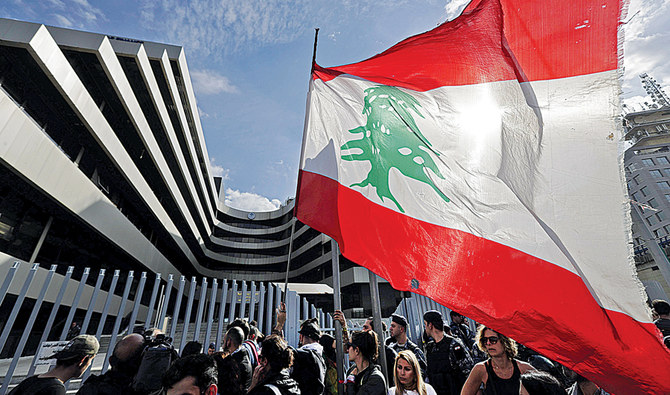
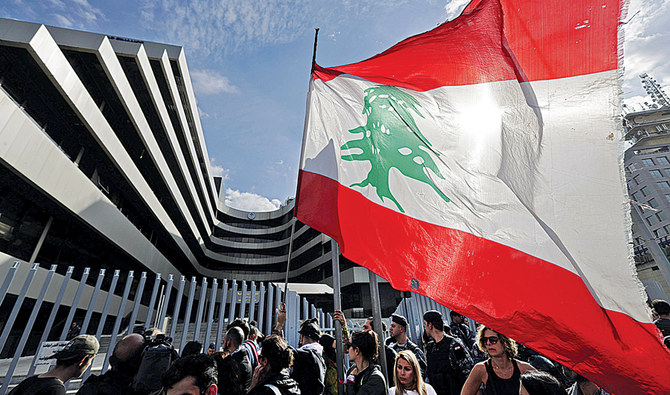
Lebanese protesters gather outside a Ministry of Finance department. Growth in Lebanon has been battered by years of stubborn political deadlock. (AFP)
Updated 29 November 2019
Follow

Job losses and pay cuts as Lebanon’s economy crumbles

  • After years of political turmoil, the Lebanese economy is in a sharp downturn, banks have restricted access to dollars while prices have risen

BEIRUT: Weeks into a protest movement partly driven by a collapsing economy, Lebanese interior architect Laeticia Nicolas was called in by her boss and told she was fired.

“There had been fewer and fewer projects for a year,” said the 28-year-old, who since Oct. 17 has taken part in anti-government protests sweeping the country.

“Before the revolution began, they warned us they would be paying just half our salaries in exchange for reducing working hours,” she said.

But as the protests gained momentum, he downsized his team. Nicolas was informed of the bad news at the end of the month when she received her salary.

“It’s not because of the revolution, but it may well have accelerated things,” she said.

After years of political turmoil, the Lebanese economy is in a sharp downturn, banks have restricted access to dollars while prices have risen.

Amid the crisis, thousands of Lebanese say their jobs are at risk.

Activists have denounced what they call illegal lay-offs and urged the labour ministry to intervene.

Some people, like Nicolas, have lost their jobs altogether, while others have been told to work part-time for a fraction of their original salary.

Economic growth in Lebanon has been battered by repeated political deadlock in recent years, compounded by the eight-year war in neighbouring Syria.

Successive cabinets have failed to implement desperately needed reforms to redress a floundering economy heavily reliant on tourism and services.

The World Bank projected negative growth of 0.2 percent in Lebanon for 2019, but now warns the recession could be even worse.

It has urged that a new cabinet be swiftly formed, after the government stepped down less than two weeks into the protests, to avoid more Lebanese becoming poor.

Around a third of Lebanese live in poverty, and that figure could soon rise to half, according to the World Bank.

Unemployment, already above 30 percent for young people, would also go up, it said.

A group of Lebanese banks and private businesses also warned of bleak times ahead.

“Thousands of companies are threatened with closure, and tens of thousands of employees and workers risk losing their jobs,” they said.

The union of restaurant and bar owners has said 265 establishments have closed already, and that figure could reach 465 by the end of the year.

In the month before the protests, banks began restricting access to dollars, sparking a greenback liquidity crisis.

Bilal Dandashli, who heads a small road safety equipment company he founded in the 1990s, said he was struggling. “We can no longer import supplies from abroad,” he said.

The Lebanese pound is pegged at around 1,500 pounds to the dollar, and both are used interchangeably in everyday transactions. But caps on dollar withdrawals have forced people to resort to moneychangers, sending the unofficial exchange rate soaring to more than 2,200.

To make matters worse, Dandashli said customers were also not paying their debts. “It’s like begging for our own money,” he said.
Emerging markets driving global growth despite rising risks: Saudi finance minister 

Updated 41 sec ago
Follow

Emerging markets driving global growth despite rising risks: Saudi finance minister 

RIYADH: Emerging markets now account for a growing share of global output and are driving the bulk of world economic expansion, Saudi Arabia’s finance minister said, even as those economies grapple with rising debt and mounting geopolitical risks. 

Speaking at the opening of the annual AlUla Conference for Emerging Market Economies on Feb. 8, Mohammed Al-Jadaan said the role of emerging and developing nations in the global economy has more than doubled since 2000, underscoring a structural shift in growth away from advanced economies.

The meeting comes as policymakers in developing markets try to keep growth on track while controlling inflation, managing capital flows and repairing public finances after years of heavy borrowing. Saudi Arabia has positioned the forum as a platform to coordinate policy responses and strengthen the voice of emerging economies in global financial discussions. 

“This conference takes place at a moment of profound transition in the global economy. Emerging markets and developing economies now account for nearly 60 percent of the global gross domestic product in purchasing power terms and 70 percent of global growth,” Al-Jadaan said. 

He added: “Today, the 10 emerging economies and the G20 alone account for more than half of the world’s growth. Yet, emerging markets face a more complex and fragmented environment, elevated debt levels, slower trade growth and increasing exposure to geopolitical shocks.” 

According to Al-Jadaan, more than half of low-income nations face the risk of debt distress, while global trade growth has slowed to around half its pre-pandemic pace. 

Launched in 2025, the conference this year brings together economic decision-makers, finance ministers, central bank governors, leaders of international financial institutions, and a select group of experts and specialists from around the world. 

Al-Jadaan said credible fiscal frameworks and disciplined debt management are essential for long-term growth, pointing to Saudi Arabia’s own reform experience. 

“Macroeconomic stability is not the enemy of growth; it is actually the foundation. Credible fiscal framework, clear medium-term anchors, and disciplined debt management create the space for investment and reform, especially in volatile global conditions,” he said. 

The minister stressed that policy credibility depends on execution rather than plans, adding that structural reforms succeed only when institutions are able to deliver. 

The importance of multilateral cooperation is rising as the global system becomes more divided, he said, calling for stronger international financial safety nets for developing economies. 

“International cooperation matters more, not less, in a fragmented world. Strong multilateral institutions, effective surveillance and adequate global financial safety nets are essential, particularly for emerging and developing economies,” Al-Jadaan said. 

Kristalina Georgieva, managing director of the International Monetary Fund, said emerging markets are growing faster than advanced economies but remain vulnerable to future shocks. 

“Growth still lags pre-pandemic levels, and this is doubly concerning as we will surely experience more shocks, but face them with depleted fiscal buffers in many places, with high spending pressures practically everywhere, and rising debt levels in many countries,” she said. 


Georgieva outlined two policy priorities emerging economies should embrace to sustain growth. 

“First priority, unleash private sector-led growth by cutting red tape, deepening financial markets, strengthening institutions and improving governance,” she said.  

Georgieva added: “Second priority is stepping up integration. In a world of shifting alliances and trade partners, there are new opportunities for cooperation at the regional and cross-regional levels.”  

Lan Fo’an, China’s finance minister, said the world has entered a period of turbulence marked by unilateralism and geopolitical conflict. 

“A cold wave of deglobalization is sweeping across the globe, and the world once again stands at a crucial crossroads,” he said, adding that the global economy expanded 3.3 percent in 2025, below the pre-pandemic average of 3.7 percent. 

He called for reforms to global economic governance and greater attention to the needs of developing countries. 

“We should improve the global economic governance system through reforms. We should add dialogue over confrontation. We should practice multilateralism to ensure that our countries, regardless of their size or wealth, can participate, make decisions and benefit on an equal footing.” 

According to Fo’an, China has joined hands with the Global South to advance cooperation in food security, development financing and climate change.