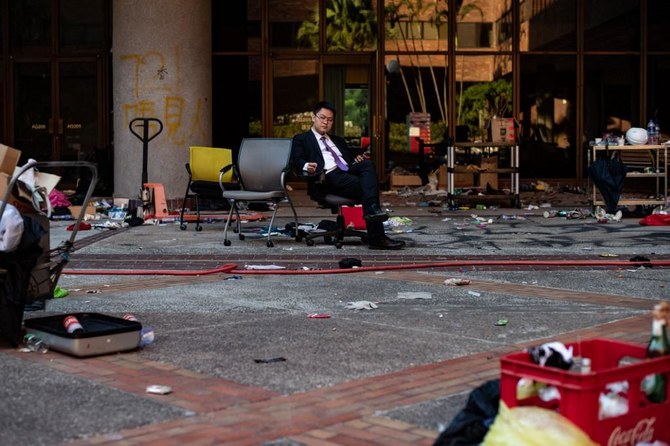
HONG KONG: A Hong Kong university campus under siege for more than a week was a deserted wasteland on Saturday, with a handful of protesters holed up in hidden refuges across the trashed grounds, as the city’s focus turned to local elections.
The siege neared its end as some protesters at Polytechnic University on the Kowloon peninsula desperately sought a way out and others vowed not to surrender, days after some of the worst violence since anti-government demonstrations escalated in June.
“If they storm in, there are a lot of places for us to hide,” said Sam, a 21-year-old student, who was eating two-minute noodles in the cafeteria, while plotting his escape.
Another protester, Ron, vowed to remain until the end with other holdouts, adding, “The message will be clear that we will never surrender.”
About 1,000 people have been arrested in the siege in the Chinese-ruled city, about 300 of them younger than 18.
Police have set up high plastic barricades and a fence on the perimeter of the campus. Towards midday, officers appeared at ease, allowing citizens to mill about the edges of the cordon as neighborhood shops opened for business.
Rotting rubbish and boxes of unused petrol bombs littered the campus. On the edge of a dry fountain at its entrance lay a Pepe the frog stuffed toy, a mascot protesters have embraced as a symbol of their movement.
Scores of construction workers worked at the mouth of the Cross-Harbor Tunnel, closed for more than a week after it was first blockaded, to repair toll booths smashed by protesters and clear debris from approach roads.
The road tunnel links Hong Kong island to the Kowloon area.
The repairs got underway as a record 1,104 people gear up to run for 452 district council seats in elections on Sunday.
A record 4.1 million Hong Kong people, from a population of 7.4 million, have enrolled to vote, spurred in part by registration campaigns during months of protests.
Young pro-democracy activists are now running in some of the seats that were once uncontested and dominated by pro-Beijing candidates.
The protests snowballed from June after years of resentment over what many residents see as Chinese meddling in freedoms promised to Hong Kong when the former British colony returned to Chinese rule in 1997.
Beijing has said it is committed to the “one country, two systems” formula by which Hong Kong is governed. It denies meddling in the affairs of the Asian financial hub and accuses foreign governments of stirring up trouble.
In an interview with Fox News Channel on Friday, US President Donald Trump said he had told Chinese President Xi Jinping that crushing the protests would have “a tremendous negative impact” on efforts to end the two countries’ 16-month-long trade war.
“If it weren’t for me Hong Kong would have been obliterated in 14 minutes,” Trump said, without offering any evidence.
“He’s got a million soldiers standing outside of Hong Kong that aren’t going in only because I ask him, ‘Please don’t do it, you’ll be making a big mistake, it’s going to have a tremendous negative impact on the trade deal,’ and he wants to make a trade deal.”

Campus siege nears end as Hong Kong gears up for election
- About 1,000 people have been arrested in the siege in the Chinese-ruled city, about 300 of them younger than 18
- Police have set up high plastic barricades and a fence on the perimeter of the campus
Trump takes unconventional approach to communicating to the public about war in Iran
- The communications strategy opened Trump to criticism that he hadn’t done enough to explain the rationale and objectives of the war
Typical of an unconventional presidency, the Trump administration waited more than 48 hours to make any live, public communication to the American people about why it had decided to go to war with Iran.
President Donald Trump discussed why he launched the attack prior to a White House ceremony honoring military heroes on Monday but took no questions from reporters. Earlier in the day, Defense Secretary Pete Hegseth and Joint Chiefs of Staff Chairman Dan Caine briefed journalists at the Pentagon.
The two days previous, Trump delivered two pretaped statements that were released on Truth Social, the social media site owned by the president’s media company, and granted telephone interviews to more than a dozen journalists — several of which produced fragmented responses that, to some, clouded as much as they cleared up.
The communications strategy opened Trump to criticism that he hadn’t done enough to explain the rationale and objectives of the war, even as the American military suffered its first casualties. By contrast, Israeli Prime Minister Benjamin Netanyahu, who has teamed with the US against Iran, delivered two statements the day the war began and addressed reporters Monday at the site of a missile attack that killed nine people. The Israeli military has held multiple press briefings each day.
“The American people need a commander in chief, and he has been absent in that role,” Rahm Emanuel, White House chief of staff under President Barack Obama, said on CNN Monday. Emanuel, a Democrat, is contemplating a run for the presidency in 2028.
An unconventional strategy leads to criticism
Peter Baker, chief White House correspondent for The New York Times, wrote on social media that “after Trump launched a new war on Iran, he did not rush back to the White House to make an Oval Office address to rally the nation as other presidents have done. He stayed at Mar-a-Lago to attend a glitzy political fundraiser.”
That post provoked a response from Steven Cheung, White House communications director. “Imagine being a reporter so consumed with Trump Derangement Syndrome that he wants President Trump to mimic the failed policies of the past. The truth is that President Trump spent the majority of his time monitoring the situation in a secure facility, in constant contact with world leaders, and made multiple addresses to the nation that garnered hundreds of millions of views. He also took dozens of calls with reporters.”
The calls included one with Baker’s colleague at The Times, Zolan Kanno-Youngs. Trump’s mobile phone number is known to many of the reporters who cover him, and the president often takes their calls for on-the-spot interviews. Besides The Times, he spoke in the aftermath of the attack to journalists for ABC, CBS, NBC, CNN, CNBC, Fox News Channel, The Atlantic, The Washington Post, Axios, Politico and an Israeli television station.
Most of the calls were brief and marginally illuminating; Politico’s Dasha Burns said Trump answered but said he was too busy to talk. The public couldn’t hear what Trump said in the interviews and was dependent upon what the journalists chose to report on the conversations.
“I spoke to President Trump today and he told me that the operation in Iran is going to go very fast,” Libby Alon, a reporter for Channel 14 News in Israel, wrote about her interview on X. “It’s doing very well, and (will) make the people of Israel very happy, and the people of the world very happy.”
The Times reported that in its six-minute chat, Trump “offered several seemingly contradictory visions of how power might be transferred to a new government — or even whether the existing Iranian power structure would run that government or be overthrown.”
In one of his two conversations with Trump, ABC News’ Jonathan Karl said when he asked about the death of Iranian Ayatollah Ali Khamenei, the president said: “I got him before he got me. They tried twice. Well I got him first.” CNN’s Jake Tapper went on the air minutes after his conversation Monday, saying Trump told him “the big one is coming soon,” an apparent reference to a future attack.
Asked for comment, White House spokeswoman Anna Kelly said: “President Trump is the most transparent and accessible president in American history. The American people have never had a more direct and authentic relationship with a president of the United States than they have with President Trump.”
Hegseth briefing concentrates on friendly reporters
Pentagon reporters learned late Sunday about Hegseth’s briefing. Reporters from The Associated Press, Reuters, ABC, CBS, NBC, CNN, Fox News Channel and Stars & Stripes were permitted into the briefing room, but Hegseth did not call on them. Instead, he took questions from NewsNation and Trump-friendly outlets like the Daily Caller, Daily Wire, One America News and the Christian Broadcasting Network. Most mainstream news outlets left their regular stations at the Pentagon last fall rather than agree to Hegseth’s rules restricting their work.
Hegseth denounced the “foolishness” of people wanting to know details of the operation in advance, such as whether Americans would commit to more than air power, and said the operation would continue as long as it took to achieve objections. He initially ignored NBC News’ Courtney Kube when she called out a question: “President Trump put a four-week time limit on it. Are you saying he’s wrong?”
Later, Hegseth denounced Kube for asking “the typical NBC sort of gotcha-type question. President Trump has all the latitude in the world to talk about how long it might take — four weeks, two weeks, six weeks, it could move up, it could move back. We’re going to execute at his command the objectives he set out to achieve.”
Unlike Pentagon briefings in past administrations, reporters were given assigned seats, with the Trump-friendly outlets seated in front. Jennifer Griffin, Hegseth’s former colleague at Fox News Channel who left the Pentagon with other reporters after not accepting his new rules, was seated in the last row.