HONG KONG: A few dozen pro-democracy protesters remained holed up inside a besieged Hong Kong university campus for a fourth straight day on Wednesday as supporters took up online calls to disrupt the city’s train network in a bid to distract police.
The violent standoff between demonstrators and police at Hong Kong Polytechnic University (PolyU) rippled overseas, with the United Nations calling for a peaceful resolution to the siege, while the US passed new legislation supporting protesters’ demands.
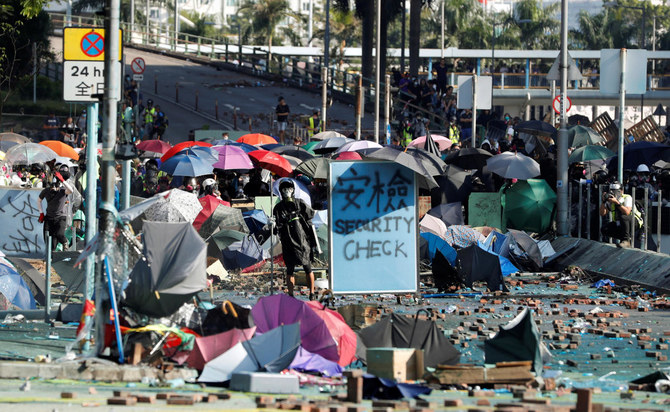
The epicenter of nearly six months of increasingly savage anti-China protests has shifted to the PolyU campus, a stone’s throw from the city’s harbor, where hardcore protesters have repelled riot police with Molotov cocktails, bricks and arrows.
The standoff has been the most intense and prolonged in nearly six months of unrest that began over a now-shelved bill to allow extraditions to China.
Millions of angry citizens hit the streets in a movement that quickly snowballed into a wider call for free elections and an inquiry into alleged police brutality, demands that Hong Kong’s Beijing-appointed leaders have refused.
Protesters at PolyU said around 50 of their number remained after hundreds had fled deteriorating conditions and following official warnings that police may fire live rounds to clear the area.
Exhausted bands of youths continued to wander the campus, preparing Molotov cocktails while others slept on a gym floor.
Hong Kong chief executive Carrie Lam called Tuesday for the protesters to surrender, adding that those over 18 would face rioting charges, but minors would not be arrested.
“I don’t ever give up. Yes, I will fight until the end,” said a 15-year-old holdout armed with bow and arrow who identified himself as William.
“But ... it’s very dangerous, because when you use the bow, the police must shoot you, with some unknown bullets. Maybe real bullets.”
Others were medically evacuated on gurneys overnight, and on Wednesday before dawn AFP journalists watched as police chased down and arrested around a dozen students making a break for it.
“Police appeal to all staying in the campus to leave in a peaceful manner and pledge to bring offenders to justice in a fair manner,” a police statement late Tuesday said.
The UN human rights office was watching the university situation with “deepening concern,” spokesman Rupert Colville said in Geneva.
He called for authorities “to address the humanitarian situation of those inside, which is clearly deteriorating, and facilitate a peaceful resolution.”
A “Blossom Everywhere” strategy of disruptive vandalism lasting more than a week has brought much of the city’s transport network to a standstill and shuttered schools.
Some of the busiest train lines were disrupted yet again on Wednesday, with huge queues of commuters forming after local media reported that protesters were blocking subway doors from closing and damaging stations.
Appeals also circulated online calling for citizens to use their lunch breaks to take to the streets. The midday actions began last week and were met in some places with tear gas.
The city’s education bureau reopened primary and secondary schools on Wednesday after a suspension that began last week. Kindergartens remain closed.
But local media reported that masked students at one school barricaded road access to the facility, causing scuffles with local residents and forcing riot police to disperse the students, arresting some.
China has repeatedly condemned protesters as violent criminals and rejected any foreign criticism.
But the US Senate on Tuesday unanimously adopted new legislation calling for Hong Kong democracy and threatening to revoke the favorable trade status that the semi-autonomous Chinese territory enjoys with the United States.
Lawmakers also approved a measure that would ban the sale of tear gas, rubber bullets and other equipment used by Hong Kong security forces.
Hong Kong’s government responded Wednesday by warning that the legislation would also harm US interests and “add fuel to the fire” of the protests.


![]()

Diehards hold out at Hong Kong campus as foreign pressure grows
Diehards hold out at Hong Kong campus as foreign pressure grows
- The violent standoff between demonstrators and police at Hong Kong Polytechnic University rippled overseas
- The standoff has been the most intense and prolonged in nearly six months of unrest that began over a now-shelved bill to allow extraditions to China


Latest updates


© 2026 SAUDI RESEARCH & PUBLISHING COMPANY, All Rights Reserved And subject to Terms of Use Agreement.