

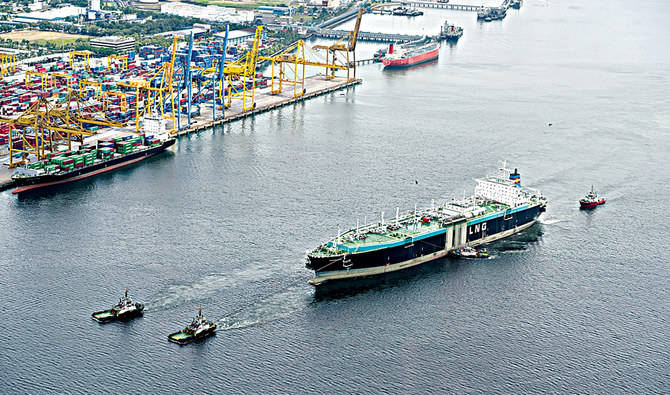
Asian LNG prices tumble as supply floods market

Traders say LNG cargoes may struggle to find a home. (AFP)
Updated 23 November 2019
Follow

Asian LNG prices tumble as supply floods market

  • Singapore’s Pavilion Energy has taken the unusual step of canceling the loading of a cargo from the US

SINGAPORE: Asian spot prices for liquefied natural gas (LNG) fell this week as a supply glut continued to weigh, while demand growth was muted by signs of a mild winter in Northeast Asia.

Prices for January delivery to Northeast Asia are estimated to be about $5.70 per million British thermal units (mmBtu), down 20 cents from last week for the same period, said several sources who are market participants.

With European gas storage nearly full, cargoes may struggle to find a home, traders said.

Singapore’s Pavilion Energy has taken the unusual step of canceling the loading of a cargo from the US, but has agreed to pay for it, several industry sources said.

A company spokeswoman said Pavilion evaluated scheduling and other commercial matters and took the decision not to lift the cargo in coordination with the supplier.

Supply was ample with several LNG plants offering cargoes this week.

Angola’s LNG project offered a cargo for delivery in January to as far as Indonesia, while Australia’s Ichthys and Papua New Guinea LNG plants offered a cargo each for December, sources said.

Indonesia’s Tangguh LNG plant, which is operated by oil major BP, also offered five cargoes for delivery over the first quarter of next year, sources added.

Some buy tenders from Thailand were finalized with PTT’s Singapore trading unit awarding a tender to buy more than 10 LNG cargoes for delivery over a year from March, 2020, a company official said.

State-run Electricity Generating Authority of Thailand (EGAT) has awarded its first spot tender to import LNG cargoes for delivery in December this year and in March next year, industry sources said.

It is also seeking government approval to import one more spot LNG cargo for next year, one of the sources said.

South Korea’s SK Energy and POSCO were jointly seeking a cargo for delivery in the second half of December, industry sources said, although further details of the tender were not immediately available.

Low spot prices also attracted some demand from India, with Indian Oil Corp. seeking a cargo for delivery on Dec. 17, industry sources said.

“The low prices may be creating some end-user demand in India which is attracting purchase interest in the international market,” a source familiar with the Indian market said.


Saudi stock market opens its doors to foreign investors

Updated 06 January 2026
Follow

Saudi stock market opens its doors to foreign investors

RIYADH: Foreigners will be able to invest directly in Saudi Arabia’s stock market from Feb. 1, the Kingdom’s Capital Market Authority has announced.

The CMA’s board has approved a regulatory change which will mean the capital market, across all its segments, will be accessible to investors from around the world for direct participation.

According to a statement, the approved amendments aim to expand and diversify the base of those permitted to invest in the Main Market, thereby supporting investment inflows and enhancing market liquidity.

International investors' ownership in the capital market exceeded SR590 billion ($157.32 billion) by the end of the third quarter of 2025, while international investments in the main market reached approximately SR519 billion during the same period — an annual rise of 4 percent.

“The approved amendments eliminated the concept of the Qualified Foreign Investor in the Main Market, thereby allowing all categories of foreign investors to access the market without the need to meet qualification requirements,” said the CMA, adding: “It also eliminated the regulatory framework governing swap agreements, which were used as an option to enable non-resident foreign investors to obtain economic benefits only from listed securities, and the allowance of direct investment in shares listed on the Main Market.”

In July, the CMA approved measures to simplify the procedures for opening and operating investment accounts for certain categories of investors. These included natural foreign investors residing in one of the Gulf Cooperation Council countries, as well as those who had previously resided in the Kingdom or in any GCC country. 

This step represented an interim phase leading up to the decision announced today, with the aim of increasing confidence among participants in the Main Market and supporting the local economy.

Saudi Arabia, which ‌is more than halfway ‍through an economic plan ‍to reduce its dependence on oil, ‍has been trying to attract foreign investors, including by establishing exchange-traded funds with Asian partners in Japan and Hong Kong.