

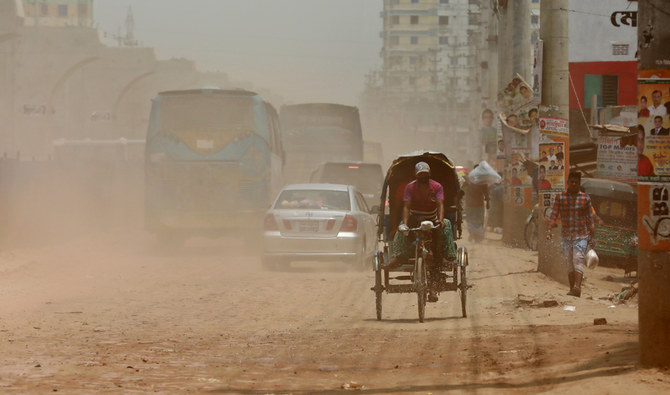

DHAKA: The Bangladeshi capital Dhaka is officially one the world’s most polluted cities, according to the US Consulate’s monitors in the city.
As the deteriorating air quality in Dhaka threaten the lives of its residents, government agencies are mulling an “integrated approach” to address air pollution after accusations of bad coordination. From Sunday to Tuesday, Dhaka’s air was the worst in the world. On Thursday, Lahore, in Pakistan, took the lead, becoming the most heavily polluted city, followed by Delhi, in India.
Officials at the country’s directorate of environment say their efforts are focused on preventing pollution from becoming even worse than “very unhealthy” during the dry season which runs from November through to January.
Under the US-based Air Quality Index (AQI), air quality is considered as “good” while the index score is between 0 and 50. It is “moderate” when the score is 51-100. If readings show 101-150, the air is “unhealthy” for sensitive groups of people, and when the score is 151-200, it is considered as “unhealthy” for all. If the score reaches 201-300, the air is considered “very unhealthy.”
“We are trying hard to maintain the AQI index during winter at 200–250. Our best efforts are focused on keeping the score below 300,” said Ziaul Haque, air quality director at the environment directorate.
The AQI reading is determined by the prevalence of particulate matter (PM) in the air. Particulate matter is a mixture of hazardous solid and liquid particles, ranging from 2.5 (PM2.5) to 10 (PM10) micrometers in diameter. They are so tiny that they can easily enter the bloodstream and lead to serious health conditions.
According to Haque, Dhaka’s pollution is worsening as brick kilns surrounding the city are mostly coal-fueled, emitting toxic pollutants. In two industrial towns on the outskirts a majority of production facilities do not comply with emission standards.
The situation is aggravated further by infrastructure mega-projects such as a metro rail system and an elevated expressway that produce huge amounts of dust, adding to emissions from old vehicles, private construction projects, and open trash burning.
The department of environment has scheduled a meeting with the ministers of environment, home affairs and public works, as well as the city’s mayors on Nov. 25, to suggest an “integrated approach” in addressing the problem, Haque said. He explained that coordination among different government agencies needs to be improved, especially with regard to development and maintenance works.
He also said that law enforcement will be strengthened at the brick kilns that pollute the city. More than 100 have already been shut down in the past few months.
Bangladeshi environmentalists blame miscoordination among different agencies for the government’s inefficiency in improving Dhaka’s air quality.
“All of the construction sites should be duly protected with a cover. City corporations should introduce modern waste management systems and vehicles emitting black smoke should not run on the city’s streets,” said Dr. Mohammad Abdul Matin, vice president of the Bangladesh Environmentalist Movement (BAPA).
According to Matin, monitoring of polluters needs to be improved.
Catalin Bercaru, World Health Organization spokesman in Dhaka, said the authorities need not only to develop a comprehensive monitoring framework for ambient air quality, but also to update the existing regulations to curb the air pollution. They also require “better enforcement of environmental and antipollution laws,” he said.
Bercaru also suggested that Bangladesh should develop green technologies for emissions control and “set new air quality standards for important polluters which are source-specific and health-based.”
According to the WHO’s report World Health Statistics 2018, air pollution in Bangladesh results in premature deaths of 149 per every 100,000 people, contributing to heart and respiratory diseases, stroke and cancer.


