DUBAI: Junoon’s music keeps getting better with age, said Salman Ahmed, the Sufi rock band’s lead guitarist and songwriter, ahead of their second and last Dubai concert this year.
After the success of The International Premiere Concert in Dubai in January, witnessed by more than 7,000 Junoonis – as their fans are fondly called – the show, dubbed Junoon Reloaded – The Middle East Exclusive, will go on at the Dubai Duty Free Tennis Stadium on Nov. 29.
“Junoon has performed sold-out shows across the planet,” Salman told Arab News. “From Pakistan to UAE, from UK to USA, and from Canada to Bangladesh, the response from our Junoonis has been incredible,” he said, adding that particularly loyal are their audiences in the Gulf.
The January concert marked Junoon’s reunion and was its first international gig after a split in 2005.
One of the most popular Pakistani bands of all times, Junoon dominated the South Asian music industry in the 1990s and early 2000s.
Singles such as “Jazba-e-Junoon,” “Sayonee,” “Saeein,” “Bulleya” and “Khudi” conquered the charts and hearts of the Subcontinent, earning Junoon raging popularity and recognition for its unique “Sufi rock” sound, which blends Western rock music with Pakistani folk songs and classical poetry.
With Ahmed as lead guitarist and songwriter, Ali Azmat as lead vocalist and Brian O’Connel on bass, the band produced critically acclaimed and commercially successful albums “Inquilab,” “Azadi” and “Parvaaz.”
Ahmed shared with Arab News that during the Nov. 29 concert the group will celebrate the 20th anniversary of the release of “Parveez.”
Junoon has over 100 million albums sold worldwide, with “Sayonee” being one of the most covered songs in India. An upcoming Bollywood film will have it as the theme song.
The group performed at prestigious music events such as the Millennium Peace Concert in Paris and the Roskilde Music Festival in Denmark. In 2001, Junoon became the first rock band to perform at the United Nations General Assembly in New York.
Called “the U2 of Pakistan” by the New York Times, the band has released seven studio albums, one soundtrack, two live albums, four video albums and five compilations.
They won the Best International Group Award at the Channel (V) Awards in Delhi, and the Nigar Award for the “Jinnah” biopic soundtrack song “Azadi.”
The group’s “Jazba-e-Junoon” became the theme song of the 1996 Cricket World Cup.
The band split up in 2005, when O’Connel returned to the US and Azmet started a solo career.
The group’s name stayed with Ahmed who kept on producing music under the label. He also became involved in social activism and has served as a goodwill ambassador for the UN HIV/AIDS Program in South Asia. He also became Rotary International’s goodwill ambassador for the eradication of polio in Pakistan.
For 13 years, as Junoon members were engaged in solo careers, fans kept the band and its music alive, never losing hope for their reunion. According to Naresh Oberoi, founder and chairman of Oberoi Middle East Events, which organizes the Dubai concert, “Junoon is not just a band, it’s a phenomenon with a cult-like following that cuts across geographical boundaries and age groups.”
“The band’s split was heartbreaking for everyone. Thousands of Junoonis have been waiting for years to see Salman, Ali and Brian get back together. ‘Junoon Reloaded Concert’ will see everyone’s dream finally coming true once again. It promises to be a highly emotional and memorable event that no fan will want to miss,” he said.


![]()

Junoon plans special celebration at next week’s Dubai concert
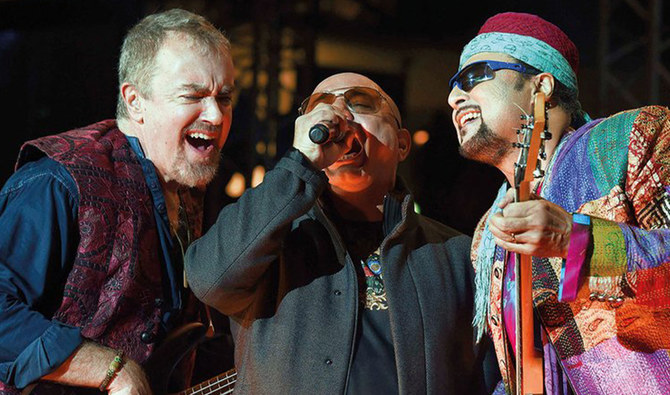
Junoon plans special celebration at next week’s Dubai concert
- Junoon will perform at the Dubai Duty Free Tennis Stadium on Nov. 29
- The group will celebrate the 20th anniversary of the release of its sixth album “Parveez”
Latest updates


© 2026 SAUDI RESEARCH & PUBLISHING COMPANY, All Rights Reserved And subject to Terms of Use Agreement.