

Lt Gen Raza appointed new head of joint chiefs of staff committee

Newly appointed Chairman Joint Chiefs of Staff Committee (CJCSC), Lt Gen Nadeem Raza, left, with the Prime Minister of Pakistan at his office in Islamabad on Nov. 21. 2019. (Photo courtesy: Screengrab from the PM house video)
Updated 22 November 2019
Follow

Lt Gen Raza appointed new head of joint chiefs of staff committee

  • A highly decorated officer, Raza served most recently as Chief of General Staff
  • The government already notified General Qamar Javed Bajwa’s reappointment as army chief in August this year

ISLAMABAD: Prime Minister Imran Khan has appointed Lt Gen Nadeem Raza as the country’s new Chairman Joint Chiefs of Staff Committee (CJCSC), announced an official statement circulated by the PM Office on Thursday.
His appointment will take effect from November 27 when he will replace the incumbent CJCSC, Gen Zubair Hayat.
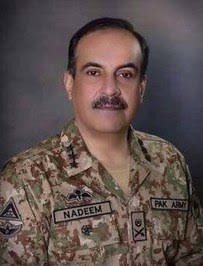


Chairman Joint Chiefs of Staff Committee (CJCSC), Lt Gen Nadeem Raza (Photo courtesy: ISPR)

Lt Gen Raza is a highly decorated military officer who became the Chief of General Staff last year. The post is considered extremely prestigious among the armed forces since the officer occupying it gets to work closely with the country’s powerful army chief.
According to the local media, Lt Gen Raza was commissioned in the infantry in September 1985. He will now be running the topmost military office in the country, serving as an adviser to the government on defense-related matters and coordinating with the Pakistan Navy and Air Force.
Apart from announcing the appointment of Lt Gen Raza, the official statement from the PM Office also mentioned that Gen Qamar Javed Bajwa’s reappointment as the army chief had already been notified in August 2019.
Gen Bajwa will continue to serve as Chief of Army Staff for the next three years.


Pakistan cabinet reviews private Hajj policy as mandatory pilgrim training enforced

Updated 10 sec ago
Follow

Pakistan cabinet reviews private Hajj policy as mandatory pilgrim training enforced

  • Cabinet sends draft Private Hajj Policy 2027–2030 to committee for further review
  • Religion minister warns pilgrims who skip mandatory training will be barred from Hajj

ISLAMABAD: Pakistan’s federal cabinet on Wednesday reviewed proposals for stricter oversight of private Hajj operators, as authorities separately warned that pilgrims who failed to complete mandatory training would be barred from performing Hajj next year.

The cabinet, chaired by Prime Minister Shehbaz Sharif, was briefed on a draft Private Hajj Policy for 2027–2030, which includes third-party registration and scrutiny of private Hajj operator companies, according to a statement from the Prime Minister’s Office.

“The Federal Cabinet directed that the draft Private Hajj Policy 2027–2030, presented by the Ministry of Religious Affairs and Interfaith Harmony regarding third-party registration and scrutiny of private Hajj operators’ companies, be referred to the Hajj Policy Committee for further deliberation in light of the views of Cabinet members,” the prime minister’s office said in a statement.

The development comes as Religious Affairs Minister Sardar Muhammad Yousaf said on Wednesday pilgrims who failed to attend both phases of mandatory Hajj training would not be allowed to perform the pilgrimage.

“Pilgrims who do not complete mandatory Hajj training will be barred from performing Hajj,” the ministry quoted Yousaf as saying during a training workshop in Islamabad.

Around 120,000 pilgrims are currently undergoing training at 200 locations nationwide, with the second phase scheduled to begin after Ramadan. The training aims to familiarize pilgrims with Saudi laws, Hajj rituals and safety protocols to prevent accidents in crowded areas.

Saudi Arabia has allocated 179,210 pilgrims to Pakistan for Hajj 2026, including about 118,000 seats under the government scheme, while the remainder will be handled by private tour operators.

Under Pakistan’s government Hajj package, the estimated cost ranges from Rs1.15 million to Rs1.25 million ($4,049.93 to $4,236), subject to final agreements with service providers.