


DUBAI: I must confess I was a little nervous about telling Stephen Schwarzman, co-founder and CEO of the gigantic financial group Blackstone, that I had not read every single word of his recently published book “What is Takes — Lessons in the Pursuit of Excellence.”
Ahead of our intercontinental conference-call interview, his aides had told me that he could work out pretty quickly if an interviewer had read it or not, and a recent interview in the Financial Times had made the point that he is not the type of man to indulge perceived lapses equably.
There was a long silence when I told him that, although I had read large chunks of it, I had not quite finished it, but I needn’t have worried. I have seen Schwarzman speak on many occasions, most recently at the Future Investment Initiative in Riyadh, and he was as pleasant and softly spoken on the phone with me as he had invariably been on those occasions. No expletives or combativeness during our phone call.
Schwarzman is pretty high up the list of the most powerful people in the world. Worth some $18 billion, he is one of the financial “masters of the universe” who count presidents, kings and princes among his circle of friends, and who has the fate of hundreds of thousands of employees in Blackstone’s portfolio companies in his hands.
Why did he write the book, which is a mixture of autobiographical memoire and self-help advice?
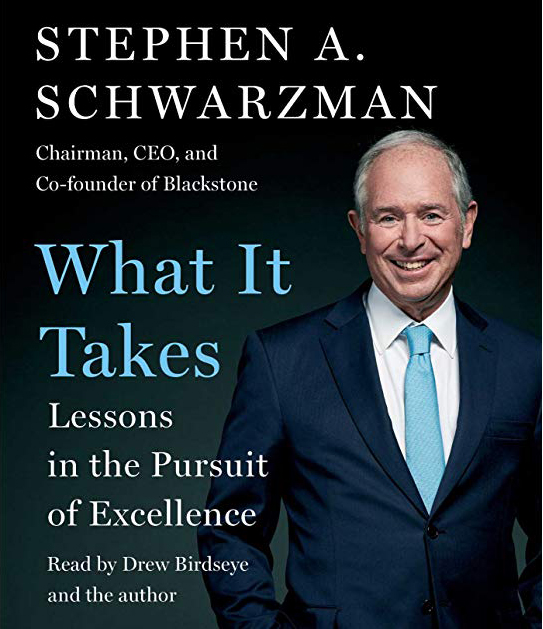
“I was mostly trying to give people advice and used myself as a literary device. My life’s been pretty interesting, and I’m writing about the types of things that happen to almost everyone — how through dejection and disappointment you scramble to reinvent yourself and learn from your mistakes to establish a new paradigm,” he explained.
The message from the book seems to be encapsulated in the first of his “25 rules for work and life”: “It’s as easy to do something big as to do something small, so reach for a fantasy worthy of your pursuit, with rewards commensurate with your effort.”
The response to publication has been “marvellous,” he said, including a story about a woman who had passed it on to her children as a primer for life.
Schwarzman’s own life is one that, arguably, could only have been possible in the post-war US. From small-town beginnings in suburban Philadelphia, the son of second generation immigrants who ran a linen store, he worked hard at school, got into Yale, was a track-star who signed up for the Vietnam-era army reserve and ended on Wall Street, after Harvard Business School.
A decade of fast-learning at Lehman Brothers in the 1970s — where he rose to be head of global mergers and acquisitions — gave way to disillusionment when the venerable firm was sold, and gave him the spark for what was to become Blackstone, one of the world’s foremost private equity investors.
I suggested that he had “invented” the private equity business, but he was not having that. “Inventing may be a bit too grand. What we did do was invent in effect the full-line alternative assets firm, you could call it the full-line private equity firm, which doesn’t just buy companies, which a normal private equate firm does. We also buy real estate, we also lend money, we buy credit products, we also have a big hedge fund operation.
BIO
Born: Philadelphia, US, 1947
Education
- Abingdon Senior High School, Philadelphia
- Yale University, bachelor of arts
- Harvard Business School, master’s in business administration.
Career
- Analyst, Donaldson, Lufkin & Jenrette.
- Managing director and head of global M&A, Lehman Brothers.
- Co-founder and CEO, Blackstone.
- Numerous political advisory and philanthropic positions.
“We started out with one private equity fund, but we now have over 50 different business lines. We were pioneers in looking at new things that could be done within a private framework. Our high performance products typically earn double the stock market and almost never lose money,” he said.
He and his co-founder, Peter Peterson, put $400,000 into Blackstone in 1985. The firm now has $554 billion in assets and $62 billion in market value. Innovation has been the key to that success, identifying new sectors, new geographies and new financial products.
But old-fashioned bricks-and-mortar has also played a big role. Schwarzman saw a buying opportunity in the US real estate market when property prices fell, and Blackstone is now the “largest owner of real estate in the world,” he said.
I asked whether the current trend for valuation was up or down — for instance in New York.
His response echoed the recent comments from his friend President Donald Trump who moved his permanent residence from his home town to Florida. “New York has some special circumstances and doesn’t have as good prospects as some other places. We have extremely high taxes in New York which discourages people,” he said.
I think the Kingdom has got very ambitious plans for both growth and reform, individual rights especially for women.
Other parts of the US real estate market are more appealing. “You do the best typically when you buy near water, so the east and west coasts tend to be the best places to buy.” But the best property asset classes are warehouses, he said, which are benefiting from the logistics boom brought about by the likes of Amazon’s home delivery services. He has around $1 billion in warehouse assets.
Blackstone went public in 2007, just ahead of the global financial which it navigated much more successfully than many on Wall Street, including his old employer Lehman Brothers which became the largest bankruptcy in American history.
Schwarzman was able to use to broad spread of Blacktone’s global business to “see what was going on, this massive housing bubble,” before the crisis hit. He stopped investment in some real estate projects, sold down property related loans and shorted sub-prime mortgages, even making some money out of the meltdown, though he admits to some “very minimal damage.”
“We had exited, while many of the others were like the people sitting on a beach in Thailand watching the tsunami coming in. We were already a few miles inland by the time it hit,” he said. Blackstone has grown sixfold since the crisis.
Another reason for my initial trepidation on talking to Schwarzman was a warning from his advisers not to ask him too early in the conversation about the Middle East. For the past few years, he has been a confidant and business partner of Saudi Arabia, appearing on panels and forums in the Kingdom and speaking supportively of the Vision 2030 strategy, but the region does not figure too prominently in the book.
Founded in 1985 with with just a $400,000 capital, Blackstone now has $554 billion in assets and $62 billion in market value. (AP file photo)
There are only a couple of references to the Gulf — a capital-raising trip in the early 1990s that “bombed,” and a Kuwait-Dubai visit that nearly turned into disaster when a colleague had to be evacuated after a medical emergency by a private plane that developed engine trouble over Iran. (All ended well.)
The book ends before his most recent involvement with Saudi Arabia, the $40 billion infrastructure fund jointly invested with the Public Investment Fund, but he is happy to update his relationship with the Middle East.
“We have extensive relationships with the region. Let me give you some perspective: Since my first trip to Riyadh, it has grown seven times in population; many of the roads were dirt roads back then, but now the city is a huge, super-modern city. It’s changing so fast.
“I was in Kuwait six weeks after the Iraqi invasion was thrown back, and you could still smell cordite and see bullet holes all over. That’s where we got our first money in the region, the Kuwaitis were so grateful and we were the first Americans many of them had seen,” he said.
Saudi Arabia has been a Blackstone focus for the past couple of years. “I think the Kingdom has got very ambitious plans for both growth and reform, individual rights especially for women. Those are all good things.
“There’s a huge emphasis on the digital economy there, which is quite unusual by the historic background, and 70 percent of the population is under 30. There has been a positive response from them for what is going on there,” he added.
The $40 billion fund with PIF was “going quite well,” he said, especially against the background of low interest rates. He and PIF have bought one of the biggest ports businesses in north America and a big US pipeline business.
Like many wealthy self-made men, philanthropy is an increasing element of his personal philosophy. Schwarzman estimated he has given away something over $1 billion to a variety of philanthropic ventures, ranging from a cultural center at Yale University to the biggest ever donation to a British educational institute, a £150 million ($193 million) gift to Oxford University.
He seems most proud of the Schwarzman Scholars, a program at Tsinghua University in China which he hopes will help defuse the tensions between the US and China that have resulted in trade wars that have damaged the global economy.
That fits in perfectly with the Schwarzman philosophy. Rule number 19 in his 25-item list is: “Don’t lose money,” but he noted: “You might say that’s the No.1 rule.”


