KUWAIT: The Kuwaiti prime minister resigned on Thursday along with his cabinet amid allegations of infighting between ministers and criticism of their performance.
Prime Minister Sheikh Jaber Mubarak Al-Sabah "submitted the resignation of the cabinet to the emir... in order to allow for a cabinet reshuffle," government spokesman Tareq Al-Mazrem said.
Emir of Kuwait Sheikh Sabah Al-Ahmad Al-Sabah accepted his resignation, the official KUNA news agency reported.
Minister of Finance Nayef Al-Hajraf resigned last month to avoid being questioned in parliament over violating Islamic law by charging interest on loans taken by retired Kuwaitis from the state-run pension agency.
And Public Works Minister Jenan Bushehri announced her resignation following a lengthy grilling in parliament during which she came under fire for alleged mismanagement of her portfolios and poor use of public funds.
On Tuesday, parliament also grilled Interior Minister Sheikh Khaled Al-Jarrah Al-Sabah, a member of the ruling family, over similar accusations and MPs filed a no-confidence motion to oust him.
Independent MP Saleh Ashour told AFP that as well as those criticisms, disputes between ministers over the current composition of the cabinet had also triggered the resignation.
Parliament speaker Marzouk Al-Ghanem told reporters Thursday that "a large group of MPs believe that the problem lies in the government team because it is not homogenous".
He however ruled out the possibility that parliament could be dissolved by the emir.
After accepting the resignation, the emir can rename the outgoing premier or appoint a new head of government to form the cabinet, the eighth since 2011.
Kuwait is the only Gulf state with a fully elected parliament that enjoys wide legislative powers and can vote ministers out of office.
The country has been shaken by political disputes between lawmakers and the ruling family-led government for over a decade, with parliament and cabinets dissolved several times.
A demonstration held outside parliament last week over alleged rampant corruption was reminiscent of past crises that have marred political life in the country.


Kuwait’s government resigns ahead of anticipated elections
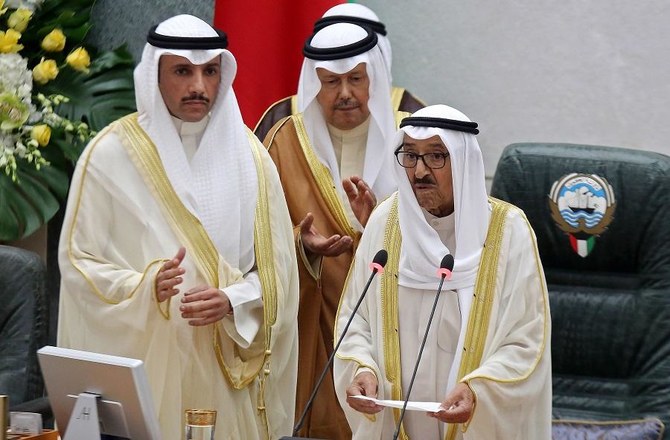
Kuwait’s government resigns ahead of anticipated elections

- An election is also expected for the 50-seat parliament in early 2020
- Emir of Kuwait accepted the resignation Prime Minister Sheikh Jaber Mubarak Al-Sabah


Trump says change of power in Iran would be ‘best thing’
- Trump’s comments were his most overt call yet for the toppling of Iran’s clerical establishment
- USS Gerald R. Ford — the world’s largest warship — would be “leaving very soon” for the Middle East
WASHINGTON: US President Donald Trump said Friday that a change of government in Iran would be the “best thing that could happen,” as he sent a second aircraft carrier to the Middle East to ratchet up military pressure on the Islamic republic.
Trump’s comments were his most overt call yet for the toppling of Iran’s clerical establishment, and came as he pushes on Washington’s arch-foe Tehran to make a deal to limit its nuclear program.
At the same time, the exiled son of the Iranian shah toppled in the 1979 Islamic revolution renewed his calls for international intervention following a bloody crackdown on protests by Tehran.
“Seems like that would be the best thing that could happen,” Trump told reporters at the Fort Bragg military base in North Carolina when a journalist asked if he wanted “regime change” in Iran.
Trump declined to say who he would want to take over in Iran from supreme leader Ayatollah Ali Khamenei, but he added that “there are people.”
He has previously backed off full-throated calls for a change of government in Iran, warning that it could cause chaos, although he has made threats toward Khamenei in the past.
Speaking earlier at the White House, Trump said that the USS Gerald R. Ford — the world’s largest warship — would be “leaving very soon” for the Middle East to up the pressure on Iran.
“In case we don’t make a deal, we’ll need it,” Trump said.
The giant vessel is currently in the Caribbean following the US overthrow of Venezuela’s Nicolas Maduro. Another carrier, the USS Abraham Lincoln, is one of 12 US ships already in the Middle East.
‘Terribly difficult’
When Iran began its crackdown on protests last month — which rights groups say killed thousands — Trump initially said that the United States was “locked and loaded” to help demonstrators.
But he has recently focused his military threats on Tehran’s nuclear program, which US forces struck last July during Israel’s unprecedented 12-day war with Iran.
The protests have subsided for now but US-based Reza Pahlavi, the son of Iran’s last shah, urged international intervention to support the Iranian people.
“We are asking for a humanitarian intervention to prevent more innocent lives being killed in the process,” he told the Munich Security Conference.
It followed a call by the opposition leader, who has not returned to his country since before the revolution, for Iranians at home and abroad to continue demonstrations this weekend.
Videos verified by AFP showed people in Iran this week chanting anti-government slogans as the clerical leadership celebrated the anniversary of the Islamic revolution.
Iran and the United States, who have had no diplomatic relations since shortly after the revolution, held talks on the nuclear issue last week in Oman. No dates have been set for new talks yet.
The West fears the program is aimed at making a bomb, which Tehran denies.
The head of the UN nuclear watchdog, Rafael Grossi, said Friday that reaching an accord with Iran on inspections of its processing facilities was possible but “terribly difficult.”
Reformists released
Trump said after talks with Israeli Prime Minister Benjamin Netanyahu earlier this week that he wanted to continue talks with Iran, defying pressure from his key ally for a tougher stance.
The Israeli prime minister himself expressed skepticism at the quality of any agreement if it didn’t also cover Iran’s ballistic missiles and support for regional proxies.
According to the US-based Human Rights Activists News Agency, 7,008 people, mostly protesters, were killed in the recent crackdown, although rights groups warn the toll is likely far higher.
More than 53,000 people have also been arrested, it added.
The Norway-based Iran Human Rights (IHR) NGO said “hundreds” of people were facing charges linked to the protests that could see them sentenced to death.
Figures working within the Iranian system have also been arrested, with three politicians detained this week from the so-called reformist wing of Iranian politics supportive of President Masoud Pezeshkian.
The three — Azar Mansouri, Javad Emam and Ebrahim Asgharzadeh — were released on bail Thursday and Friday, their lawyer Hojjat Kermani told the ISNA news agency.