Iraq protests swell as UN presses Baghdad to ‘step up’

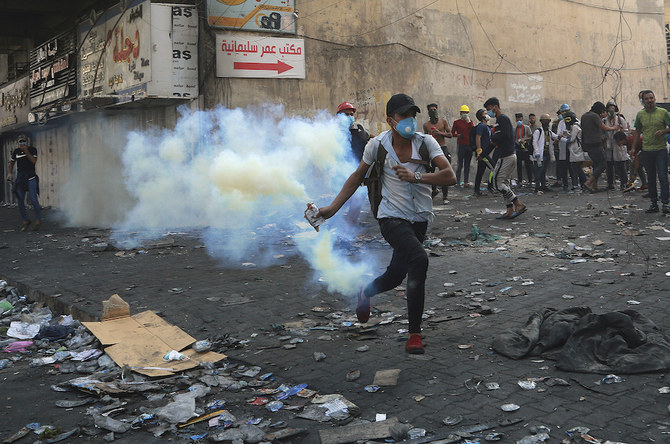
An anti-government protester prepares to throw back a tear gas canister fired by police during clashes between Iraqi security forces and demonstrators, in downtown Baghdad, Iraq, Wednesday, Nov. 13, 2019. (AP)
Updated 13 November 2019
Follow

Iraq protests swell as UN presses Baghdad to ‘step up’

  • UN has put forward a phased roadmap calling for an immediate end to violence and electoral reform within 2 weeks
  • Protesters have escalated their demands to deep-rooted regime change

BAGHDAD: Iraqi officials must “step up” to respond to mass demonstrations, the UN representative in Baghdad told AFP on Wednesday as anti-government rallies swelled in Iraq’s capital and the country’s south.
Protests demanding an overhaul of the political system have rocked Baghdad and the Shiite-majority south for weeks — the crowds unmoved by government pledges of reform and undeterred by the deaths of more than 300 demonstrators.
Washington and the United Nations have called on the government to respond seriously to the protests, with the world body’s representative Jeanine Hennis-Plasschaert saying the country’s authorities must “step up to the plate and make things happen.”
“They are elected by the people, they are accountable to them,” the head of the UN’s Iraq mission (UNAMI) told AFP in an exclusive interview.
US Secretary of State Mike Pompeo, for his part, has said he told Iraqi Prime Minister Adel Abdel Mahdi that he “deplored the death toll” and to address the popular movement’s “legitimate grievances.”
The protests had slowed for a few days following a deadly crackdown by security forces in Baghdad and major southern cities but flared again Wednesday with demonstrations by striking students and teachers.
“We’re here to back the protesters and their legitimate demands, which include teachers’ rights,” said Aqeel Atshan, a professor on strike, in Baghdad’s Tahrir (Liberation) Square, the epicenter of the protest movement.
In the southern port city of Basra, around 800 students returned to camp outside the provincial government headquarters, days after they had been pushed out by riot police.
Schools were also shut in the protest hotspots of Diwaniyah and Nasiriyah.
Protesters have felt emboldened since the country’s top Shiite religious authority Grand Ayatollah Ali Sistani said they “cannot go home without sufficient reforms.”
“Students, boys and girls alike, are all here for a sit-in,” another demonstrator in Tahrir told AFP.
“If Sistani gave the orders for mass civil disobedience, everything would close — the government, the oil companies, everything. That’s how we’ll have a solution.”
The UN has put forward a phased roadmap, backed by Sistani, calling for an immediate end to violence, electoral reform and anti-graft measures within two weeks.
Hennis-Plasschaert, the UN envoy, discussed the plan with lawmakers during a parliamentary session on Wednesday afternoon.
“Now is the time to act, otherwise any momentum will be lost — lost at a time when many, many Iraqis demand concrete results,” she told them on the sidelines of the parliamentary meeting.
At the session’s opening, speaker of parliament Mohammed Al-Halbussi pledged to work on laws to respond to protesters’ demands including electoral reform.
Parliament has received a draft law for electoral reform but has yet to discuss it.
Lawmakers also set dates to interrogate two ministers, which could indicate the first steps of a cabinet reshuffle announced by Abdel Mahdi.
Oil-rich Iraq is ranked the 12th most corrupt country in the world by Transparency International, and youth unemployment stands at 25 percent.
Demonstrations erupted on October 1 in fury over a lack of jobs and corruption, initially fracturing the ruling class.
Populist cleric Moqtada Sadr then called on the government to resign and President Barham Saleh suggested early elections, while other factions stood by Abdel Mahdi.
But after a series of meetings led by Iran’s influential Major General Qassem Soleimani, a consensus emerged at the weekend over the government remaining intact and both Saleh and Sadr appear to have changed their tunes.
Sadr, who is reported to be in Iran, took to Twitter on Wednesday to call on parliament to enact reforms and for “a general strike, even for one day,” but did not demand the premier step down.
Saleh, too, appears to have dropped the idea of early elections.
The agreement brokered by Soleimani appeared to have paved the way for a crackdown on demonstrations last weekend that sent the death toll amid the unrest to well over 300.
Iraq has faced growing criticism over its response to rallies, with rights defenders accusing authorities of shooting live rounds at protesters and curtailing freedom of expression with an Internet blackout and mass arrests.
Also on Wednesday, the president of autonomous Iraqi Kurdistan, Nechirvan Barzani, was in Baghdad to meet with the premier, president and speaker of parliament.
Barzani and Abdel Mahdi are believed to have good personal ties, and the Iraqi Kurdish authorities have backed the current government.
But they have worried that any amendments to Iraq’s 2005 constitution as part of a reform process could infringe on Kurdish rights.


Palestinian shot dead in Hebron

Updated 4 sec ago
Follow

Palestinian shot dead in Hebron

  • Bedouin families continue flee West Bank village due to harassment by settlers living in illegal outposts

RAMALLAH: Palestinian health officials said on Sunday that Israeli forces shot dead a Palestinian man in the occupied West Bank city of Hebron, an incident the Israeli military said it was reviewing.
The Health Ministry in Ramallah said the Palestinian body that coordinates with Israeli authorities had informed it that Israeli fire had killed Shaker Falah Ahmad Al-Jaabari, 58, on Saturday evening.
The ministry said Israeli forces were still holding Al-Jaabari’s body.
Late on Saturday, the Israeli military said its troops had responded to a “threat and opened fire at the terrorist who attempted to run them over.
Hours later, however, the military said in a separate statement that investigators had found “no conclusive findings (to) indicate that the incident constituted an intentional terror attack,” adding the case remained under investigation.
Violence has surged across the West Bank since the war in Gaza broke out in October 2023 after an unprecedented attack by Hamas on Israel.
At least 1,029 Palestinians have been killed in the West Bank by Israeli forces or settlers since the war started, according to the Palestinian Health Ministry.
Some 500,000 Israelis have settled in the West Bank since Israel captured the territory, along with East Jerusalem and the Gaza Strip, in the 1967 Mideast war. 
Their presence is viewed by most of the international community as illegal and a major obstacle to peace. 
The Palestinians seek all three areas for a future state.
Over two dozen families from one of the few remaining Palestinian Bedouin villages in the central West Bank have packed up and fled their homes in recent days, saying harassment by Jewish settlers living in unauthorized outposts nearby has grown unbearable.
The village, Ras Ein El-Auja, was originally home to some 700 people from more than 100 families that have lived there for decades.
Twenty-six families already left on Thursday, scattering across the territory in search of safer ground, rights groups say. Several other families were packing up and leaving on Sunday.
“We have been suffering greatly from the settlers. Every day, they come on foot, or on tractors, or on horseback with their sheep into our homes. They enter people’s homes daily,” said Nayef Zayed, a resident, as neighbors took down sheep pens and tin structures.
Other residents pledged to stay put for the time being. That makes them some of the last Palestinians left in the area, said Sarit Michaeli, international director at B’Tselem, an Israeli rights group helping the residents.
She said that mounting settler violence has already emptied neighboring Palestinian hamlets in the dusty corridor of land stretching from Ramallah in the West to Jericho, along the Jordanian border, in the east.
The area is part of the 60 percent of the West Bank that has remained under full Israeli control under the interim peace accords signed in the 1990s. 
Since October 2023, over 2,000 Palestinians — at least 44 entire communities — have been expelled by settler violence in the area, B’Tselem says.
The turning point for the village came in December, when settlers put up an outpost about 50 meters (yards) from Palestinian homes on the northwestern flank of the village, said Michaeli and Sam Stein, an activist who has been living in the village for a month.
Settlers strolled easily through the village at night. Sheep and laundry went missing. International activists had to begin escorting children to school to keep them safe.
“The settlers attack us day and night, they have displaced us, they harass us in every way,” said Eyad Isaac, another resident. 
“They intimidate the children and women.”
Michaeli said she has witnessed settlers walk around the village at night, going into homes to film women and children and tampering with the village’s electricity.
The residents said they call the police frequently to ask for help — but it seldom arrives. 
Settlement expansion has been promoted by successive Israeli governments over nearly six decades. 
But Benjamin Netanyahu’s far-right government, which has placed settler leaders in senior positions, has made it a top priority.
That growth has been accompanied by a spike in settler violence, much of it carried out by residents of unauthorized outposts. 
These outposts often begin with small farms or shepherding that are used to seize land, say Palestinians and anti-settlement activists. 
UN officials warn the trend is changing the map of the West Bank, entrenching Israeli presence in the area.
For now, displaced families from the village have dispersed to other villages near the city of Jericho and Hebron, further south, residents said. 
Some sold their sheep and are trying to move into the cities.
Others are just dismantling their structures without knowing where to go.
“Where will we go? There’s nowhere. We’re scattered,” said Zayed, the resident, “People’s situation is bad. Very bad.”