Fazlur Rehman says opposition protests to spread across the country

1 / 6
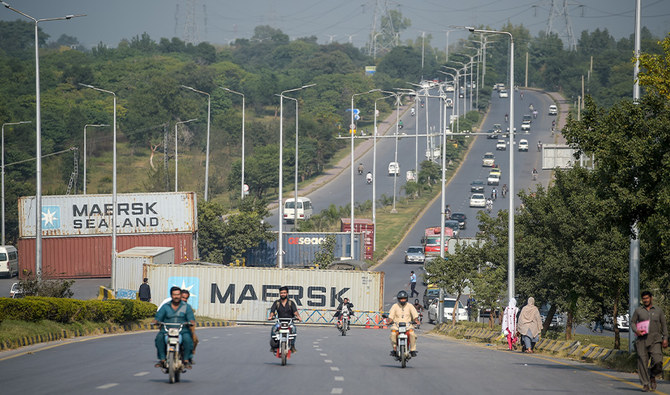
Motorists ride on a road blocked with containers, during an anti-government "Azadi March" led by Jamiat Ulema-e-Islam Chief Maulana Fazlur Rehman, in Islamabad on October 31, 2019. (AFP)
2 / 6
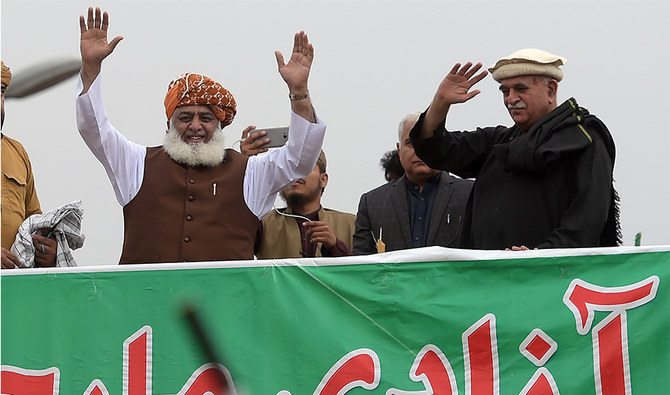
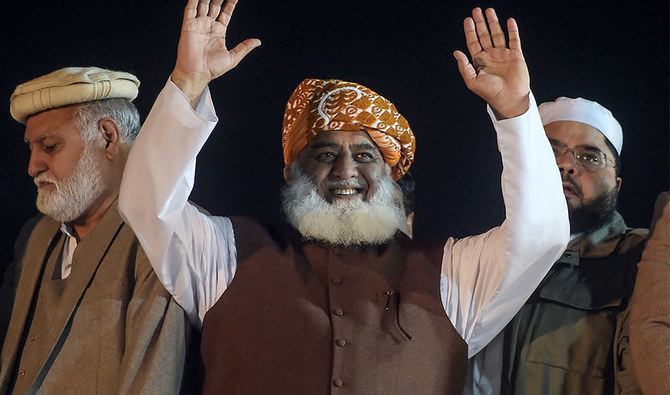
Islamic political party Jamiat Ulema-e-Islam (JUI-F) leader Maulana Fazlur Rehman (2L) waves at supporters during anti-government "Azadi (Freedom) March" in Islamabad on November 1, 2019. (AFP)
3 / 6
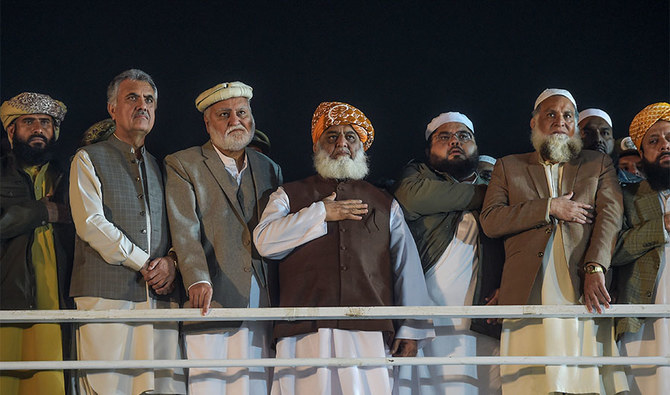
Islamic political party Jamiat Ulema-e-Islam (JUI-F) leader Maulana Fazlur Rehman (C), gestures to supporters during an anti-government "Azadi (Freedom) March" in Islamabad on November 13, 2019. (AFP)
4 / 6
Islamic political party Jamiat Ulema-e-Islam (JUI-F) leader Maulana Fazlur Rehman (C), gestures to supporters during an anti-government "Azadi (Freedom) March" in Islamabad on November 13, 2019. (AFP)
5 / 6
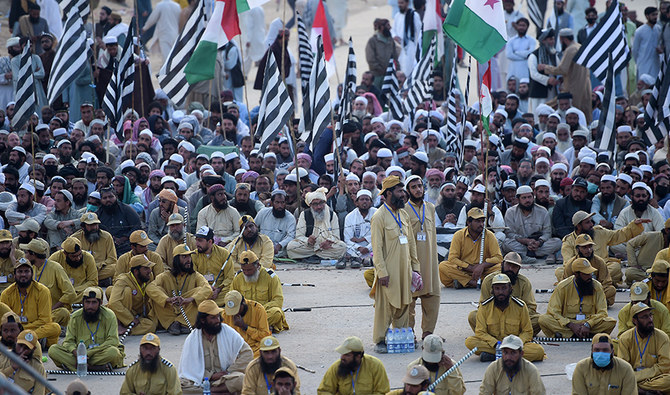
Activists and supporters of Islamic political party Jamiat Ulema-e-Islam (JUI-F) attend an anti-government "Azadi (Freedom) March" in Islamabad on November 5, 2019. (AFP)
6 / 6
Jamiat Ulema-e Islam (F) chief Maulana Fazal-ur-Rehman, left, during an exclusive interview with Arab News at his residence in Islamabad on Nov. 11, 2019. (AN photo)
Updated 14 November 2019
Follow

Fazlur Rehman says opposition protests to spread across the country

  • The firebrand cleric urges his followers to refrain from disrupting public life in the next phase of the protest
  • Tens of thousands of anti-government protesters were camped in Islamabad since Oct 31, seeking PM Khan’s resignation

ISLAMABAD: Pakistan’s opposition leader and Jamiat-e-Ulema-e-Islam (JUI-F) chief, Maulana Fazlur Rehman, on Wednesday called off his anti-government protest in Islamabad, announcing to block the country’s main highways and motorways in the next phase of the protest.

“You are leaving here today … but the journey of Azadi March will continue,” he told tens of thousands of demonstrators camped in Islamabad since October 31 who sought Prime Minister Imran Khan’s resignation and fresh polls in the country.

The firebrand religious cleric urged his followers to remain peaceful while implementing the next phase of the protest that, he said, would include blockade of highways and motorways across the country.

“We want to put the government under pressure since we refuse to accept the illegitimate rulers,” Rehman said while paying tribute to the demonstrators for being steadfast during the anti-government sit-in.

Huge crowds descended on Islamabad from various parts of the country on October 31, denouncing Khan’s government as illegitimate and calling for him to resign. The protesters are occupying a large open area alongside one of Islamabad’s main roads.

Khan has dismissed the calls to step down while the negotiations between the government and opposition politicians hit a snag.

Addressing the protesters in Islamabad Tuesday night, Rehman asked his party supporters across the country to come out of their homes to execute plan “B” of the anti-government protest but advised them not to take the law into their hands.

Rehman said that after taking protest to the next level “it will not be possible for the government to stand.”

“We will continue our struggle until we get rid of this illegitimate government,” Rehman said.

The ongoing anti-government protest in Islamabad has impacted the everyday life of the local residents and commuters traveling from other cities for work. The metro bus service between Rawalpindi and Islamabad cities has also been closed for almost two weeks.

“The venue of the rally, the metro (bus) depot, and Itwar (Sunday) bazar are side by side. Busses can’t enter the depot for fueling/maintenance without passing through the crowd. The Company that runs the operation is not willing to take the risk. We apologize for the inconvenience but there is no alternative,” the Deputy Commissioner of Islamabad Muhammad Hamza Shafqat tweeted Tuesday night.


Uzbekistan president arrives in Pakistan to increase trade, defense, energy cooperation

Updated 5 sec ago
Follow

Uzbekistan president arrives in Pakistan to increase trade, defense, energy cooperation

  • Uzbek President Shavkat Mirziyoyev leads high-level delegation of ministers, business leaders on Feb. 5-6 visit, says state media 
  • Visit takes place days after Pakistan, Uzbekistan reaffirmed $2 billion trade target during intergovernmental commission meeting

ISLAMABAD: Uzbekistan President Shavkat Mirziyoyev arrived in Pakistan’s capital Islamabad on Thursday, with a high-level delegation to identify new avenues for bilateral cooperation in trade, defense, energy and other avenues, state-run media reported. 

The visit takes place after the 10th session of the Pakistan–Uzbekistan Intergovernmental Commission (IGC) on Trade, Economic and Scientific-Technical Cooperation was held in Islamabad on Feb. 2. Both sides reaffirmed their $2 billion trade target and agreed to push for regional connectivity, develop trade routes and accelerate cooperation in several sectors. 

Mirziyoyev was given a red-carpet welcome when his aircraft landed at the Nur Khan Airbase, the state-run Associated Press of Pakistan (APP) said. He was welcomed by President Asif Ali Zardari, Prime Minister Shehbaz Sharif and senior members of the cabinet. 

“Discussions will focus on reviewing the entire gamut of bilateral relations and identifying new avenues to further deepen cooperation in diverse sectors, including trade, energy, defense, education, people-to-people exchange and regional connectivity,” APP reported. 

The Uzbek president will meet President Zardari, hold delegation-level talks with Prime Minister Sharif, and address the Pakistan-Uzbekistan Business Forum during his visit. 

Mirziyoyev’s visit takes place two days after Kazakhstan President Kassym-Jomart Tokayev arrived in Islamabad to hold talks on trade, business and connectivity. 

Pakistan and Kazakhstan signed 37 memoranda of understanding (MoUs) and set a target of raising bilateral trade to $1 billion within a year during Tokayev’s visit. 

Pakistan and Uzbekistan have steadily increased economic ties in recent years as Islamabad seeks greater access to landlocked Central Asian markets, aiming to position itself as a regional transit and trade hub linking South Asia with Central Asia.

Pakistan was the first Central Asian partner with which Uzbekistan signed a bilateral Transit Trade Agreement, along with a Preferential Trade Agreement in March 2022, covering 17 items, which became operational in 2023.

Pakistan’s finance ministry said last month that Azerbaijan’s state energy company SOCAR was set to finalize an investment in the country’s oil and gas sector following high-level engagements at the World Economic Forum in Davos.