KARTARPUR: Pakistani Prime Minister Imran Khan said on Saturday he was happy to serve the Sikh community by successfully opening a visa-free border crossing for pilgrims from India, allowing thousands of pilgrims to easily visit a Sikh shrine just inside Pakistan each day.
The shrine to Guru Nanak, the founder of the Sikh religion, is known as Gurdwara Darbar Sahib. It’s the second-holiest place in the Sikh faith and is located on the Ravi River just 4.5 kilometers from Pakistan’s border with India.
The shrine is visible from the Indian side of the border, and Sikhs would often gather on bluffs to view the site from the Indian side. Under a new arrangement, however, up to 5,000 pilgrims each day will be able to visit the shrine after applying for online permits.
Many Sikh holy sites were left in Pakistan after the British partitioned the subcontinent into separate nations in 1947 following two centuries of colonial rule.
“I’m so happy we [Pakistan] could do this for you [Sikhs],” Khan said during an address at the Kartarpur Corridor’s opening ceremony, adding that the inability of Sikhs to visit the Kartarpur shrine in the past was akin to Muslims being able to see Madina from a distance but not go near it.
“I tell the Muslims of Pakistan, imagine the pain of not being able to visit Madina if it was only four km away,” Khan said. “That is why I am happy to see you happy, and the way your hearts are full of prayers for us.”
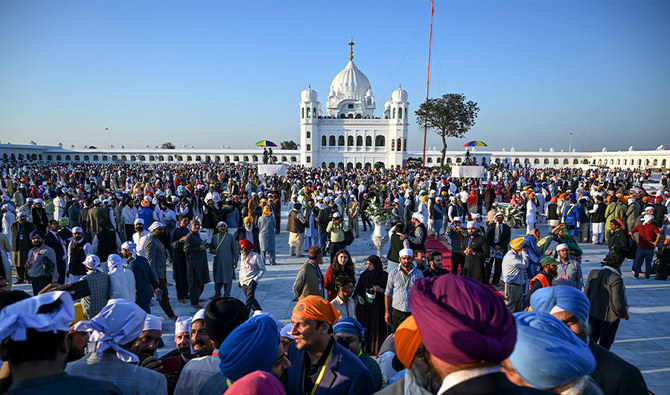
The opening ceremony, which comes just days before the 550th birth anniversary of Guru Nanak, was attended by hundreds of SIkhs from across the border including former Prime Minister Sardar Manmohan Singh, Bollywood star Sunny Deol, Indian Punjab Chief Minister Captain Amarinder Singh and several other Indian parliamentarians.
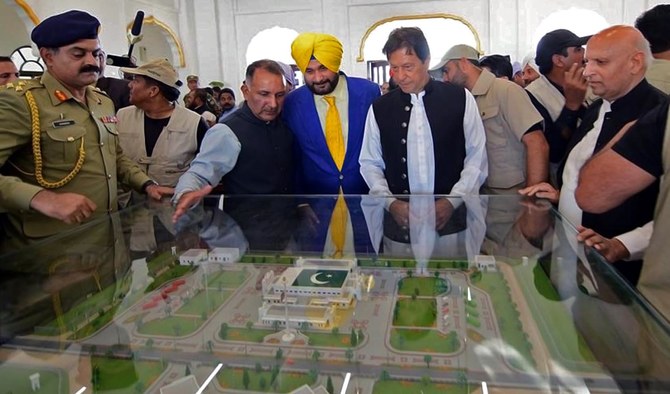
Over the past year, Pakistan has constructed a huge complex around the Sikh shrine with facilities to accommodate 5,000 pilgrims daily, including a vast dining hall, a library and rooms for performing rituals.
Pakistani authorities have called it the biggest Sikh shrine in the world. The religious group makes up only a tiny minority in Muslim-majority Pakistan.
“We have created this beautiful complex. This means we can do so much more work,” Khan said, standing before the massive white structure, its four cupolas glistening in the late afternoon sun.
India and Pakistan have fought three wars since independence from Britain in 1947. They came close to a fourth in February after a suicide bomb attack by a Pakistan-based militant group killed scores of Indian paramilitary police in the Indian part of the disputed Kashmir region, which both countries claim.
Relations have been especially tense since August, when India stripped autonomy and statehood from its portion of Kashmir. Pakistan reacted by cutting trade and transport ties and expelling India’s ambassador.
Khan said if Pakistan and India could solve the Kashmir conflict, they would be able to live together like good neighbors and work to lift their people out of poverty.
“Kashmir has gone beyond a territorial issue; this is an issue of humanity,” the PM said. “If Modi is listening, [he should know that] justice brings peace and injustice spreads confusion.”
“When this problem is solved and Kashmiris get their rights, the sub-continent will see prosperity and our entire region will rise in the world, and I pray that day is not far,” he said.
In a poetic speech in Punjabi, former Indian cricketer-turned-politician Navjot Singh Sidhu, a close friend of Khan’s, said his forefathers had died longing to come to Kartarpur, and Khan’s courage had made the dream possible “for the love of God.”
“I am thankful, the whole Sikh community is thankful, to Imran Khan who made this possible without weighing benefits or losses,” Sidhu said, adding: “You have won hearts.”
“The Sikh community is going to take you further than you can fathom,” he said to Khan who held his hand to his heart as Sidhu spoke. “We will become your mouthpiece.”
In India, Prime Minister Narendra Modi held a separate inauguration ceremony for the corridor’s opening, thanking Khan for the gesture.
“I would like to thank the Prime Minister of Pakistan, Imran Khan Niazi, for respecting the sentiments of India,” Modi said at the event. “The opening of Kartarpur Sahib corridor before the 550th birth anniversary of Guru Nanak Devi Ji has brought us immense happiness.”


![]()
![]()
![]()

Hundreds of Sikhs throng to Pakistan as PM Khan inaugurates Kartarpur crossing

Hundreds of Sikhs throng to Pakistan as PM Khan inaugurates Kartarpur crossing
- Corridor will allow thousands of pilgrims visa-free access to visit a Sikh shrine just inside Pakistan
- Opening ceremony attended by hundreds of Indian Sikh pilgrims including ex-PM Manmohan Singh, cricketer and politician Sidhu
Latest updates





© 2026 SAUDI RESEARCH & PUBLISHING COMPANY, All Rights Reserved And subject to Terms of Use Agreement.