Al Hilal facing history as well as Urawa in Asian final

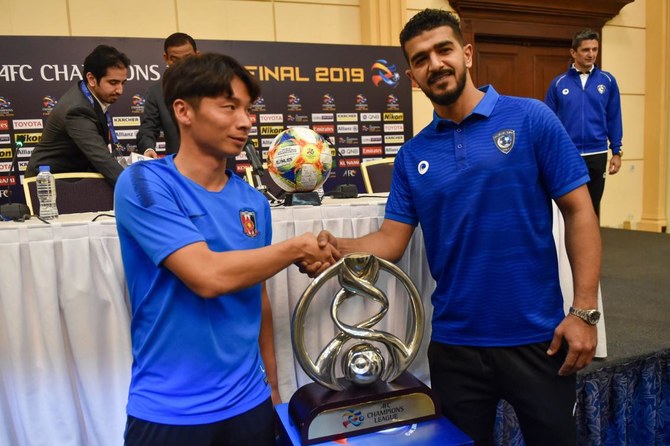
Urawa’s midfielder Kazuki Nagasawa, left, and Al Hilal’s goalkeeper Abdullah Al-Mayouf with the AFC Champions League trophy in the Saudi capital Riyadh. (AFP)
Short Url
Updated 29 April 2023
Follow

Al Hilal facing history as well as Urawa in Asian final

  • Teams from South Korea, China, Japan and Australia have dominated the continental tournament since 2005, winning every title but one
  • Al Hilal has fallen in two finals in the past five years: losing 1-0 over two legs to Western Sydney Wanderers in 2014 and then, in 2017, to Saturday’s opponent Urawa 2-1 on aggregate

RIYADH: Al Hilal is not just facing Japan’s Urawa Reds in the first leg of Asian Champions League final on Saturday in Riyadh. The Saudi Arabian club also has to overcome the dominance of teams from east Asia.
Teams from South Korea, China, Japan and Australia have dominated the continental tournament since 2005, winning every title but one. West Asia — the tournament is split into east and west geographic zones until the final — only has the 2011 triumph of Qatar’s Al Sadd to celebrate.
Other top West Asian nations such as Saudi Arabia, Iran, Syria and United Arab Emirates have all sent their best to contest the final yet all have failed to win the tournament that was established in 2003.
In addition to the regional failure, the Riyadh powerhouse has fallen in two finals in the past five years: losing 1-0 over two legs to Western Sydney Wanderers in 2014 and then, in 2017, to Saturday’s opponent Urawa 2-1 on aggregate.
It could be a case of third-time lucky for Al Hilal especially as it has the tournament’s top scorer in its ranks. Bafetimbi Gomis has already scored 10 goals.
“I know that we have been unlucky in the Asian Champions League final on two previous occasions but we are confident that we can win this time,” said Gomis, a former French international who signed for the club for a reported transfer fee of around $16 million in August 2018.
Al Hilal’s failure to win the home leg cost the team in 2014 and 2017 and the ex-Lyon and Swansea City striker knows that taking an advantage to Japan for the return match on Nov. 24 is vital.
 “We have to play to our best from the start of the first game and look to get on top,” Gomis said. “The game will not be decided here in our home stadium and will go all the way to the final whistle but we want to get a good start.”
Al Hilal starts as favorite despite Urawa’s 2017 success. The Japanese team has been struggling at home for most of the season.
While the two-time continental champion has been progressing toward another Asian final, there have been relegation worries in the J League.
Urawa sits just five points clear of the relegation zone after playing two games more than its rivals.
The Reds will put domestic worries aside and have a star striker of their own to shoot Urawa to a record third Champions League title.
“Of course I want to become a history-maker,” said forward Shinzo Koroki, who has scored eight goals on the road to the final. “This is the top club competition and the champions will go to the FIFA Club World Cup. It is a big honor for any team.”


Morocco banish any doubts about ability to host World Cup 2030

Updated 4 sec ago
Follow

Morocco banish any doubts about ability to host World Cup 2030

  • Impressive stadiums, easy transportation links and a well-established tourism infrastructure ensured the 24-team tournament went off without any major hitch and will assuage any doubters about the World Cup in four years’ time

RABAT: Morocco’s successful staging of the Africa Cup of Nations means there should be no skepticism about its ability to co-host the World Cup with Portugal and Spain in 2030, even if Sunday’s final was clouded by a walk-off and defeat for the home team.

Impressive stadiums, easy transportation links and a well-established tourism infrastructure ensured the

24-team tournament went off without any major hitch and will assuage any doubters about the World Cup in four years’ time.

Morocco plans to use six venues in 2030 and five of them were used for the Cup of Nations, providing world-class playing surfaces and a spectacular backdrop.

The Grande Stade in Tangier with a 75,000 capacity is an impressive facility in the northern coastal city, less than an hour’s ferry ride from Spain.

Meanwhile, FIFA President Gianni Infantino condemned "some Senegal players" for the "unacceptable scenes" which overshadowed their victory in the final when they left the pitch in protest at a penalty awarded to Morocco.

African football's showpiece event was marred by most of the Senegal team walking off when, deep into injury time of normal play and with the match locked at 0-0, Morocco were awarded a spot-kick following a VAR check by referee Jean-Jacques Ndala for a challenge on Brahim Diaz.

security personnel at the other end of the stadium, Senegal's players eventually returned to the pitch to see Diaz shoot a soft penalty into the arms of their goalkeeper Edouard Mendy.

The match was played at the Stade Moulay Abdellah in the capital Rabat, which has a capacity of 69,500. The attendance for the final was 66,526.

Stadiums in Agadir, Fes and Marrakech were also more than adequate and will now be renovated over the next few years.

But the crowning glory is the proposed 115,000-capacity Stade Hassan II on ⁠the outskirts of Casablanca which Morocco hope will be chosen to host the final over Madrid’s Santiago Bernabeu Stadium.

In all, Morocco will spend $1.4 billion on the six stadiums. Also planned is extensive investment in airports, with some 10 Moroccan cities already running direct air links to Europe and many budget airlines offering flights to the country.

An extension of Africa’s only high-speed rail service, which already provides a comfortable three-hour ride from Tangier to Casablanca, further south to Agadir and Marrakech is also planned. Morocco hopes all of this will modernize its cities and boost the economy.

On the field, Morocco will hope to launch a credible challenge for a first African World Cup success, although on Sunday they continued their poor return in the Cup of Nations, where their only triumph came 50 years ago.

They surprised with a thrilling run to the last four at the Qatar 2022 World Cup as the first African nation to get that far and will hope for a similar impact at this year’s finals in North America. They are in Group C with Brazil, Scotland and Haiti.