

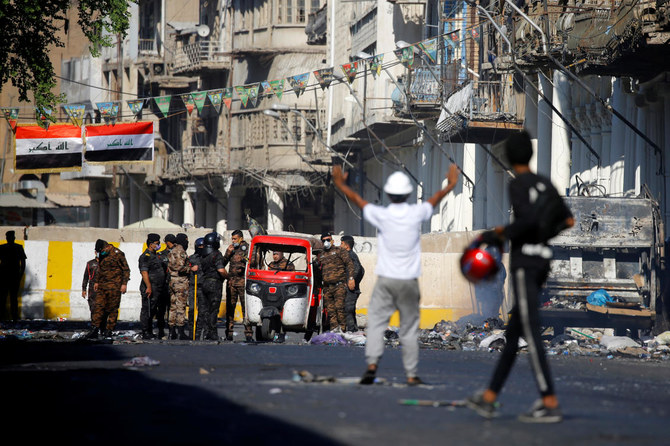
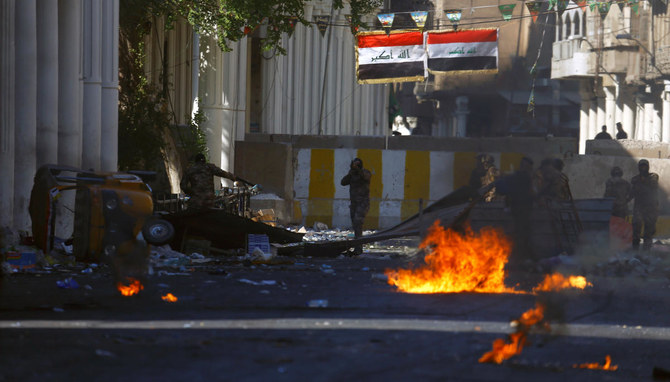
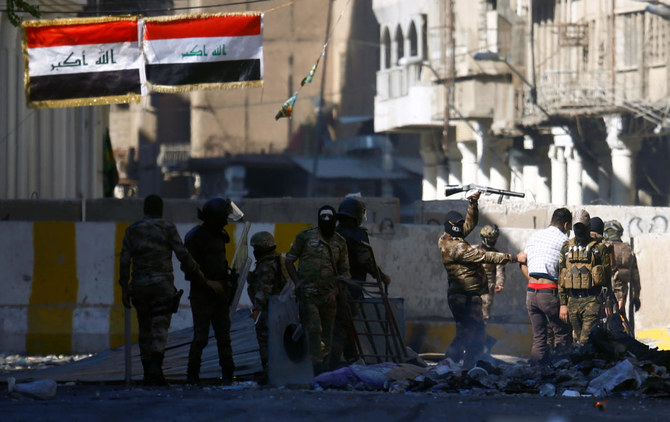


BAGHDAD: Fresh clashes between Iraqi security forces and anti-government demonstrators broke out in Baghdad on Friday as protests entered their third week, despite a call for calm by the country’s top Shiite cleric.
Government leaders also appeared to have refused to backdown, closing rank instead around the country’s embattled premier.
Security forces fired tear gas and threw stun grenades into crowds of protesters wearing helmets and makeshift body armor on a main road in the middle of the Iraqi capital, sending demonstrators scattering, some wounded.
More than a dozen demonstrators had died in the capital Baghdad and the southern port city of Basra within 24 hours, medical sources said Friday.
Grand Ayatollah Ali Al-Sistani held security forces accountable for any violent escalation and urged the government to respond as quickly as possible to demonstrators’ demands.
“The biggest responsibility is on the security forces,” a representative of Sistani said in a sermon after Friday prayers in Karbala. “They must avoid using excessive force with peaceful protesters.”
Sistani warned against the exploitation of the unrest by “internal and external” forces which he said sought to destabilize Iraq for their own goals. He did not elaborate.
He said those in power must come up with a meaningful response to the demonstrations.
Protesters took little solace from the cleric’s words. “He says he’s supporting protests and that we should keep going but he hasn’t helped. The speech won’t make a difference either way,” said one woman protesting in Baghdad whose son was killed in recent clashes.
In the latest violence, 32 people were injured by rubber bullets and tear gas canisters in confrontations on Baghdad’s famous Rasheed Street, its oldest avenue and cultural center known for its crumbling houses. Tear gas filled the air as protesters used slingshots to hurl stones at security forces.
In Basra, one elderly woman died after inhaling tear gas, while 180 suffered injuries on Friday.
On Thursday night, masked men attacked protesters in the city, killing five people. The shooting also wounded about 120, said medical officials.
Rasool Mohammed, an activist from Baghdad’s Al-Sadr City, said four of his friends have vanished in the last few days. “They’re not among the dead, they’re not among the wounded, where are they? We don’t know who took them,” he said.
Rights groups have also raised the alarm over the arrest and intimidation of activists and medics, who have reported being followed by unidentified security forces.
Live fire is still being used and even tear gas canisters, fired directly at protesters’ bodies instead of being lobbed into crowds, have killed at least 16 people, New York-based Human Rights Watch said.
The canisters have pierced protesters’ skulls and chests, with the United Nations saying at least 16 people had been killed that way as of November 5.
Amnesty International said it had found the military-grade canisters were Serbian- and Iranian-made.
In Missan province, two activists were killed on Wednesday by unknown assailants, security sources said.
This week’s violence has raised to around 130 the death toll since the protests resumed on October 24 after a lull.
A first wave of rallies from October 1 to 6 had killed 157 people, according to an official probe, most of them protesters shot dead in Baghdad.
US Secretary of State Mike Pompeo threw his weight behind the protesters, saying that “we need to support these people wherever we can.”
Public anger has been directed particularly toward Iran, which supports the parties and paramilitary groups that dominate the Baghdad government and state institutions.
(With AFP)


