MENA startups inject tech savvy into Saudi Arabia’s entertainment scene

Events and entertainment tourism are expected to play a key role in the Kingdom’s economic reform, with more than 5,000 events on the calendar for 2019. (Supplied)
Updated 08 November 2019
Follow

MENA startups inject tech savvy into Saudi Arabia’s entertainment scene

  • Event organizers are delivering an experience that lives up to the expectations of attendees
  • Up-and-coming event organizers will be able to provide professional and seamless digital experiences

CAIRO: While the Middle East and North Africa (MENA) region has always been a popular destination for business and entertainment events, a host of startups are taking the industry to the next level through the power of technology.

Earlier this year, Saudi Arabia’s General Entertainment Authority announced a new strategic plan to revamp the local entertainment sector. There are more than 5,000 events on the calendar for 2019, with investments projected to exceed $64 billion over the next decade.

The plan is part of a broader push to diversify the Kingdom’s economy away from oil by 2030. 

Events and entertainment tourism are expected to play a key role in this ambitious economic reform.

However, this sector boom is nothing new to the region. The UAE has established itself as a leading destination for business events and entertainment tourism, while more of MENA’s major economies are implementing economic plans that incorporate the thriving events industry in one way or another.

Startups in the region are capitalizing on the evolution of this space by developing a digital ecosystem which allows event organizers to deliver an experience living up to the expectations of their attendees.

Whether it is making ticket purchases easier, streamlining event check-in, or addressing a whole host of other challenges regional events organizers have historically faced, these startups are leveraging technology to raise the standards of event management.
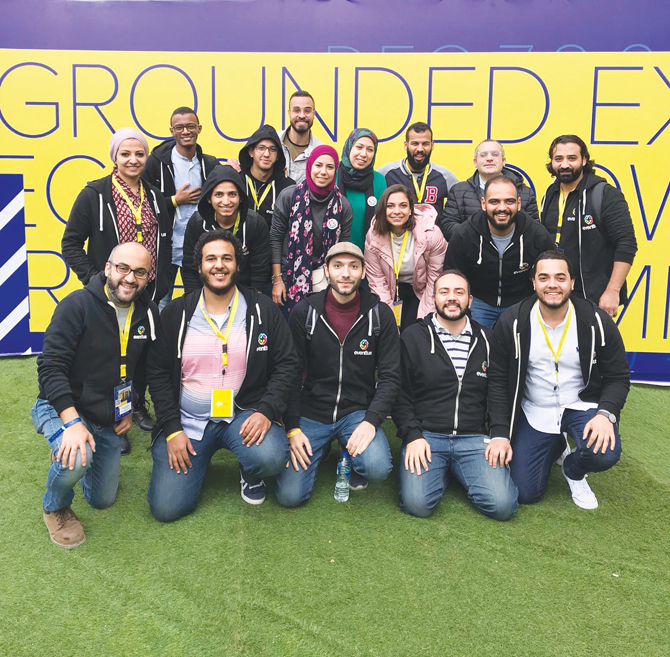


A new generation of startups are leveraging technology and tourist entertainment. (Supplied)

“After all, it is not enough to have great performers when the rest of the experience that comes with attending events is below par,” says Farrukh Bandey, a user experience research manager at UXBERT Labs, the digital experience design company behind event planning and discovery app HalaYalla.

Launched in early 2014 by Bandey and Nadeem Bakhsh, the Saudi-based venture came to dominate the country’s entertainment scene after becoming the official ticketing app for the Jeddah Season series of events.

HalaYalla provides a full suite of event-management features together with live event analytics and reporting for organizers. It also worked with local authorities to let international event attendees apply for a tourist visa while buying their tickets through the platform.

While gaining the trust of the government was a huge milestone for the company, it was also a challenge. The team’s abilities were first put to the test when they handled the registration for Saudi Arabia’s first-ever Baloot Championship, a card game popular in Gulf Cooperation Council countries.

Held in October 2018, the event saw more than 85,000 players register to compete.

Considered by many as one of the earliest disruptors in MENA’s event space, Eventus was founded in 2012 by Egyptian duo Mai Medhat and Nihal Fares. The company was backed by multimillion-dollar investment rounds from prominent local and international venture capitals.

The market Eventus excelled at addressing was providing event organizers with a customized app. The execution was a great hit for forums such as the Startup Grind’s Global Conference, an annual gathering for a community that supports 2 million entrepreneurs in more than 125 countries.


 This report is being published by Arab News as a partner of the Middle East Exchange, which was launched by the Mohammed bin Rashid Al Maktoum Global Initiatives and the Bill and Melinda Gates Foundation to reflect the vision of the UAE prime minister and ruler of Dubai to explore the possibility of changing the status of the Arab region.


Syrian army pushes into Aleppo district after Kurdish groups reject withdrawal

Updated 10 January 2026
Follow

Syrian army pushes into Aleppo district after Kurdish groups reject withdrawal

  • Two Syrian security officials told Reuters the ceasefire efforts had failed and that the army would seize the neighborhood by force

ALEPPO, Syria: The Syrian army said it would push into the last Kurdish-held district of Aleppo ​city on Friday after Kurdish groups there rejected a government demand for their fighters to withdraw under a ceasefire deal.
The violence in Aleppo has brought into focus one of the main faultlines in Syria as the country tries to rebuild after a devastating war, with Kurdish forces resisting efforts by President Ahmed Al-Sharaa’s Islamist-led government to bring their fighters under centralized authority.
At least nine civilians have been killed and more than 140,000 have fled their homes in Aleppo, where Kurdish forces are trying to cling on to several neighborhoods they have run since the early days of the war, which began in 2011.

HIGHLIGHTS

• Standoff pits government against Kurdish forces

• Sharaa says Kurds are ‘fundamental’ part of Syria

• More than 140,000 have fled homes due to unrest

• Turkish, Syrian foreign ministers discuss Aleppo by phone

ِA ceasefire was announced by the defense ministry overnight, demanding the withdrawal of Kurdish forces to the Kurdish-held northeast. That would effectively end Kurdish control over the pockets of Aleppo that Kurdish forces have held.

CEASEFIRE ‘FAILED,’ SECURITY OFFICIALS SAY
But in a statement, Kurdish councils that run Aleppo’s Sheikh Maksoud and Ashrafiyah districts ‌said calls to leave ‌were “a call to surrender” and that Kurdish forces would instead “defend their neighborhoods,” accusing government forces ‌of intensive ⁠shelling.
Hours ​later, the ‌Syrian army said that the deadline for Kurdish fighters to withdraw had expired, and that it would begin a military operation to clear the last Kurdish-held neighborhood of Sheikh Maksoud.
Two Syrian security officials told Reuters the ceasefire efforts had failed and that the army would seize the neighborhood by force.
The Syrian defense ministry had earlier carried out strikes on parts of Sheikh Maksoud that it said were being used by the Kurdish-led Syrian Democratic Forces (SDF) to launch attacks on the “people of Aleppo.” It said on Friday that SDF strikes had killed three army soldiers.
Kurdish security forces in Aleppo said some of the strikes hit a hospital, calling it a war crime. The defense ministry disputed that, saying the structure was a large arms depot and that it had been destroyed in the resumption of strikes on Friday.
It ⁠posted an aerial video that it said showed the location after the strikes, and said secondary explosions were visible, proving it was a weapons cache.
Reuters could not immediately verify the claim.
The SDF is ‌a powerful Kurdish-led security force that controls northeastern Syria. It says it withdrew its fighters from ‍Aleppo last year, leaving Kurdish neighborhoods in the hands of the Kurdish ‍Asayish police.
Under an agreement with Damascus last March the SDF was due to integrate with the defense ministry by the end of 2025, ‍but there has been little progress.

FRANCE, US SEEK DE-ESCALATION
France’s foreign ministry said it was working with the United States to de-escalate.
A ministry statement said President Emmanuel Macron had urged Sharaa on Thursday “to exercise restraint and reiterated France’s commitment to a united Syria where all segments of Syrian society are represented and protected.”
A Western diplomat told Reuters that mediation efforts were focused on calming the situation and producing a deal that would see Kurdish forces leave Aleppo and provide security guarantees for Kurds who remained.
The diplomat ​said US envoy Tom Barrack was en route to Damascus. A spokesperson for Barrack declined to comment. Washington has been closely involved in efforts to promote integration between the SDF — which has long enjoyed US military support — and Damascus, with which the ⁠United States has developed close ties under President Donald Trump.
The ceasefire declared by the government overnight said Kurdish forces should withdraw by 9 a.m. (0600 GMT) on Friday, but no one withdrew overnight, Syrian security sources said.
Barrack had welcomed what he called a “temporary ceasefire” and said Washington was working intensively to extend it beyond the 9 a.m. deadline. “We are hopeful this weekend will bring a more enduring calm and deeper dialogue,” he wrote on X.

TURKISH WARNING
Turkiye views the SDF as a terrorist organization linked to the outlawed Kurdistan Workers’ Party and has warned of military action if it does not honor the integration agreement.
Turkish Foreign Minister Hakan Fidan, speaking on Thursday, expressed hope that the situation in Aleppo would be normalized “through the withdrawal of SDF elements.”
Though Sharaa, a former Al-Qaeda commander who belongs to the Sunni Muslim majority, has repeatedly vowed to protect minorities, bouts of violence in which government-aligned fighters have killed hundreds of Alawites and Druze have spread alarm in minority communities over the last year.
The Kurdish councils in Aleppo said Damascus could not be trusted “with our security and our neighborhoods,” and that attacks on the areas aimed to bring about displacement.
Sharaa, in a phone call with Iraqi Kurdish leader Masoud Barzani on Friday, affirmed that the Kurds were “a fundamental part ‌of the Syrian national fabric,” the Syrian presidency said.
Neither the government nor the Kurdish forces have announced a toll of casualties among their fighters from the recent clashes.