DHAKA: Bangladesh’s plan to relocate 100,000 Rohingya to a new island in the Bay of Bengal is yet to receive the green light from the UN although authorities on the ground have completed all requirements, officials told Arab News on Tuesday.
The Bhasan Char island project has been built at a cost of $275 million to ease pressure on Bangladesh, which is host to the world’s largest refugee camps at Cox’s Bazaar.
It also aims to provide refugees with better living conditions as they will be able to earn a livelihood through agriculture, cattle breeding and fish farming.
However, the UN insists that the island is “isolated” and “flood prone” and therefore not suitable for the relocation of the Rohingya.
“A joint technical team comprising UN experts and Bangladesh government members will visit the Bhashan Char island from Nov. 17-19. The UN will provide their assessment report after the visit of that technical team,” Shah Kamal, senior secretary of the disaster management ministry, told Arab News.
He added that representatives from both sides will hold another round of talks on Wednesday,
with the Bangladeshi side to be led by Foreign Secretary Shahidul Haque.
“I am hopeful that the UN will agree with the relocation initiative taken by the Bangladesh government,” Kamal said.
UN agencies at Cox’s Bazar have stressed the need to undertake “independent and thorough technical assessments before relocations take place.”
“These assessments focus on such issues as exposure to cyclone risks and other natural hazards, as well as the adequacy of water resources,” Louise Donovan, UN High Commissioner for Refugees (UNHCR) spokeswoman at Cox’s Bazar, told Arab News.
“The critical protection and operational issues must be considered, including refugee access to basic rights and services, such as health care and education, livelihoods opportunities, as well as their ability to move within Bhasan Char and to and from the mainland. We look forward to resuming discussions with the government on these key issues soon,” Donovan said.
Bangladeshi authorities said that they were drawing up a list of Rohingya refugees who were voluntarily relocating to the island.
“(Up to) today, we have received a good number of families who are interested in the relocation. All the families who have enrolled their names came up voluntarily and we are not putting anybody under pressure,” a spokesman from the Kutupalong Rohingya camp told Arab News. He requested not to be named as he is not authorized to speak to the media.
Mohammad Noor, a Rohingya community leader and secretary of Kutupalong camp 2, said that he had found 56 refugee families from his camp who had volunteered for the relocation.
“I have handed over the list of the families who voluntarily came up to the camp under the charge of the Bangladesh government. But I didn’t hear about any particular date or anything else regarding the relocation,” Noor told Arab News.
He also said that there was no pressure on the Rohingya to relocate: “We are just informing them (the Rohingya) about the facilities and livelihood opportunities built over there for the refugees.”
“From camp 6, a neighboring camp of mine, I have heard that 32 more refugee families have expressed their interest to be relocated,” Noor said.
There are more than 1,150,000 Rohingya currently living in 34 squalid refugee camps in Cox’s Bazar.


UN stalls relocation plan for 100,000 Rohingya
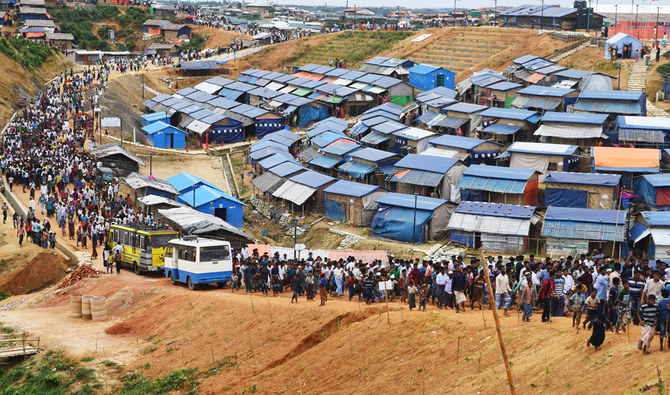
UN stalls relocation plan for 100,000 Rohingya

- There are more than 1,150,000 Rohingya currently living in 34 squalid refugee camps in Cox’s Bazar


Hundreds in London protest against Beijing ‘mega embassy’
- Protesters, their faces mostly covered with scarves or masks, chanted “No to Chinese embassy“
- The latest protest came ahead of an expected decision this week
LONDON: Hundreds of people on Saturday rallied in London against Beijing’s controversial new “mega” embassy, days ahead of a decision on the plan.
Protesters, their faces mostly covered with scarves or masks, chanted “No to Chinese embassy” and waved flags reading “Free Hong Kong. Revolution now.”
Others held up placards with slogans such as “MI5 warned. Labour kneeled,” referring to the UK’s domestic intelligence agency and Prime Minister Keir Starmer’s ruling party.
Others read: “CCP (Chinese Communist Party) is watching you. Stop the mega embassy.”
China has for several years been trying to relocate its embassy, currently in the British capital’s upmarket Marylebone district, to the sprawling historic site in the shadow of the Tower of London.
The move has sparked fierce opposition from nearby residents, rights groups and critics of China’s ruling Communist Party.
The latest protest came ahead of an expected decision this week.
Benedict Rogers, head of the human rights group Hong Kong Watch said if it got the go-ahead it was “highly likely” that the site “will be used for espionage,” citing the sensitive underground communications cables close to the site.
He said China had already been “carrying out a campaign of transnational repression against different diaspora communities” and other critics and predicted that that would “increase and intensify.”
Beijing ‘operations base’ -
A protester who gave his name only as Brandon, for fear of reprisals, said the plans raised a “lot of concerns.”
The 23-year-old bank employee, originally from Hong Kong but now living near Manchester in northwestern England, said many Hong Kongers had moved to the UK “to avoid authoritarian rule in China.”
But they now found there could be an embassy in London serving as an “operations base” for Beijing.
“I don’t think it’s good for anyone except the Chinese government,” he said.
Another demonstrator, who did not to give her name, called on Starmer to “step back and stop it (the plan) because there is a high risk to the national security of the UK, not only Hong Kongers.”
The 60-year-old warehouse worker, also originally from Hong Kong and now living in Manchester, said the embassy would be a “spy center not only to watch the UK but the whole of Europe.”
Speakers at the rally throwing their weight behind the campaign to stop the embassy included Kemi Badenoch, leader of the main opposition Conservative Party.
British MPs voiced major security concerns earlier this week after a leading daily reported the site would house 208 secret rooms, including a “hidden chamber.”
The Daily Telegraph said it had obtained unredacted plans for the vast new building which would stand on the historical site of the former Royal Mint.
It showed that Beijing reportedly plans to construct a single “concealed chamber” among “secret rooms” underneath the embassy which would be placed alongside the underground communications cables.