DUBAI: Technology has become an essential part of our daily lives, including in the field of art and culture.
This was one of the main takeaways from the keynote speech of Noura bint Mohammed Al-Kaabi, the UAE’s minister of culture and knowledge development, on the first day of the EmTech MENA conference in Dubai.
The two-day conference began on Monday at Jumeirah Emirates Towers. It has lined up 500 professionals from throughout the Middle East and North Africa (MENA) to shed light on five themes: Artificial intelligence (AI) and the future of work; computer-created reality; the future of digital health; future cities; and the future of energy and sustainability.
With regard to the possibilities for combining art and technology and their potential impact on cultural expression, Al-Kaabi said technology and art have become “complementary.”
She added: “The way art is created, exhibited and experienced has changed through the use of digital technology, including AI and VR (virtual reality).”
Citing the works of Andy Warhol and Bahraini VR artist Najla Al-Khalifa as examples of new means of artistic expression, Al-Kaabi said: “The digital world has become the new ordinary.”
She described modern-day art galleries and exhibitions as “interactive spaces” that are no longer “passive buildings” where static art is viewed.
While many still prefer to view art in a more traditional form, the evolution of the field through technology can improve an audience’s overall experience, she said.
“For those who dare to imagine the benefits of pushing boundaries, innovating new concepts and venturing into new territories through technology, the possibilities are endless,” Al-Kaabi added.
Technology also plays a crucial role when it comes to expression of cultural identity, she said, adding that the integration of the two fields could go even further to eliminate language barriers, build on common values, and captivate and educate new consumers of art and heritage.
Al-Kaabi described the diffusion of cultural awareness through AI technology to the rest of the world as the concept of “intangible experiences.”
Immersive AI experiences can better reflect aspects of culture such as hospitality, and even simpler traditions such as the way Emiratis drink their coffee, she said.
Such experiences are also crucial in collecting data, building a museum, and even in an artist’s journey, Al-Kaabi added.
Alberto Levy, associate professor at the IE Business School in Spain, demonstrated the use of AI by creating a piece of “brain art” on the EmTech stage, through a device that shows how brainwaves react to emotions.
However, he said while AI has the ability to make everyone an artist, machines cannot replicate emotions.
“Machines are good for repetition. They can only emulate something that might resemble a feeling,” Levy added.
“We have to focus on the human part, the critical thinking, the creativity that machines can’t replicate.”
Saying the “music, the energy in the hall, and the essence of being on a Dubai stage” were elements that helped him create his piece of art, Levy questioned the need for copyright in a world of AI-made art.
“Why do we have to own the art?” he asked. “Why not produce it and see what emotions it’s generating? After all, it came out of a moment that’s priceless.”


Technology’s role in art and culture debated at EmTech MENA conference
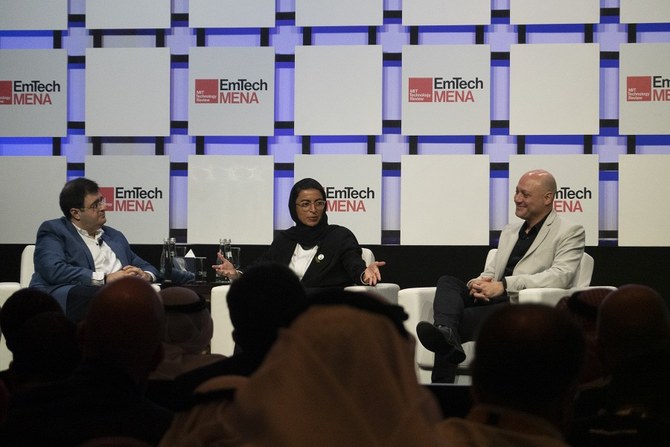
Technology’s role in art and culture debated at EmTech MENA conference

- ‘Technology has changed the way we create and consume art’
- Conference told how technology has become the ‘new normal’


G7 countries to release oil reserves as IEA agrees to largest ever market intervention
- IEA recommends release of 400 million barrels
RIYADH: Germany, Japan and Austria will release part of their oil reserves after the International Energy Agency recommended the release of 400 million barrels of oil from stockpiles, the largest such move in IEA history.
In a statement, IEA Executive Director Fatih Birol said the flow of oil, gas and other commodities through the Strait of Hormuz have all but stopped, leading global energy supply to fall by around 20 percent.
Ahead of the confirmation of the move — a larger intervention than the 182.7 million barrels that were released in 2022 by in response to Russia’s invasion of Ukraine — several countries began setting out plans to bring their reserves into play as countries grapple with soaring crude prices amid the US-Israeli war with Iran.
Birol said: “I can now announce that IEA countries have decided to launch the largest ever release of emergency oil stocks in our agency's history.
“IEA countries will be making 400 million barrels of oil available to the market to offset the supply lost through the effective closure of the strait.
“This is a major action aiming to alleviate the immediate impacts of the disruption in markets.”
Germany’s Economy Minister Katherina Reiche confirmed on Wednesday her government plans to limit petrol price increases at filling stations to once a day and to introduce more stringent antitrust regulation of the sector.
She did not give an exact timing for those measures, but added that the US and Japan would be the largest contributors to the release of the oil reserves.
The US has not confirmed it would do so, but its Interior Secretary Doug Burgum told Fox News on Wednesday that “these are the kinds of moments that these reserves are used for.”
The announcements did not stop oil prices rising, with Brent crude up 3.26 percent to $90.66 a barrel at 4:29 p.m Saudi time, and West Texas Intermediate up 3.12 percent to $86.05. Both were some way below the $119 a barrel seen earlier in the week.
“The situation regarding oil supplies is tense, as the Strait of Hormuz is currently virtually impassable,” Germany’s Reiche said.
“We will comply with this request and contribute our share, because Germany stands behind the IEA’s most important principle: mutual solidarity,” Reiche said about the IEA’s request.
According to a statement by Reiche’s ministry, Germany will contribute 2.64 million tonnes of oil. This corresponds to 19.51 million barrels.
Reiche stressed there was no supply shortage in the country, which has a legally mandated reserve of oil and oil products intended to cover 90 days’ demand.
South Korea will release 22.46 million barrels of oil, which represents 5.6 percent of the total IEA ask, the country's industry ministry said.
“The government will consult with the IEA secretariat on details, such as the timing and amount, from the perspective of national interests in accordance with domestic conditions,” the ministry said in a statement.
The ministry said it would continue to coordinate closely with major countries in responding to high oil prices to minimise any domestic impact.
Austrian Economy Minister Wolfgang Hattmannsdorfer said his country was releasing part of the emergency oil reserve and extending the national strategic gas reserve, adding: “One thing is clear: in a crisis, there must be no crisis winners at the expense of commuters and businesses.”
Acting ahead of the IEA move, G7 member Japan announced plans to release 15 days' worth of private-sector oil reserves and one month's worth of state oil reserves.
“Rather than wait for formal IEA approval of a coordinated international reserve release, Japan will act first to ease global energy market supply and demand, releasing reserves as early as the 16th of this month,” Prime Minister Sanae Takaichi said in a broadcast statement.
Following a meeting with the IEA on Wednesday, G7 energy ministers said: “In principle, we support the implementation of proactive measures to address the situation, including the use of strategic reserves.”
All IEA member countries are required to keep 90 days’ worth of their nation’s oil use in reserve in case of global disruption.


