

Five killed in Baghdad, three in Karbala during Iran consulate protest

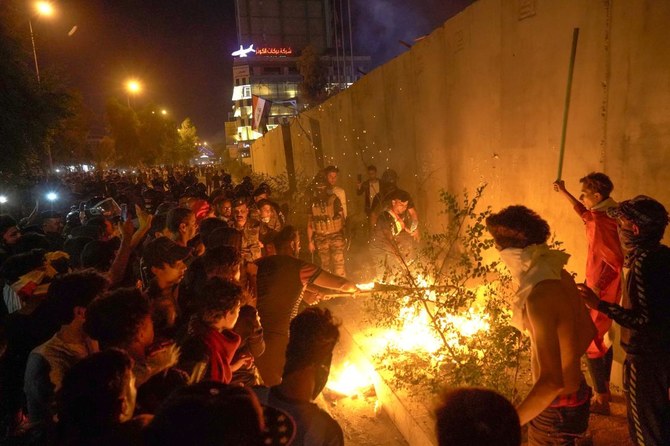
Three protesters were shot dead overnight during a demonstration outside the Iranian consulate in Karbala, the head of the forensics department there told AFP on Nov. 4. (FILE/AFP/Mohammed Sawaf)
Updated 09 November 2019
Follow

Five killed in Baghdad, three in Karbala during Iran consulate protest

  • Security forces in Karbala fired live ammunition to disperse protesters
  • In Karbala late Sunday, protesters hung Iraqi flags on the concrete blocks surrounding the imposing Iranian consulate

KARBALA, Iraq: Three protesters were shot dead overnight during a demonstration outside the Iranian consulate in Iraq’s holy city of Karbala, the head of the forensics department there told AFP on Monday.

Another five were killed on Monday in Baghdad when security forces opened fire on demonstrators.   
Overnight, security forces in Karbala fired live ammunition to disperse protesters trying to scale the walls of the consulate in the southern city and torch it.
AFP correspondents witnessed protesters left motionless after suffering gunshot wounds, and the forensic medicine department later confirmed three people died.
More than 250 people have lost their lives since anti-government rallies broke out in Iraq on October 1, but officials have stopped providing casualty numbers.
In Karbala late Sunday, protesters hung Iraqi flags on the concrete blocks surrounding the imposing Iranian consulate and spray-painted “Karbala is free, Iran out, out!” on them.
Others threw rocks or shot fireworks over the walls into the consulate, then set fire to tires at the gates of the building as police officers looked on.

Opinion

This section contains relevant reference points, placed in (Opinion field)

As the crowds grew, heavy gunfire and volleys of tear gas rang out.
“They’re not firing up in the air. They intend to kill, not disperse,” said one young protester wearing a medical mask to protect himself from the tear gas.
“They’re protecting the Iranian embassy while all we want is a country. Why are they killing their own countrymen for another country?“
Iraq has close but complicated ties with its eastern neighbor Iran, with whom it fought a deadly war in the 1980s but which now has significant political and economic sway in Iraq.
Every year, millions of Iranian pilgrims travel to the holy city of Karbala, 100 kilometers (60 miles) south of Baghdad, to visit the golden-domed mausoleum of Hussein, the prophet Mohammad’s grandson.
But many Iraqis protesting over the past month accuse Iran of being the primary sponsor of the corrupt, inefficient system they want to overthrow.
Tehran, meanwhile, has sought to clamp down the protests next door, with sources reporting top commander Qassem Soleimani making several visits to “advise” Iraqi authorities on coping with the rallies.
Iran’s supreme leader Ayatollah Ali Khamenei has also slammed protests in Iraq and Lebanon as conspiracies by the US and others.


High-level Turkish team to visit Damascus on Monday for talks on SDF integration

Updated 55 min 38 sec ago
Follow

High-level Turkish team to visit Damascus on Monday for talks on SDF integration

  • The visit by Turkiye’s foreign and defense ministers and its intelligence chief comes amid efforts by Syrian, Kurdish and US officials to show some progress with the deal

ANKARA: A high-level Turkish delegation will visit Damascus on Monday to discuss bilateral ties and the implementation of a deal for integrating the Kurdish-led Syrian Democratic Forces (SDF) into ​Syria’s state apparatus, a Turkish Foreign Ministry source said.
The visit by Turkiye’s foreign and defense ministers and its intelligence chief comes amid efforts by Syrian, Kurdish and US officials to show some progress with the deal. But Ankara accuses the SDF of stalling ahead of a year-end deadline.
Turkiye views the US-backed SDF, which controls swathes ‌of northeastern Syria, as ‌a terrorist organization and has ‌warned of ⁠military ​action ‌if the group does not honor the agreement.
Last week Foreign Minister Hakan Fidan said Ankara hoped to avoid resorting to military action against the SDF but that its patience was running out.
The Foreign Ministry source said Fidan, Defense Minister Yasar Guler and the head of Turkiye’s MIT intelligence agency, Ibrahim Kalin, ⁠would attend the talks in Damascus, a year after the fall of ‌former President Bashar Assad.

TURKEY SAYS ITS ‍NATIONAL SECURITY IS AT ‍STAKE
The source said the integration deal “closely concerned Turkiye’s national ‍security priorities” and the delegation would discuss its implementation. Turkiye has said integration must ensure that the SDF’s chain of command is broken.
Sources have previously told Reuters that Damascus sent a proposal to ​the SDF expressing openness to reorganizing the group’s roughly 50,000 fighters into three main divisions and smaller ⁠brigades as long as it cedes some chains of command and opens its territory to other Syrian army units.
Turkiye sees the SDF as an extension of the outlawed Kurdistan Workers Party (PKK) militant group and says it too must disarm and dissolve itself, in line with a disarmament process now underway between the Turkish state and the PKK.
Ankara has conducted cross-border military operations against the SDF in the past. It accuses the group of wanting to circumvent the integration deal ‌and says this poses a threat to both Turkiye and the unity of Syria.