



DHAHRAN/DUBAI: The 21-page document published by Saudi Aramco on Sunday in Dhahran seemed almost anticlimactic, after all the hype that had initially surrounded it.
But those dry-as-dust business phrases have kicked off a process that could transform the lives of Saudi Arabia’s citizens and residents, the international energy industry and the world of high finance.
In a few weeks, Saudi citizens, resident expatriates and professional foreign investors in the Kingdom will be able to buy and sell shares in the most profitable company in history on the Saudi Stock Exchange (Tadawul).
Over the next couple of years, there are likely to be more share sales, either to big investing institutions and industry partners around the world, or on a foreign stock market — perhaps even both.
Aramco, already a global giant in its commercial operations, will be a truly international company in its investor makeup too.
FASTFACT
$75 billion
Total cash dividends declared for 2020 by Saudi Aramco.
As Yasir Al-Rumayyan, chairman of Aramco and governor of the Kingdom’s Public Investment Fund, said, it is a “milestone” in the company’s 81-year history, and in the history of Saudi Arabia.
It will be a “unique investment proposition,” as the document understatedly recognized. The Vision 2030 reform plan, designed to open the Kingdom up to the world, will have a truly global corporate champion.
But the international aspects of the biggest share sale in history will have to wait a little longer.
The initial public offering (IPO) announced on Sunday will, at least initially, be a largely Saudi affair.
The Kingdom’s citizens will be given encouragement and incentives to take up shares, its own financial and investment institutions are likely to be the most enthusiastic buyers of the shares on offer, and Saudi stock markets will be the area where valuations will be tested.
In the section titled “IPO Retail Incentive Arrangement,” the document sets out the benefits that people living and working in the Kingdom can expect.
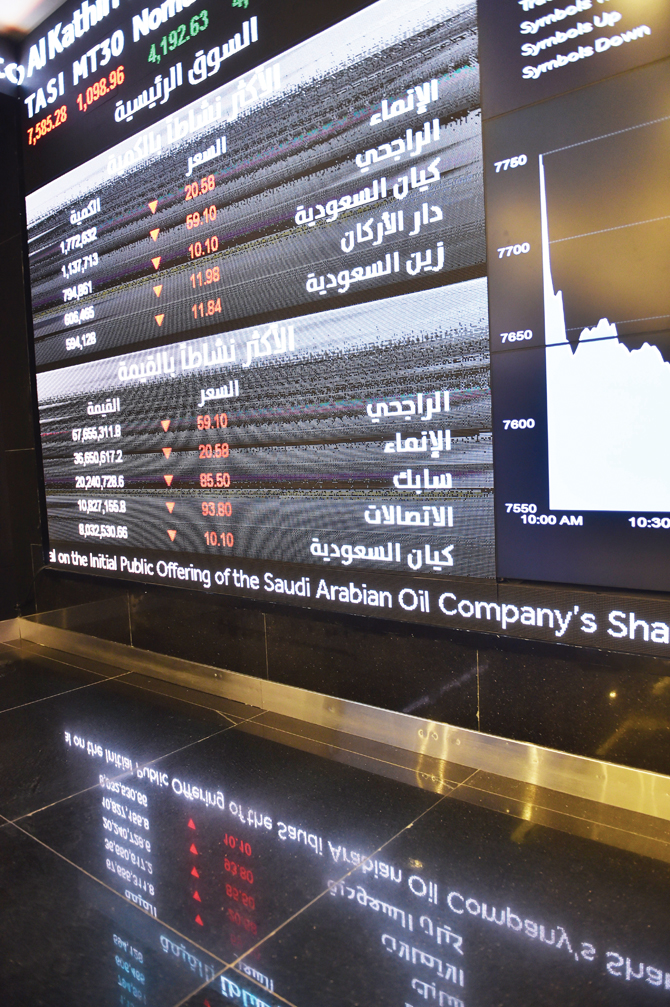
The petroleum giant, having now received approval, will list a small number of shares on the Saudi stock exchange Tadawul, in an initial public offering. (AFP)
Retail investors, under “tranche B” of the issue, are the individuals who want to buy or sell shares on their own account, rather than as part of an investing institution.
Saudi nationals, including female divorcees or widows with Saudi minors, can buy shares for themselves and their families (as long as they are registered on the family ID card), and will be eligible to receive bonus shares (100 each, as long as they hold the original IPO shares for a minimum of 180 days after first listing).
The IPO is open not just to Saudi citizens, as another part of the document makes clear. “Any non-Saudi natural person who is resident in the Kingdom and any Gulf Cooperation Council national” can also buy shares and be eligible for the bonus issue, as long as they bank with one of the institutions on the IPO-approved list.
The government wants to make the IPO popular and profitable. Some analysts have warned of the risks if smaller investors take on extra debt to buy shares and are left with big loans if the shares do not perform well.
While the retail element to the IPO is important for symbolic and patriotic reasons, the big money will come into the offering via global institutional investors, which are the driving force in any financial system.
Opinion
This section contains relevant reference points, placed in (Opinion field)
They will fall under tranche B of the offer, and will likely receive a share allocation at least four times those eligible under tranche A.
Many of these potential investors will be big Saudi investment groups (banks, insurance companies or pension funds) that already buy and sell on a daily basis on Tadawul. But foreigners will also be eligible to take part in the IPO.
The Capital Markets Authority (CMA), which regulates Tadawul, has already opened up the Saudi market to foreign investing institutions, provided they meet the standards for “qualified foreign financial institutions.”
Many have piled into the market after Tadawul gained admission to global index rankings such as the MSCI marker this year.
Sunday’s document took further measures to strengthen the appeal of the IPO to foreigners, with the creation of a “specialized investor” category, subject to the approval of the CMA.
It is among these key foreign investing institutions that much of the debate will be focused, especially among those from Europe and North America.
In the run-up to the announcement, it was these investors that harbored the biggest doubts about valuation and governance concerns in the IPO.
But Aramco is advised by the cream of financial institutions in Wall Street and the financial centers of Europe, which will be well paid to ensure that the IPO is a success among foreign investors.


