

‘Biggest terrorism sponsor’ Iran spends $1 billion a year on global proxies: US report

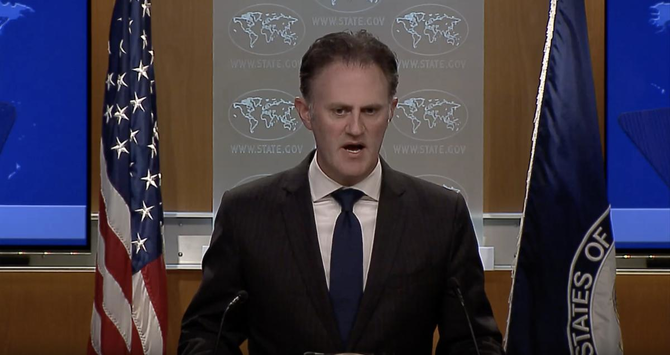
A briefing by the department’s counter-terrorism spokesman Nathan Sales showed the Iranian regime funnels nearly a billion dollars a year to support its proxies. (Screenshot/US State Department)
Updated 01 November 2019
Follow

‘Biggest terrorism sponsor’ Iran spends $1 billion a year on global proxies: US report

  • Regime continues malign activity despite US sanctions says State Department
  • Report also showed global presence of Daesh continued to advance in 2018

WASHINGTON: Iran remained a top state sponsor of terrorism around the world in 2018, the State Department said in its annual terrorism report on Friday.
A briefing by the department’s counter-terrorism spokesman Nathan Sales showed the regime funnels nearly a billion dollars a year to support its proxies in the region despite Washington having significantly ramped up its sanctions against Tehran.
The report also showed global presence of Daesh continued to advance in 2018 through networks and affiliates, even though the Trump administration declared it defeated the jihadi group in Syria and killed its leader last month in a US raid.
Terrorism tactics and the use of technologies have also evolved in 2018, while war-hardened fighters from groups such as Daesh returning to their home countries began raising fresh threats, the report said.

“Even as Daesh lost almost all its physical territory, the group proved its ability to adapt, especially through its efforts to inspire or direct followers online,” said Sales using an acronym for Daesh, the US counter-terrorism coordinator, whose office produced the congressionally mandated report.
“Additionally, battle-hardened terrorists headed home from the war zone in Syria and Iraq or traveled to third countries, posing new dangers,” he said.
Daesh declared its so-called “caliphate” in 2014 after seizing large swathes of Syria and Iraq. The hard-line group established its de facto capital in the Syrian city of Raqqa, using it as a base to plot attacks in Europe.
In 2017, Daesh lost control of Mosul in Iraq and Raqqa in Syria, and quickly thereafter almost all of its territory as a result of operations by US-backed forces. Its leader, Abu Bakr Al-Baghdadi, was killed last month in Syria in a raid by US Special forces.
World leaders welcomed his death, but they and security experts warned that the group, which carried out atrocities against religious minorities and horrified most Muslims, remained a security threat in Syria and beyond.
The group on Thursday confirmed his death in an audio tape posted online and said a successor, identified as Abu Ibrahim Al-Hashemi Al-Quraishi, had been appointed. It vowed revenge against the US.


US makes plans to reopen embassy in Syria after 14 years

Updated 21 February 2026
Follow

US makes plans to reopen embassy in Syria after 14 years

  • The administration has been considering re-opening the embassy since last year
  • Trump told reporters on Friday that Al-Sharaa was “doing a phenomenal job” as president

WASHINGTON: The Trump administration has informed Congress that it intends to proceed with planning for a potential re-opening of the US Embassy in Damascus, Syria, which was shuttered in 2012 during the country’s civil war.
A notice to congressional committees earlier this month, which was obtained by The Associated Press, informed lawmakers of the State Department’s “intent to implement a phased approach to potentially resume embassy operations in Syria.”
The Feb. 10 notification said that spending on the plans would begin in 15 days, or next week, although there was no timeline offered for when they would be complete or when US personnel might return to Damascus on a full-time basis.
The administration has been considering re-opening the embassy since last year, shortly after longtime strongman Bashar Assad was ousted in December 2024, and it has been a priority for President Donald Trump’s ambassador to Turkiye and special envoy for Syria, Tom Barrack.
Barrack has pushed for a deep rapprochement with Syria and its new leadership under former rebel Ahmad Al-Sharaa and has successfully advocated for the lifting of US sanctions and a reintegration of Syria into the regional and international communities.
Trump told reporters on Friday that Al-Sharaa was “doing a phenomenal job” as president. “He’s a rough guy. He’s not a choir boy. A choir boy couldn’t do it,” Trump said. “But Syria’s coming together.”
Last May, Barrack visited Damascus and raised the US flag at the embassy compound, although the embassy was not yet re-opened.
The same day the congressional notification was sent, Barrack lauded Syria’s decision to participate in the coalition that is combating the Daesh militant group, even as the US military has withdrawn from a small, but important, base in the southeast and there remain significant issues between the government and the Kurdish minority.
“Regional solutions, shared responsibility. Syria’s participation in the D-Daesh Coalition meeting in Riyadh marks a new chapter in collective security,” Barrack said.
The embassy re-opening plans are classified and the State Department declined to comment on details beyond confirming that the congressional notification was sent.
However, the department has taken a similar “phased” approach in its plans to re-open the US Embassy in Caracas, Venezuela, following the US military operation that ousted former President Nicolás Maduro in January, with the deployment of temporary staffers who would live in and work out of interim facilities.